Category: Uncategorized

  • Fun Questions to Ask Friends That Deepen Your Friendships

    Fun Questions to Ask Friends That Deepen Your Friendships

    Fun Questions to Ask Friends That Deepen Your Friendships

    A single conversation with a friend can change your entire day. Research from the University of Kansas confirms this: just one quality conversation daily—catching up, joking around, or simply showing you care—can measurably increase happiness and reduce stress by day’s end. Yet many of us leave these interactions feeling unsatisfied, as if something essential remained unspoken.

    The gap between pleasant small talk and genuine connection lies in the questions we ask. Surface-level exchanges about weather, work schedules, and weekend plans serve a social function, but they rarely create the lasting bonds we crave. Fun questions to ask friends that invite vulnerability and self-reflection transform casual chats into meaningful dialogues that strengthen friendship over time.

    Why Small Talk Isn’t Enough: The Science of Quality Conversations

    Small talk greases the wheels of social interaction, but it rarely provides the emotional nourishment humans need. A groundbreaking 2023 study from the University of Kansas, involving nearly 5,000 Americans, identified seven distinct types of quality conversations that significantly impact well-being:

    Two close friends having a deep, authentic conversation in a cozy living room with warm evening light streaming through the window, creating an atmosphere of trust and genuine connection.
    Quality conversations transform casual chats into meaningful connections that strengthen friendship over time.

    1. Catching up – Sharing life updates and current experiences
    2. Meaningful talk – Discussing ideas, values, and deeper topics
    3. Joking around – Playful banter and shared humor
    4. Showing care – Expressing concern and checking in on welfare
    5. Listening – Giving full attention to what others share
    6. Valuing opinions – Seeking and respecting another’s perspective
    7. Offering compliments – Providing sincere praise and affirmation

    The research revealed that face-to-face interactions deliver the greatest mental health benefits, though quality conversations via phone or text also show positive effects. Study participants who engaged in just one quality conversation daily reported higher well-being and lower stress levels than those who had multiple superficial interactions.

    "One of the take-home messages of this study is that there are many paths toward the same goal… Just once is all it takes." — Jeffrey Hall, University of Kansas Communication Studies Professor and friendship expert

    The key distinction lies in quality over quantity. While small talk establishes social comfort, meaningful conversations build the emotional scaffolding of friendship. They create opportunities to understand who your friends truly are—what they value, fear, hope for, and believe in.

    The Science Behind Vulnerability and Deep Connection

    If meaningful conversation builds friendship, vulnerability provides the mortar. Psychologist Arthur Aron’s famous research on interpersonal closeness demonstrated that gradual mutual vulnerability fosters deep connections between people. His renowned "36 questions" study proved that structured, escalating self-disclosure could create measurable intimacy between strangers in less than an hour.

    A diverse group of friends sitting in a circle at sunset on a grassy hill, engaged in meaningful conversation with golden hour lighting creating a warm, inviting atmosphere of trust and belonging.
    Vulnerability and openness create the foundation for lasting bonds between friends.

    The mechanism is straightforward yet powerful: when one person shares something personal and receives a accepting, non-judgmental response, trust develops. This trust enables deeper sharing, creating a virtuous cycle of increasing closeness. The critical element is gradual vulnerability—sharing too much too quickly often backfires, creating discomfort rather than connection.

    Mandy Len Catron documented her experience with Aron’s questions in a widely-read New York Times essay:

    "Because the level of vulnerability increased gradually, I didn’t notice we had entered intimate territory until we were already there."

    Psychology Today emphasizes vulnerability as an essential ingredient for deepening friendships:

    "Vulnerability is an essential ingredient for deepening friendships. To whom can you say, ‘I feel lousy,’ or ‘I’m having trouble with my daughter,’ or ‘I made a real mistake’? Your intimate friends."

    Healthy vulnerability involves openness about emotions while maintaining appropriate boundaries. It’s not about trauma dumping or oversharing—it’s about authentic expression of thoughts, feelings, and experiences in a context of mutual trust. This vulnerability creates the safety that allows friendships to evolve from casual acquaintances into chosen family.

    What Makes a Question Actually ‘Deep’? Understanding the Three Pillars

    Not all questions are created equal. Arthur Aron’s research identifies how well-formulated questions accomplish three relationship-building tasks simultaneously:

    1. Showing interest – The act of asking demonstrates that you care about the other person’s inner world
    2. Creating understanding – Questions invite personal revelation, helping you comprehend their perspective
    3. Building rapport – The question creates an opportunity for you to respond authentically to what they share

    As Aron explains:

    "When questions are formulated and asked the right way, they can do a few key things. First, just by asking, you’re showing that you care about the other person. Second, the question encourages that person to reveal something about themselves. And then that creates an opportunity for you to respond to what they’re revealing."

    Deep conversation starters differ from surface-level questions in what they invite. Consider the contrast:

    Surface Questions Deep Questions
    "What do you do for work?" "What aspects of your work bring you the most satisfaction?"
    "Do you have any siblings?" "How did your relationship with your siblings shape who you are today?"
    "What are your hobbies?" "What do your hobbies reveal about what you value most in life?"
    "Where did you grow up?" "How did where you grew up influence your view of the world?"

    Effective questions encourage "I feel" and "I value" statements rather than "I did" recitations. They connect to identity, values, dreams, and life experiences rather than circumstances. The right question creates space for thoughtful response and follow-up exploration, transforming Q&A into genuine dialogue.

    Fun Questions to Ask Friends About Dreams and Aspirations

    Understanding what drives your friends—their hopes, goals, and visions for the future—creates a foundation of mutual support and encouragement. These conversation starters for friends reveal core motivations while generating positive, energizing discussion:

    Dreams and Ambitions

    • If money were no object, how would you spend your days?
    • What’s something you’ve always wanted to learn but haven’t yet?
    • What does your ideal life look like five years from now?
    • What’s a dream you’ve hesitated to pursue because of fear?
    • If you could master any skill instantly, what would you choose?

    Life Design and Purpose

    • What legacy do you hope to leave behind?
    • What’s the most meaningful goal you’ve ever achieved?
    • How do you define success for yourself?
    • What’s a risk you’re glad you took?
    • What would you attempt if you knew you couldn’t fail?

    These questions naturally create excitement and positive energy in conversations. They help friends understand each other’s core motivations and provide opportunities to offer encouragement, practical support, or accountability partnerships. When you understand a friend’s aspirations, you can better celebrate their wins and support them through setbacks.

    Practical Application: Try dedicating one friend gathering each month to "Dream Talk"—structured time where each person shares a current aspiration and receives brainstorming, encouragement, or offers of help from the group.

    Deep Conversation Starters That Reveal Core Values

    Values are the invisible compass guiding our decisions, yet they rarely surface in casual conversation. Values-based questions reveal the principles that shape your friends’ choices, creating deeper empathy and mutual respect even when perspectives differ:

    Beliefs and Philosophy

    • What’s a belief you held strongly in the past that has changed over time?
    • What principles guide your most important decisions?
    • What do you value most in your friendships?
    • When have you stood up for something you believed in, despite opposition?
    • What’s the best advice you’ve ever received?

    Moral Compass and Ethics

    • What would you do if you knew no one would judge you?
    • What’s a situation that tested your integrity?
    • What values do you hope to pass on to others?
    • When have you had to choose between being right and being kind?
    • What does ‘living authentically’ mean to you?

    Understanding values builds deeper empathy. When you comprehend the principles behind a friend’s choices, even behaviors you initially found puzzling often make sense in context. This understanding reduces judgment and creates space for authentic friendship that accommodates difference.

    Practical Application: During your next dinner with friends, try the "Lightning Round" approach—each person draws a values question and has two minutes to respond before passing to the next person. The time constraint encourages spontaneous, honest answers.

    Questions That Transform Shared Experiences Into Lasting Bonds

    Every life is a collection of experiences, but few friends know the full story of how we became who we are. Questions about past experiences and transformative moments help friends understand each other’s narratives:

    Life-Changing Moments

    • What experience fundamentally changed how you see the world?
    • What’s the hardest thing you’ve ever gone through?
    • When did you feel most proud of yourself?
    • What’s a moment that defined who you are today?
    • What’s the biggest risk you’ve ever taken?

    Family and Upbringing

    • How did your family handle conflict when you were growing up?
    • What’s your earliest childhood memory?
    • How did your parents show love?
    • What family traditions do you want to continue (or break)?
    • What did you learn about relationships from your family?

    The ancient Greeks recognized friendship as a unique form of love called "philia"—distinct from romantic love ("eros") and familial love ("storge"), but equal in importance. When friends become family-like, they significantly enhance mental wellbeing and self-esteem. Processing experiences together helps friends make sense of their lives and feel less alone in their struggles.

    Practical Application: Create a "Story Sharing" ritual at gatherings. One person shares a significant life experience (10-15 minutes), then friends ask follow-up questions and reflect on similar experiences from their own lives. This creates the dual benefit of deep listening and shared vulnerability.

    Lighthearted Conversation Starters That Lead Deeper

    Not every meaningful conversation needs to start with intensity. Some of the best deep talks begin with playful, hypothetical questions that lower defenses and create safety before serious topics emerge:

    Fun Hypotheticals

    • If you could have dinner with any person, living or dead, who would you choose?
    • What would you do with a million dollars?
    • If you could live in any era, which would you pick?
    • What fictional character do you most relate to?
    • If you could instantly develop one superpower, what would it be?

    Playful Scenarios

    • What would your autobiography be titled?
    • If you had to eat one meal for the rest of your life, what would it be?
    • What’s the most ridiculous thing you’ve ever done?
    • If you could trade lives with anyone for a day, who would it be?
    • What’s a hidden talent most people don’t know you have?

    The University of Kansas research identified "joking around" as one of the seven quality conversation types. Lighthearted questions serve as bridges—particularly for newer friendships not yet ready for intense vulnerability. They create shared laughter and comfort, establishing safety that makes deeper conversations possible later.

    Practical Application: Keep a running list of "bridge questions" on your phone. When conversation lulls or feels too surface-level, pull one out. These questions work particularly well in group settings where they can spark animated discussion.

    How to Create the Right Setting for Meaningful Conversations

    The right questions in the wrong setting fall flat. Dr. Serani, a clinical psychologist, notes:

    A peaceful, inviting conversation setting with two plush armchairs facing each other, warm ambient lighting from string lights, coffee cups on a small table, and plants creating an intimate space designed for deep talks.
    The right environment can create the safety and comfort needed for meaningful dialogue.

    "Deep subjects may not be best for first, second, or third social interactions because the intensity of deep questions requires a sense of safety, trust, and intimacy in a friendship."

    Creating conditions for vulnerability requires intentionality about timing, environment, and pacing:

    Optimal Settings

    • Choose environments free from distractions where you won’t be interrupted
    • Consider timing—late-night settings often facilitate deeper discussion than rushed daytime talks
    • Create physical comfort through seating that allows for eye contact and relaxed body language
    • Limit group size—intimate conversations work best with 2-4 people rather than large gatherings

    Building Trust Gradually

    • Start with lighter topics and progress to deeper subjects as comfort grows
    • Match the other person’s level of disclosure rather than pushing too quickly
    • Respect boundaries when a friend signals they’re not ready to discuss certain topics
    • Follow up on previous conversations to show you remember and care about what they’ve shared

    Practical Application: Try "conversation scheduling." When you sense a friend might be open to deeper discussion, explicitly propose it: "I’d love to hear more about your experience with [previous topic]. Would you be up to grabbing coffee and talking about it sometime?" This gives them control over timing and preparation.

    Tips for Being a Better Listener During Deep Conversations

    Asking great questions matters, but how you receive the answer matters equally. Deep conversation requires active listening—not just waiting for your turn to speak. The University of Kansas research identified "listening" and "valuing others’ opinions" as distinct quality conversation types, underscoring their importance.

    Active Listening Techniques

    • Give full attention—put away phones and eliminate multitasking
    • Respond to emotions, not just facts: "That sounds incredibly frustrating" vs. "What happened next?"
    • Ask follow-up questions that show genuine curiosity: "What was that like for you?"
    • Reflect back understanding: "It sounds like you felt betrayed when that happened"
    • Offer sincere compliments on their courage to share: "I really appreciate you trusting me with this"

    Creating Safety for Sharing

    • Avoid immediate problem-solving—sometimes friends want understanding, not answers
    • Validate their experience even when you’d respond differently
    • Keep confidences—nothing kills vulnerability faster than betrayed trust
    • Share your own relevant experiences without centering yourself
    • Express gratitude for their openness

    Quality friendships require consistency. One deep conversation won’t create lasting bonds, but that single conversation can begin a trajectory toward deeper connection. As Jeffrey Hall’s research confirms, "just once is all it takes" to start experiencing the benefits of quality conversation.

    Practical Application: Practice the "80/20 rule" in conversations—aim to listen 80% of the time and speak 20%. When you do speak, focus on questions and reflections rather than shifting the topic to yourself.

    Start Your Journey to Deeper Friendships Today

    Deep friendships that evolve into family-like bonds significantly enhance mental wellbeing, reduce stress, and create resilience during difficult times. The path to these connections doesn’t require expensive therapy sessions or specialized programs—meaningful conversation is free and accessible to anyone willing to ask better questions.

    You don’t need to overhaul your communication style overnight. Start small:

    1. Choose one friend you’d like to know better
    2. Select one question from this article that feels authentic to your relationship
    3. Create the right setting—suggest coffee, a walk, or a quiet drink together
    4. Ask the question genuinely and listen to the answer with full attention
    5. Share your own response to build mutual vulnerability
    6. Follow up in future conversations to show you remember and care

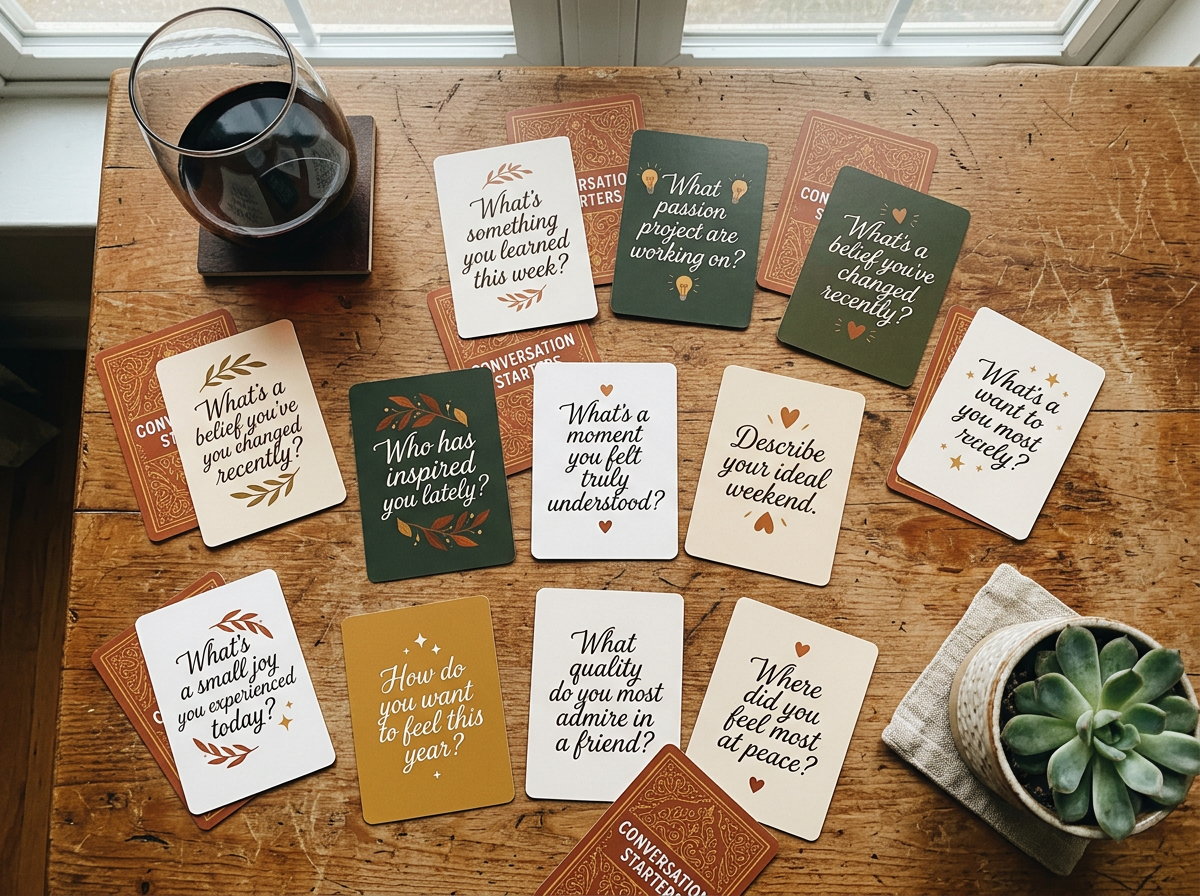
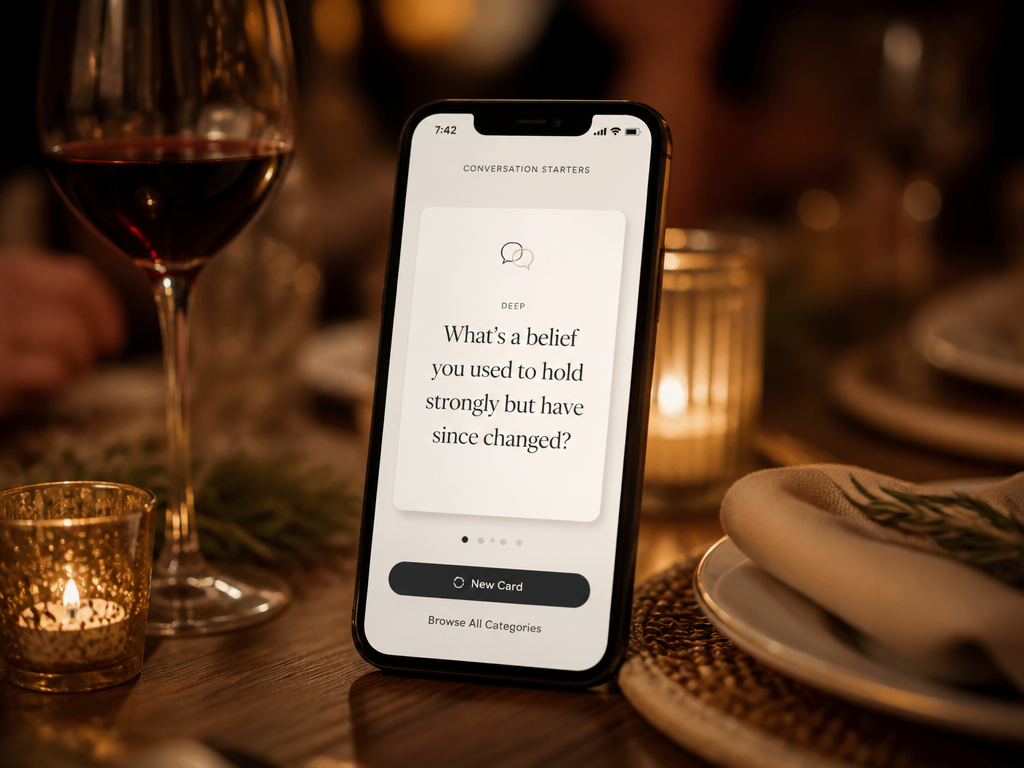
    For those seeking structured support, conversation cards and digital platforms like Convo Cards offer curated question packs specifically designed for friend gatherings. With themed decks covering everything from lighthearted fun to deep values exploration, these tools remove the pressure of coming up with questions and create an easy framework for meaningful dialogue. At just $4.99 per year, Convo Cards provides an affordable way to ensure you never run out of fun questions to ask friends.

    The research is clear: quality conversations are within your reach, and their benefits are immediate. Take the first step this week by asking one friend one question that goes beyond the surface. You might be surprised at what you discover—and how much your friendship deepens as a result.

  • Living Room Staycation Ideas That Prioritize Meaningful Couple Connection

    Living Room Staycation Ideas That Prioritize Meaningful Couple Connection

    Living Room Staycation Ideas That Prioritize Meaningful Couple Connection

    Picture this: It’s Friday evening, and instead of battling traffic to reach an overpriced restaurant or boarding a flight for an expensive getaway, you and your partner transform your living room into an intimate escape where meaningful conversation flows freely and genuine connection takes center stage. This scenario isn’t just a budget-friendly fantasy—it’s a growing movement among couples who have discovered that the most romantic destination isn’t a place on a map, but the space of intentional connection you create together.

    Why Budget-Friendly Staycations Are the New Couple’s Escape

    The landscape of couple’s getaways has undergone a remarkable transformation. According to 2025 TravelPulse data, 60% of couples now prefer shorter, local getaways or home-based weekends over expensive, time-intensive travel. This shift represents more than just financial pragmatism—it reflects a deeper understanding of what truly strengthens relationships: focused, uninterrupted time together rather than destination-based experiences that come with hefty price tags.

    The modern approach to budget friendly date ideas centers on connection-based experiences rather than location-based spending. Couples are discovering that transforming familiar spaces into romantic destinations creates psychological separation from daily routines, allowing for deeper intimacy without the financial strain of traditional getaways. This approach to affordable couples activities prioritizes what relationship experts have long known: quality conversation and intentional interaction build stronger bonds than expensive dinners or luxury accommodations.

    These staycations succeed because they eliminate the pressure to "make the most of" an expensive destination. Instead, couples can focus entirely on each other, using guided conversations to explore topics that often get pushed aside in the busyness of everyday life. As you’ll discover, combining thoughtful room transformation with structured conversation opportunities creates an experience that rivals any traditional getaway—at a fraction of the cost.

    What follows is a comprehensive guide to creating your own living room staycation, complete with transformation techniques, date night questions that deepen intimacy, and romantic touches that elevate ordinary evenings into extraordinary connection experiences—all without leaving home or breaking your budget.

    Budget-Friendly Date Ideas: Setting Up Your Living Room Oasis

    The foundation of any successful staycation lies in creating a psychological shift from "regular living room" to "special destination." This transformation doesn’t require purchases—just intention and creativity. Here’s how to begin:

    Cozy romantic living room staycation setup with a couple on a sofa surrounded by soft warm lighting, string lights, candles, and textured throw blankets
    Transform your living room into an intimate escape with intentional lighting and cozy textures

    Establish Your "Do Not Disturb" Policy

    The single most critical element of staycation success is eliminating interruptions. As one romantic getaway expert advises:

    "Maintain a ‘do not disturb’ policy. Let your company, close relatives, and friends know you are on vacay. Leave the computers off and the phones out of sight and out of mind." — The Frugal Feminista

    This policy creates the mental boundary necessary for both partners to fully disconnect from daily responsibilities and reconnect with each other. Consider these practical steps:

    • Notify family members and close friends of your unavailability
    • Set an email auto-responder if needed
    • Silence all notifications or place phones in another room entirely
    • Turn off computers and televisions
    • Let go of guilt about being unavailable for a few hours

    Transform Your Space with Layered Textures

    Your living room already contains the elements needed for romantic ambiance—you simply need to rearrange and repurpose them. Focus on creating cozy, intimate spaces through texture layering:

    • Throw blankets: Pull out all available blankets, focusing on soft textures like fleece, velvet, or chunky knits
    • Pillow arrangements: Gather pillows from around your home, prioritizing those in romantic colors (burgundy, navy, plum, gold)
    • Rug layering: If you have multiple area rugs, layer them to create defined, soft conversation zones
    • Texture mixing: Combine smooth, nubby, silky, and woven textures for sensory richness

    Many of these romantic touches cost $0-$10, primarily involving items you already own. The goal is creating visual and tactile warmth that signals comfort and intimacy.

    Master the Art of Soft Lighting

    Lighting transformation is perhaps the most powerful tool in your staycation arsenal:

    "Soft lighting transforms your living room into a warm, inviting space—ideal for date nights at home." — CORT Furniture Outlet Blog

    Implement these lighting strategies:

    • Fairy lights: String lights around windows, along walls, or draped over furniture for magical ambiance
    • Candles: Real candles create authentic atmosphere (place safely), or opt for realistic LED versions for worry-free glow
    • Lamp adjustments: Use lowest wattage bulbs or dimmers to create soft, diffused lighting
    • Strategic placement: Position light sources to create pools of warm light rather than overall bright illumination

    Rearrange for Conversation Connection

    Most living rooms are arranged for television viewing or general flow—not intimate conversation. Create conversation-friendly seating by:

    • Angle chairs and sofas to face each other rather than a screen
    • Remove coffee tables or push them aside to create open space
    • Pull seating closer together to reduce the distance between partners
    • Create multiple conversation zones if space allows

    This simple furniture rearrangement signals that the evening’s purpose is connection, not passive entertainment.

    Indoor Camping Adventure: Building Your Romantic Blanket Fort

    Few staycation elements create as much delight and intimacy as a blanket fort—adults included. This collaborative project not only produces your romantic retreat but also sets the tone of shared effort and playful collaboration.

    Romantic indoor blanket fort with fairy lights, cozy blankets and pillows, creating a magical intimate space for a couple
    Building a blanket fort together becomes a bonding activity and a dedicated conversation hub

    Construction as Bonding Activity

    Building your blanket fort together isn’t just preparation—it’s the start of your staycation experience. Approach it as a team project, which naturally encourages:

    • Communication and coordination
    • Playful problem-solving
    • Shared physical activity
    • Investment in the space you’ll enjoy together

    Essential Fort Elements

    Gather these household items for construction:

    • Base structure: Dining chairs, bar stools, or the backs of sofas positioned to create a frame
    • Coverings: Bedsheets, light blankets, or throws draped over your structure
    • Fasteners: Clothespins, heavy books, or chip clips to secure sheets in place
    • Floor cushioning: Multiple blankets layered over pillows for comfortable seating
    • Atmosphere: Fairy lights strung inside the fort create magical, intimate lighting

    The goal is creating an "indoor camping" feel that provides the sense of escaping to a private cabin without leaving home.

    Your Fort as Conversation Hub

    This intimate space becomes your primary location for couples conversation starters and deeper connection activities. The enclosed, cozy environment creates psychological safety—perfect for vulnerability and authentic conversation. The physical closeness naturally encourages lowered voices, longer eye contact, and more intimate sharing.

    Budget breakdown: Typically $0 if using household items, with optional $10-20 investment for additional string lights or specific pillows for comfort.

    Affordable Couples Activities: Three Staycation Themes That Spark Connection

    With your living room oasis prepared, it’s time to choose a theme that will guide your evening’s activities and conversations. Each theme coordinates room setup with conversation opportunities while keeping costs minimal.

    Theme 1: Movie Marathon Cuisine Night

    Setup: Transform your space with travel-themed elements—maps, globes, or souvenirs from past trips displayed prominently. Choose 2-3 romantic travel films (think Under the Tuscan Sun, Eat Pray Love, or Before Sunrise).

    Culinary Component: Coordinate your meals with each film’s setting. This might mean:

    • Italian-inspired dishes for Tuscany-themed movies
    • French cuisine for Paris-based films
    • Street food style for adventure travel movies

    Conversation Integration: Between films or during meal preparation, explore questions like:

    • "If we could take a month-long trip anywhere together, where would you want to go and why?"
    • "What’s your favorite travel memory from our time together?"
    • "What kind of travel adventure do you dream about but haven’t shared with me?"

    Budget range: $15-30 for ingredients, compared to $100+ for dining out and movie theater experiences.

    Theme 2: At-Home Spa Experience

    Setup: Create a wellness sanctuary with soft lighting, calming music playlists, and essential oil diffusers or scented candles. Clear floor space for stretching or massage activities.

    Culinary Component: Prepare light, refreshing fare—infused water, fruit plates, or simple healthy snacks that won’t leave you feeling heavy.

    Wellness Activities: Incorporate elements like:

    • Partner massage using massage oils (coconut oil works perfectly with added essential oil)
    • Guided meditation or breathing exercises together
    • Gentle stretching or yoga poses modified for couples

    Conversation Integration: Wellness themes naturally invite discussions about:

    • Stress management and support
    • Physical and emotional needs
    • Personal growth goals
    • Self-care preferences

    Budget range: $10-25 for oils or essential oils, compared to $150+ for couple’s spa treatments.

    Theme 3: Culinary Adventure Recreation

    Setup: Clear dining space and create an elegant restaurant-style setting—your best dishes, cloth napkins, candlelight centerpiece.

    Culinary Component: Together recreate a meal from your favorite restaurant (search for copycat recipes online) or the dish from your most memorable date. The collaborative cooking process becomes part of the date itself.

    Ambiance Elements:

    • Dress up as if you were going out
    • Create a simple menu card
    • Set background music matching the restaurant type

    Conversation Integration: Over your candlelight meal, explore:

    • "What’s something about our early dating days that you still think about?"
    • "What’s your favorite memory of us sharing a meal together?"
    • "If we could have dinner with anyone (living or deceased), who would you choose and why?"

    Budget range: $20-40 for quality ingredients, compared to $80-150+ for comparable restaurant meals.

    Each theme demonstrates that meaningful connection comes from shared activity and intentional conversation—not from price tags. The doing together creates natural conversation flow without pressure.

    Date Night Questions: Why Open-Ended Conversations Deepen Intimacy

    Beyond the romantic setup and themed activities lies the true engine of staycation connection: intentional conversation. Understanding the psychology behind effective couple communication transforms your at-home date from pleasant evening to relationship-strengthening experience.

    The Power of Quality Conversation

    Research consistently demonstrates that couples who prioritize conversation maintain stronger, more satisfying relationships. As relationship experts note:

    "Couples who regularly engage in quality conversations tend to have stronger relationships." — Wezoree

    These conversations aren’t about logistics, schedules, or household management—they’re focused exploration of each other’s inner worlds, dreams, fears, and experiences.

    Open-Ended Versus Closed Questions

    The quality of your conversation questions directly determines the depth of your connection. Consider the difference:

    • Closed question: "Did you have a good day?" (Invits yes/no answer)
    • Open-ended question: "What was the most interesting part of your day?" (Invites story, reflection, sharing)

    "Open-ended questions invite stories, laughter, and sometimes even surprise discoveries about each other." — Calm Tree Therapy

    Open-ended questions act as invitations—your partner chooses how much to share, what direction to take, and how deeply to explore. They create space for authenticity rather than requiring specific information.

    Conversation Starters as Relationship Bumpers

    Many couples hesitate to use prepared questions, fearing it makes conversation feel artificial or scripted. However, relationship experts frame this differently:

    "Conversation starters for couples can help you lean into excitement and vulnerability because they act as a guide to connection, like bumpers on a bowling alley that keep the talk going down a shared path." — Prevention

    This perspective transforms prepared questions from crutches to tools—structures that create safety and direction while allowing natural flow. The "bumpers" prevent conversation from stalling or veering into logistics while leaving plenty of room for authentic sharing.

    Creating Psychological Safety

    Structured conversations reduce the pressure to "come up with something to say"—a common anxiety that prevents many couples from deeper communication. When you have prepared questions, both partners can relax into the conversation rather than worrying about steering it.

    This psychological safety is particularly valuable for topics that feel vulnerable or rarely discussed. The question provides a structured entry point, making it easier to approach sensitive subjects with less anxiety.

    Maintenance Questions Versus Connection Questions

    Consider these two categories:

    Maintenance questions (necessary but limited):

    • "What time should we leave tomorrow?"
    • "Did you pay the electric bill?"
    • "What’s for dinner next week?"

    Connection questions (relationship-building):

    • "What’s something you’ve always wanted to learn but haven’t told me about?"
    • "When do you feel most loved by me?"
    • "What’s a dream you’ve never said out loud?"

    Both types have their place, but staycations should prioritize connection questions over maintenance concerns.

    Couples Conversation Starters: Questions That Transform Your Staycation

    Ready to put these principles into practice? The following conversation categories provide specific questions you can use throughout your staycation. Remember: there’s no pressure to answer immediately. These are invitations, not interrogations. Return to favorites throughout your evening.

    Relationship Reflection Questions

    These questions deepen appreciation and shared meaning:

    • "What’s your favorite memory of us from this past year?"
    • "What’s something I do that makes you feel loved that I might not realize?"
    • "When did you first know you wanted to be with me?"
    • "What’s the hardest thing we’ve gone through together, and what did it teach you about us?"
    • "What’s a small moment with me that you still think about?"

    Discovery Questions

    These questions reveal new dimensions of your partner:

    • "What’s something you’ve always wanted to try but haven’t told me about?"
    • "What’s a misconception people often have about you?"
    • "What’s something about your childhood that shaped who you are today?"
    • "What’s a skill you wish you had and why?"
    • "What’s the best compliment you’ve ever received?"

    Dream-Building Questions

    These questions create shared vision and excitement:

    • "If money wasn’t a factor, what would you want our life to look like in five years?"
    • "What’s an adventure you’d love to take together?"
    • "What’s something you’d love to learn or explore as a couple?"
    • "If we could start a business or project together, what would it be?"
    • "What does your ideal day look like, and how can I help create more of those?"

    Appreciation Questions

    These questions foster gratitude and affirmation:

    • "What’s something I’ve done recently that made your life easier?"
    • "What’s your favorite physical quality of mine?"
    • "What’s something you appreciate about how I handle stress?"
    • "When do you feel most proud to be with me?"
    • "What’s something I do that makes you laugh?"

    Vulnerability Invitations

    These questions create intimacy through shared openness:

    • "What’s something you’re worried about right now?"
    • "When do you feel most uncertain or insecure?"
    • "What’s something you wish you could change about yourself?"
    • "When do you feel lonely, even when we’re together?"
    • "What’s something you need from me that you haven’t asked for?"

    Lighthearted Fun Questions

    Not every question needs to be deep—playfulness creates connection too:

    • "If we could teleport anywhere tonight, where would you want to go?"
    • "What’s the weirdest dream you’ve had recently?"
    • "If you could have dinner with anyone, living or dead, who would it be?"
    • "What’s a guilty pleasure you’ve never admitted to?"
    • "If our relationship was a movie genre, what would it be and why?"

    Best Practices for Question Conversations

    • Alternate asking questions: Take turns so both partners have opportunity to guide conversation
    • No pressure to answer: It’s okay to pass or come back to questions later
    • Follow the spark: If a particular question opens rich territory, stay there rather than moving to the next question
    • Embrace silence: Pauses are normal—your partner is processing, not rejecting
    • Practice active listening: Focus on understanding rather than planning your response

    Making It Memorable: Budget-Friendly Special Touches That Feel Expensive

    The difference between a pleasant evening at home and a memorable staycation often comes down to thoughtful details that signal intention and effort. These special touches cost very little but create significant impact.

    Surprise Takeout, Elevated

    Order takeout from your partner’s favorite restaurant, but transform the presentation:

    Elegant at-home romantic dinner setup for two with candles, fresh flowers, wine glasses, and a beautifully plated meal on a dressed table
    • Transfer food to your own dishes rather than using takeout containers
    • Set the table properly with cloth napkins and real silverware
    • Add a simple centerpiece (even a single flower in a small vase works)
    • Create a handwritten menu card for each place setting

    This approach combines the convenience of takeout with the thoughtfulness of home preparation—a perfect balance for budget friendly date ideas.

    Intentional Photo Documentation

    Most couples have countless casual phone photos but few intentional couple portraits. Use your staycation to create intentional memories:

    • Set up your phone on a timer or tripod
    • Take posed photos in your blanket fort or specially arranged space
    • Capture candid moments during activities or conversations
    • Create a simple photo collage afterward as a keepsake

    These images become touchstones—visual reminders of your intentional connection time.

    Handwritten Notes Scavenger Hunt

    Before your staycation begins, write 5-10 small notes for your partner to discover throughout the evening:

    • Tuck notes in places they’ll find naturally (under a pillow, in their jacket pocket, taped to the bathroom mirror)
    • Keep them simple: "Thinking of you," "I love this time with you," "You’re beautiful," etc.
    • Vary the timing—some should be found early, others later in the evening
    • Consider making one note a playful clue leading to a small treat or another note

    This element of surprise adds playfulness and demonstrates forethought.

    Curated Atmosphere Through Music

    Background music profoundly influences atmosphere, yet many couples overlook this simple element:

    • Create playlists that match your chosen theme (Italian classics for cuisine night, jazz for spa evening, acoustic for intimate conversation)
    • Ensure volume is low enough to allow easy conversation
    • Consider both partners’ preferences in song selection
    • Update playlists periodically to keep staycations fresh

    Themed Props from Your Collection

    Incorporate items you already own that enhance your chosen theme:

    • Travel theme: Display maps, globes, or souvenirs from trips
    • Spa theme: Arrange towels folded restaurant-style, small bowls for oils
    • Restaurant recreation: Use your best serving dishes, proper glassware

    Memory Jar Creation

    During your staycation, create a memory jar that becomes an ongoing relationship ritual:

    • Use a clean jar or decorative container you already have
    • Write favorite memories from your staycation on slips of paper
    • Add to the jar after future special moments or dates
    • Read the collection together on future anniversaries or staycations

    This creates both conversation piece and relationship archive.

    Relationship Timeline Together

    Create a visual timeline of your relationship on poster board or large paper:

    • Mark key dates (when you met, first date, first "I love you," etc.)
    • Add photos if available
    • Include significant moments that shaped your relationship
    • Leave space for adding future milestones

    This activity combines conversation, creativity, and relationship reflection—resulting in a keepsake you’ll revisit in future staycations.

    Total cost for all special touches: Under $20 if you primarily use items you already own. The investment is time and thought, not money—which is exactly what makes these touches so meaningful.

    Planning Your Next Connection-Focused Staycation: A Quick Start Guide

    Creating meaningful budget friendly date ideas at home requires planning but shouldn’t feel overwhelming. This quick-start guide ensures your staycation succeeds with minimal stress and maximum connection.

    Quick Planning Checklist (1-2 Hours Total)

    Choose Your Theme (15 minutes):

    • Review the three themes above or create your own variation
    • Consider what sounds most appealing to both partners
    • Factor in your energy levels and available time

    Gather Conversation Questions (15 minutes):

    • Select 10-15 questions from categories above
    • Write them on slips of paper or in a note on your phone
    • Choose a mix of deep and light questions

    Prepare Your Space (30-60 minutes):

    • Rearrange furniture for conversation
    • Layer textures and pillows
    • Set up lighting (fairy lights, candles, lamp adjustments)
    • Build blanket fort if choosing that element

    Gather Any Needed Supplies (30 minutes):

    • Shop for any food ingredients
    • Collect props or atmosphere elements
    • Prepare any surprise elements (notes, special touches)

    Set Your "Do Not Disturb" Policy (15 minutes):

    • Notify family/friends
    • Set email auto-responder if needed
    • Prepare space for phones (charging station in another room)

    The Staycation Mindset Shift

    As you plan, remember this core insight: meaningful connection comes from intentional conversation and focused time, not expensive destinations. The 60% of couples choosing stay-at-home connection aren’t settling—they’re prioritizing what actually strengthens relationships.

    Your living room staycation isn’t "less than" an expensive getaway. In many ways, it’s more:

    • More intimacy: Private space allows deeper vulnerability
    • More conversation: Without travel fatigue, you have energy for connection
    • More frequency: Low cost means you can enjoy staycations monthly, not annually
    • more customization: Each staycation reflects your specific relationship and preferences

    Starting the Conversation Habit

    If intentional couple conversation is new for you, start small:

    • Try 2-3 open-ended questions during your next at-home date night
    • Create a regular schedule—monthly themed staycations keep relationships fresh without financial strain
    • Build your question collection—add questions that resonate with your relationship dynamic
    • Document what works—note which questions or activities sparked the best conversations

    Remember that conversation practice builds intimacy over time. This is a habit, not a one-time fix. Each staycation strengthens your communication muscles, making future conversations easier and deeper.

    Joining the Meaningful Connection Movement

    You’re part of a growing movement of couples who understand that relationship investment doesn’t require financial investment. The most romantic destination isn’t a place—it’s the space of genuine connection you create together.

    Your living room, transformed with intention and filled with meaningful conversation, becomes more romantic than any luxury resort. Because ultimately, romance isn’t about candlelight and flowers (though those help)—it’s about being truly seen, heard, and known by your partner.

    And that’s something money can’t buy—but a thoughtfully planned staycation can absolutely create.

    Ready to begin? Choose your theme, gather your questions, and transform your living room into the most romantic destination on earth: the space where you and your partner connect deeply.

  • Ten Dollar Date Night Ideas That Actually Spark Meaningful Conversations

    Ten Dollar Date Night Ideas That Actually Spark Meaningful Conversations

    Ten Dollar Date Night Ideas That Actually Spark Meaningful Conversations

    The average movie date night for two costs $50-60 when you factor in tickets, popcorn, and drinks—yet research shows that couples who simply spend focused time together at home experience the same relationship benefits without the financial strain. This disconnect between spending and satisfaction reveals a crucial truth about modern relationships: meaningful connection doesn’t require a substantial budget, just intentional engagement.

    Why Budget-Friendly Dates Matter: The Science Behind Regular Couple Time

    Financial stress ranks among the top causes of relationship conflict, yet the cultural narrative insists that "good" dates require significant spending. This pressure creates a cruel paradox: couples feel they can’t afford to prioritize their relationship, leading to decreased connection that further strains both emotional and financial well-being.

    The data tells a different story. According to Ramsey Solutions, staying home for a movie night instead of going to a theater saves $30-40 immediately—savings that can fund an entire month of budget-friendly dates. More importantly, research from The Couples Center reveals that the frequency of couple time matters far more than the format:

    "For women who spend time with their spouse every week, they are 4 times happier than women who don’t spend this kind of time with their mate. For men, they are 2.5 times happier than men who don’t spend this kind of time with their mate."

    This happiness multiplier extends to physical intimacy as well. Call Emmy’s research shows that "when couples regularly spend focused time together, they are also more likely to report greater sexual satisfaction in their relationship—68% of wives and 67% of husbands with weekly date nights report being happy in this aspect."

    The mechanism behind these benefits lies in communication. A qualitative study of 13 couples published by Marriage.com found that "a date night can improve communication by offering this structured opportunity for meaningful discussions." Budget-friendly dates under $10 can deliver these same benefits while eliminating the financial stress that often undermines relationship satisfaction.

    This post provides specific, actionable date ideas that cost under $10, conversation techniques to deepen your connection, and planning strategies to make regular couple time sustainable regardless of your budget.

    The $10 At-Home Date Night Menu: Cozy Conversations Without Leaving Home

    Your home offers untapped potential as a romantic venue, often providing better conditions for meaningful conversation than crowded restaurants or dark theaters. The key lies in transforming familiar spaces through intentional details and focused attention.

    Cooking Together: The $15 Romantic Dinner

    Prepare a homemade meal using ingredients under $10 total. Ramsey Solutions notes that cooking at home costs "significantly less than dining out" while creating valuable shared experiences. Choose a recipe neither of you has tried before, turning the preparation into a collaborative adventure.

    A couple cooking together in a warm, cozy kitchen with fresh ingredients on wooden counters, soft golden lighting creating an intimate atmosphere

    Budget breakdown:

    • Main ingredients: $6-8
    • Fresh vegetables or herbs: $2-3
    • Total: Under $10

    Conversation strategy: While cooking, discuss your earliest food memories, family recipes, or meals that shaped your childhood. The hands-on activity reduces conversational pressure while the shared purpose builds teamwork skills.

    Living Room Movie Night: Theater Quality for Fraction of the Cost

    Transform your living room into a private cinema. As Ramsey Solutions advises, "you’ll save at least $30–40 by not going to the movies or hitting up the concession counter. Instead, rent that flick through Amazon Prime or YouTube and pick up snacks at the dollar store."

    Budget breakdown:

    • Movie rental: $3.99-5.99
    • Dollar store snacks: $5
    • Total: Under $10

    Conversation strategy: Choose a movie with meaningful themes, then discuss it over snacks afterward rather than immediately scrolling to the next option. Ask what resonated with each character and why.

    DIY Project Date: Creating While Connecting

    For the Family recommends finding craft ideas on Pinterest with supplies under $10. Working on a project together creates natural conversation flow while producing something tangible as a relationship memento.

    Project ideas under $10:

    • Painted mugs or wine glasses (dollar store ceramics + acrylic paint)
    • Scrapbook page documenting a favorite memory
    • Homemade picture frame for a relationship photo
    • Shared vision board using old magazines and glue

    Conversation strategy: While working, discuss what each element represents to you. The physical activity provides natural pauses in conversation, reducing the pressure to constantly fill silence.

    Setting the mood: Regardless of which at-home date you choose, these elements maximize connection potential:

    • Dim lighting or candles
    • Phone-free zone (silence notifications and leave phones in another room)
    • Background music that’s meaningful to your relationship
    • Comfortable seating arrangements that face each other for activities

    Outdoor Adventures: Free Date Ideas That Naturally Foster Deep Conversations

    Nature provides an ideal backdrop for meaningful dialogue. The absence of technological distractions, combined with the calming effect of natural environments, creates conditions where deeper conversations emerge organically.

    Stargazing: Philosophy Under the Stars

    Brides.com highlights stargazing as a completely free date activity that "naturally leads to philosophical and personal conversations." The vastness of the night sky prompts questions about purpose, dreams, and our place in the world—topics couples rarely discuss in daily routines.

    Couple lying on a blanket under a brilliant starry night sky, silhouetted against the cosmos while stargazing together

    What you need: Blanket, star chart app (free), possibly warm drinks from home

    Conversation starters: The celestial setting naturally invites questions like: What legacy do you want to leave? What’s something you’ve always wondered about the universe? If you could see any era of history, which would you choose?

    Nature Walks and Hiking: Movement Meets Meaning

    For the Family identifies nature walks and hiking as zero-cost activities where "physical activity paired with conversation" reduces the pressure of face-to-face interaction while maintaining intimacy. Research cited by Brides.com confirms that active dates decrease social anxiety and increase conversational ease.

    Why movement works: Walking side-by-side rather than sitting face-to-face makes difficult topics feel less confrontational. The rhythm of movement creates natural conversational pauses.

    Pro tip: Choose trails with varying difficulty levels or scenic viewpoints—the shared accomplishment and beautiful views create conversation touchpoints throughout the date.

    Geocaching Adventures: Treasure Hunting Together

    For the Family recommends geocaching as a way to turn "a simple walk into an interactive treasure hunt using only smartphone data." This global scavenger hunt uses GPS coordinates to find hidden containers in public spaces.

    Why it works for couples:

    • Creates shared purpose and teamwork
    • Discovering new places in familiar areas
    • The thrill of discovery generates positive emotions couples associate with each other
    • Completely free beyond normal smartphone data usage

    Park Picnics: Dining With a View

    A picnic with homemade food costs under $10 while providing what For the Family describes as "a romantic setting for conversation." The outdoor environment, combined with the effort of preparing food, communicates thoughtfulness without requiring expensive restaurant meals.

    Budget breakdown:

    • Homemade sandwiches or salads: $5-7
    • Fresh fruit or simple dessert: $2-3
    • Total: Under $10

    Conversation strategy: The picnic format naturally encourages extended conversations. Without waitstaff interruptions or time limits, couples can explore topics at their own pace.

    Hidden Gems in Your Community: Budget-Friendly Date Ideas Under $10

    Every community offers underutilized resources for entertainment and connection. The key lies in shifting your perspective from seeking commercialized date activities to discovering local treasures.

    Free Library Programs: Intellectual Connection

    For the Family highlights library offerings including book clubs, author readings, and workshops that "spark intellectual discussions." These events provide structured conversation topics and shared learning experiences.

    Why libraries excel for dates:

    • Free admission to quality programming
    • Built-in conversation starters based on event content
    • Opportunities to discover shared interests
    • Regular scheduling creates routine couple time

    Community Concerts and Outdoor Movies

    Many communities host free concerts in parks or outdoor movie series during warmer months. As For the Family notes, these provide "entertainment under $10 when you bring your own snacks."

    Budget breakdown:

    • Homemade snacks and drinks: $5-8
    • Event admission: Free
    • Total: Under $10

    Conversation strategy: Discuss the performance or film during breaks, then compare it to other cultural experiences you’ve shared. Discuss what art or music means to each of you individually and as a couple.

    Open Mic Nights at Local Coffee Shops

    These events typically require only a drink purchase (around $5) while providing entertainment that naturally provokes conversation. The intimate, local atmosphere encourages discussion about the performances, your own creative interests, and dreams you rarely discuss.

    Conversation goldmine: Open mic performances often touch on universal themes—love, loss, ambition, identity. These topics naturally lead to deeper discussions about your own experiences and values.

    Local Museum Free Admission Days

    Most museums offer designated free admission days or pay-what-you-wish hours. These cultural experiences naturally prompt meaningful discussions about history, art, science, or society based on the exhibits.

    Pro tip: Choose museums with interactive elements or rotating exhibitions to ensure fresh content. Discuss which exhibits resonated with each of you and why—these preferences reveal values and perspective.

    Bowling and Arcade Nights on a Budget

    For the Family identifies bowling on BOGO nights and arcade token spending ($10 worth) as providing "entertainment value" while creating "friendly competition that builds connection."

    Budget breakdown:

    • Bowling (BOGO night): $8-10 for two people
    • Arcade tokens: $10
    • Total: Under $10 each

    Why playfulness matters: Engaging your inner children together creates vulnerability and joy that strengthens bonds. Play relieves the seriousness of daily life and reminds couples why they enjoy each other’s company.

    The Secret Sauce: Conversation Starters That Transform Simple Dates Into Meaningful Connections

    The activity matters less than the conversation it facilitates. While shared experiences provide the foundation, intentional dialogue deepens the connection. The key lies in moving beyond transactional daily conversations to exploratory discussions.

    The Power of Open-Ended Questions

    Good Housekeeping explains the distinction between surface-level and meaningful questions:

    "Open-ended questions, however, dig deeper and explore what may feel unfamiliar. These discoveries are what move relationships forward."

    Yes/no questions gather information; open-ended questions build understanding. The latter invite vulnerability and insight, creating emotional intimacy that transactional questions cannot achieve.

    Structured Conversation Tools

    Convo Cards offers a digital platform specifically designed to facilitate meaningful dialogue through curated question packs. At $4.99/year—less than the cost of a single movie ticket—the app provides 18+ themed question packs covering topics from childhood memories to future dreams.

    Why structure matters: Unstructured conversations often default to logistics (work schedules, household tasks, planning). Structured questions ensure you explore meaningful territory without the pressure of constantly thinking what to say next.

    Sample conversation starters from various themes:

    • "What’s a memory from childhood that shaped who you are today?"
    • "What’s something you’ve always wanted to learn but haven’t yet?"
    • "If money wasn’t a factor, how would you spend your days?"
    • "What’s the bravest thing you’ve ever done?"
    • "What does your ideal future look like in five years?"

    Transforming Routine Moments

    Good Housekeeping suggests "setting up intentional question-and-answer sessions during everyday activities like walks or car rides" as a way to "transform routine moments into meaningful connections." This integration means you don’t need special occasions for deep conversations—you can create them during ordinary activities.

    Practical implementation:

    • Commute conversations: Choose one meaningful question to discuss during drives
    • Walking talks: Use outdoor exercise time for relationship check-ins
    • Cooking connection: Discuss meaningful topics while preparing meals together
    • Bedtime reflection: End each day with one question about each other’s internal world

    Progressive Questioning Strategy

    Start with lighthearted questions and gradually move to deeper topics as comfort increases. This progression prevents overwhelm while building emotional safety for vulnerability.

    Question progression example:

    1. Surface: "What was your favorite part of today?"
    2. Deeper: "What’s something that challenged you this week?"
    3. Deepest: "What’s a fear you’ve never shared with anyone?"

    The Question Jar Approach

    Write conversation prompts on slips of paper and place them in a jar. During your $10 date, take turns drawing questions to discuss. This removes the pressure of constant question-generation while ensuring varied topics.

    Why it works: The random element introduces novelty and prevents conversations from becoming routine. The physical jar becomes a relationship symbol representing your commitment to ongoing connection.

    Budget-Friendly Date Ideas That Double as Relationship Building Activities

    Some activities offer dual benefits: they provide enjoyable shared experiences while simultaneously strengthening relationship skills. These "two-for-one" dates maximize your investment of both money and time.

    Volunteering Together: Shared Purpose for Free

    Camille Styles identifies volunteering as an activity that "costs nothing but provides meaningful conversation opportunities and shared purpose." Working together toward a meaningful goal creates bonds that recreational activities alone cannot replicate.

    Why shared purpose strengthens relationships:

    • Creates a joint identity beyond "romantic partners"
    • Reveals values and priorities through action
    • Provides natural conversation about social issues and personal beliefs
    • Generates positive emotions associated with making a difference together

    Volunteering options: Animal shelters, food banks, environmental cleanups, community gardens, literacy programs, Habitat for Humanity builds

    Vision Board Sessions: Dreaming Together

    For the Family suggests creating vision boards using magazines and supplies under $10. This collaborative dreaming exercise reveals aspirations and creates shared goals for the future.

    Close-up of a couple's hands creating a DIY vision board together with colorful magazine cutouts, glue, and inspiring images spread on a table

    Budget breakdown:

    • Poster board: $2-3
    • Old magazines (library free box or thrift store): $2-3
    • Glue, markers, scissors (if not owned): $3-5
    • Total: Under $10

    Conversation goldmine: As you select images and words for your board, discuss what each represents. This reveals dreams, fears, and priorities that might never emerge in ordinary conversation.

    Home Improvement Projects: Building Teamwork

    Small home projects costing under $10—reorganizing a closet, painting a single wall, creating a photo gallery—build teamwork skills while improving your shared space.

    Why it works: Working on a shared project requires communication, compromise, and collaboration—the exact skills that strengthen relationships. The tangible result becomes a symbol of your ability to work together effectively.

    Exercise Together: Free Movement, Free Conversation

    YouTube offers countless free workout videos for couples, from yoga to strength training to dance tutorials. Alternatively, neighborhood jogging, bodyweight exercises in parks, or following along with fitness apps cost nothing.

    Research-backed benefits: Physical activity releases endorphins that improve mood and reduce stress—both of which benefit relationship interactions. The shared commitment to health demonstrates mutual investment in long-term wellbeing.

    Book Club for Two: Intellectual Intimacy

    Borrow books from the library (free) and create your own two-person book club. Read separately, then discuss chapters over homemade coffee or during walks.

    Why reading together deepens connection: Books provide a third subject to discuss, reducing the pressure of constant direct focus on each other while still revealing perspectives, values, and thought processes through literary analysis.

    Planning Your $10 Date Night: How to Make Every Dollar Count for Connection

    Great dates don’t happen accidentally—they’re planned with intention. The couples who maintain regular connection prioritize scheduling and preparation the same way they approach other important commitments.

    Set a Weekly Couple Time Goal

    The Couples Center’s research demonstrates that consistent couple time dramatically increases happiness: women become 4 times happier, men 2.5 times happier with weekly time together. Even one focused hour weekly yields significant benefits.

    Practical implementation: Schedule dates in your calendar as non-negotiable appointments. Treat this time with the same respect you’d give a work meeting or medical appointment—because relationship health deserves equal priority.

    Create a Rotating Date Jar System

    Write down all $10 date ideas on individual slips of paper in a jar. Each week, alternate who draws the next date, creating variety and anticipation while eliminating the "what should we do?" decision fatigue.

    Benefits:

    • Removes planning stress
    • Ensures both partners’ preferences are represented
    • Creates anticipation and surprise elements
    • Prevents decision fatigue from consistently choosing activities

    Budget Breakdown Strategies

    The math on budget-friendly dates is compelling. Allocating $40/month for dates funds four quality $10 dates without financial stress. Over a year, that’s $520 compared to $600+ for just one expensive monthly date night.

    Monthly budget breakdown:

    • Week 1: At-home cooking date ($8)
    • Week 2: Outdoor adventure (Free + $5 snacks)
    • Week 3: Community event ($5-10)
    • Week 4: DIY project or activity ($10)
    • Total: $28-33/month

    Phone-Free Zones: Maximizing Presence

    Establish clear rules about phone use during dates. Even silent notifications create psychological presence divided between your partner and digital demands. Full presence communicates that your partner deserves your undivided attention.

    Practical phone-free zone rules:

    • Phones on silent in another room during at-home dates
    • Emergency exceptions clarified in advance
    • No posting about dates until after they conclude
    • Focus on experiencing the moment rather than documenting it

    Weather Contingency Plans

    For outdoor dates, always have backup indoor options ready. Spontaneous pivots to plan B prevents disappointment while demonstrating flexibility and problem-solving—both valuable relationship skills.

    Contingency pairs:

    • Stargazing → indoor movie marathon
    • Park picnic → living room fort building
    • Nature walk → museum free day
    • Geocaching → DIY project at home

    Breaking the Dinner-and-Movie Mold: Creative Date Night Formats That Spark Better Conversations

    Traditional date night patterns—dinner at a restaurant followed by a movie—often fail to facilitate meaningful connection. Movies involve 2+ hours of silence; restaurants can be noisy, rushed, or impersonal. Intentional alternatives create better conditions for conversation.

    Why Traditional Formats Fall Short

    Movies: While enjoyable, movies provide zero opportunity for interaction during the primary activity. Discussion afterward often feels forced or unnatural after two hours of passive consumption.

    Restaurants: Despite their popularity as date venues, restaurants present multiple conversational obstacles:

    • Noise levels that require raised voices
    • Time pressure from table turnover
    • Self-consciousness about being overheard
    • Distractions from other diners and staff

    Activity-Based Dates: Keeping Conversation Flowing Naturally

    Working on something together—cooking, puzzles, DIY projects, games—keeps conversation flowing naturally because the shared activity provides conversational touchpoints and natural pauses. There’s no pressure to fill silence continuously.

    Why activity-based dates work:

    • Shared focus reduces conversational pressure
    • Physical movement increases comfort and reduces anxiety
    • Collaborative elements demonstrate teamwork
    • Tangible results create shared accomplishment
    • Natural conversation arises from the activity itself

    Skill-Sharing Dates: Free and Deeply Personal

    Take turns teaching each other something you’re passionate about or skilled at. This free activity reveals expertise, interests, and facets of your personality that rarely emerge in daily conversation.

    Skill-sharing ideas:

    • One partner teaches guitar basics; the other teaches photography principles
    • Cooking technique exchange (one teaches pasta, the other teaches stir-fry)
    • Hobby introduction (knitting basics, chess strategy, yoga poses)
    • Professional skill sharing (workplace tips, software shortcuts)

    Why it works: Teaching requires vulnerability—admitting what you know and don’t know, being patient with your partner’s learning curve, and allowing yourself to be seen as knowledgeable. Learning requires humility and curiosity. Both strengthen bonds.

    Bucket List Planning: Dreaming Without Spending

    Spend $10 on quality coffee and ingredients for a nice dessert, then spend the date dreaming about future adventures together. This costs almost nothing while creating excitement and shared goals.

    Discussion points:

    • Travel destinations and why they appeal to each of you
    • Skills to learn together
    • Experiences to have before major life milestones
    • Financial goals and how to achieve them together
    • Legacy and what you want to be remembered for

    Memory Lane Dates: Recreating Relationship History

    Recreate your first date or revisit meaningful spots from your relationship timeline. This free activity naturally prompts nostalgia and stories about your relationship journey.

    Memory lane variations:

    • Recreate your first date (even if it’s just pizza in the park where you first met)
    • Visit the location of your proposal or first "I love you"
    • Drive past your first apartment or significant relationship locations
    • Recreate your first dance or meal together

    The Surprise Element: Mystery Date Nights

    Take turns planning mystery $10 dates, revealing only logistics (time to leave, dress code) without disclosing the activity. This creates anticipation and excitement while ensuring variety.

    Why surprise works: The anticipation generates positive emotions before the date even begins. Not knowing what to expect creates novelty, and the planning partner demonstrates thoughtfulness and creativity—both of which strengthen affection.

    Making It Last: Turning One $10 Date Night Into a Lifetime of Meaningful Connection

    The research consistently shows that frequency matters more than format. Regular couple time, regardless of cost, creates the relationship benefits that expensive occasional dates cannot match.

    The Compounding Returns of Consistent Couple Time

    The Couples Center’s research demonstrates that weekly couple time makes women 4 times happier and men 2.5 times happier regardless of spending amount. These happiness gains compound over time, creating stronger relationship foundations that weather life’s inevitable challenges.

    The math of connection: 52 $10 dates annually equals $520 total investment. Compare this to one expensive monthly date night at $50+ ($600+ annually), and the budget-friendly approach delivers both financial savings AND more frequent connection opportunities.

    Relationship ROI: The Investment That Pays Dividends

    The communication improvements, emotional intimacy, and satisfaction gains from regular meaningful dates far exceed the minimal financial investment. These dividends include:

    • Conflict resolution skills developed through practice
    • Emotional bank account deposits through regular positive interactions
    • Shared memories and inside jokes that create private relationship culture
    • Trust built through consistent prioritization of each other
    • Sexual satisfaction increases (68% of wives and 67% of husbands with weekly date nights report greater satisfaction)

    Start Small: The Power of Single Steps

    Don’t pressure yourself to transform your entire relationship overnight. Commit to just one $10 date night this week using one of the ideas from this post. The goal is consistency, not perfection.

    First week challenge: Choose ONE idea from each category:

    • Pick one at-home date idea
    • Schedule one outdoor adventure
    • Identify one community event to attend together
    • Download a conversation tool (Convo Cards at $4.99/year or create your own question jar)

    Ensuring Every Date Includes Meaningful Conversation

    While activities provide the framework, intentional dialogue creates the connection. Download conversation tools like Convo Cards, which offers curated question packs for $4.99/year—less than the cost of a single movie ticket. This small investment ensures every date includes meaningful discussion rather than just shared activity.

    Why structured questions work: They remove the pressure of constantly thinking what to say next, ensure balanced conversation where both partners share deeply, and provide variety that prevents relationships from becoming routine.

    The Truth About Connection

    The best dates aren’t about what you spend, but how deeply you connect. A $10 stargazing session with open-ended conversation about dreams and fears will always beat a $100 dinner with phones on the table and surface-level chatter. Intentionality, not budget, determines relationship quality.

    Your turn: Which $10 date idea will you try first? Share your experience in the comments, or sign up for weekly budget-friendly date inspiration to keep your relationship growing without breaking the bank.

  • Conversation Starter Apps That Actually Strengthen Parent Child Relationships

    Conversation Starter Apps That Actually Strengthen Parent Child Relationships

    Why Family Conversation Starters Matter Now More Than Ever

    Sixty-nine percent of young adults report they can be their true selves around their parents at least most of the time—yet many families still struggle to establish consistent communication patterns during the critical years when children are forming independence. This paradox reveals a fundamental challenge: while most parent-child relationships are fundamentally strong, daily communication often breaks down under the weight of digital distractions, busy schedules, and the natural widening of interests between generations.

    Family conversation starters provide structured opportunities to connect that cut through these modern barriers. Rather than relying on chance encounters or spontaneous dialogue that rarely happens, conversation starter apps and tools create intentional space for meaningful exchange. These digital platforms bridge the technology gap by meeting teens where they are—on their devices—while guiding them toward the face-to-face connection parents value.

    This post explores evidence-based strategies and tools for strengthening parent-child relationships through guided conversation, examining what research reveals about effective family communication and how digital conversation starter apps can serve as catalysts for deeper connection.

    The Science Behind Family Dinner Conversations: More Than Just Small Talk

    The research on family mealtimes reveals compelling evidence that regular, structured conversation produces profound developmental benefits. Children in families who eat meals together regularly demonstrate better self-esteem, stronger academic performance, and enhanced problem-solving abilities compared to peers with fewer shared meals.

    A diverse modern family gathered around a dining table engaged in warm conversation, showing parents and teenage children connecting through meaningful dialogue during dinner time.
    Shared family mealtimes create natural opportunities for meaningful connection and conversation.

    The benefits extend far beyond communication skills. According to the Human Performance Resource Center, "Children in families who regularly eat meals together experience a wide range of benefits. They’re more resilient, have better self-esteem, do better academically, eat more fruits and vegetables, consume less alcohol and drugs, have a lower body mass index, and they have lower levels of stress and depression."

    These findings position family meals not merely as nutritional opportunities but as critical developmental infrastructure. The consistent, predictable structure of shared mealtimes creates a natural container for conversation that helps children learn give-and-take communication skills essential for adult relationships. Unlike classroom settings or peer interactions, family dialogue provides a safe environment where children can practice expressing ideas, responding to counterpoints, and navigating disagreement without social risk.

    Perhaps most surprisingly, dinnertime conversation boosts vocabulary even more effectively than being read aloud to. Research counting rare words used during dinner conversations found that family dialogue naturally introduces sophisticated language in context, supporting language acquisition more organically than formal instruction. These benefits multiply when conversations move beyond logistical discussions—schedule coordination, homework reminders—into meaningful discussions using conversation starter tools that prompt reflection and sharing.

    The intergenerational transmission of family narratives also plays a crucial role in building resilience. > "Research shows that kids who are more familiar with family stories are more resilient than their peers." — The Family Dinner Project

    When children understand their place within a larger family story—knowing where parents came from, what challenges previous generations faced, and what values guided decisions—they develop a stronger sense of identity and belonging. Family conversation starters that elicit these stories create lasting benefits that extend well beyond childhood.

    The Developmental Cascade

    The impact of regular family conversation creates a positive cascade across developmental domains:

    Developmental Domain Impact of Regular Family Conversation Research-Backed Benefit
    Academic Performance Enhanced vocabulary and critical thinking Better grades and classroom participation
    Emotional Health Regular processing of daily experiences Lower stress and depression levels
    Social Skills Practice with perspective-taking and dialogue Stronger peer relationships and conflict resolution
    Physical Health Connection to family values around wellness Better eating habits, lower BMI
    Identity Formation Understanding family narrative and values Higher self-esteem and resilience

    This interconnected development suggests that family conversation starters serve as more than entertainment—they’re developmental tools that strengthen the foundation upon which children build their futures.

    Understanding the Generation Gap: How Parents and Teens Communicate Differently

    The technological and communication style divide between generations creates unique challenges for modern families. Teens communicate primarily through social media and messaging apps, creating unfamiliar territory for many parents who prefer phone or in-person conversations. This fundamental difference in communication modalities creates friction even when both generations genuinely desire connection.

    Split-view illustration showing a teenager with a phone and a parent in a caring pose, with conversation bridges between them representing how technology can connect generations.
    Bridging the communication gap between generations requires understanding different styles and finding common ground.

    Different generations have distinct expectations around response times, emoji use, and what constitutes meaningful conversation. A parent might view a quick text response as insufficient connection, while a teen might perceive a phone call as intrusive or overwhelming. These misalignments, if unaddressed, can lead to misunderstandings and disconnection during critical adolescent years.

    The technological divide manifests in practical ways:

    • Teens prefer asynchronous communication that allows time to compose thoughts and responses
    • Parents often value immediate, synchronous conversation that reads emotional nuance
    • Teens communicate through multiple platforms simultaneously, while parents typically focus on one channel
    • Parents equate conversation with voice or in-person dialogue; teens often experience text-based exchange as equally authentic

    Digital conversation starter apps can translate between these communication styles, leveraging teens’ comfort with technology while facilitating the face-to-face connection parents value. The key is finding tools that use technology as a bridge, not a replacement for in-person dialogue.

    This paradox—using digital tools to create analog connection—represents the unique opportunity that conversation starter apps provide. Rather than adding another screen-based activity to family life, effective conversation starter apps function as launchpads for device-free interaction. The digital platform removes friction (finding questions, remembering topics, overcoming initial resistance) and then recedes to allow human connection to take center stage.

    Age-appropriate conversation strategies must account for these developmental and technological differences. What works for a 12-year-old comfortable with family dialogue might fail completely with a 17-year-old protecting their emerging independence. Understanding these nuances helps parents select and implement conversation starter tools that work with, rather than against, their child’s developmental stage and communication preferences.

    What Makes a Great Conversation Starter App? Features That Work

    Not all digital conversation tools are created equal. Analysis of effective platforms reveals specific features that distinguish genuinely helpful apps from those that create more friction than connection. Understanding these characteristics helps families select tools that will integrate seamlessly into their routines rather than becoming another abandoned attempt at improving communication.

    Mobile-first design is essential—apps must work seamlessly on any device without requiring downloads or complex setup. Families rarely have the patience for cumbersome onboarding processes or technical barriers. The most effective conversation starter platforms load quickly, display clearly on both phones and tablets, and function equally well across operating systems. This platform-agnostic approach ensures that the tool adapts to the family’s existing technology rather than requiring new hardware or software investments.

    Effective conversation starter platforms offer themed question packs tailored for different family dynamics and age groups. A generic set of 100 questions might work occasionally, but curated packs designed for specific situations—dinner table, car rides, bedtime routines, family meetings—significantly increase the likelihood of consistent use. Families with children spanning multiple age ranges need questions appropriate for developmental stages, while single-parent families might benefit from prompts specifically designed for their unique dynamics.

    Progress tracking and favorites features allow families to build conversation routines and revisit meaningful topics. When a particular question sparks an especially good conversation, the ability to save it for future discussion creates continuity and allows family members to build on previous insights. Similarly, tracking which topics have been covered prevents redundant conversations and helps parents identify themes their children find most engaging.

    The best apps balance affordability with quality content. Many families cannot justify $20-30 physical card sets or $70+ app subscriptions, particularly when uncertain whether the tool will work for their specific situation. Research shows that families are more likely to consistently use conversation starters when the financial barrier to entry is low enough to allow experimentation without significant investment. This suggests that freemium models—where families can try before committing—produce better engagement than expensive upfront purchases.

    Feature Category Essential Elements Why It Matters
    Accessibility Mobile-first, no download required, works on any device Reduces friction, increases likelihood of regular use
    Content Quality Themed packs, age-appropriate questions, variety of topics Ensures questions resonate with family members
    User Experience Quick load times, clean interface, favorites/tracking Makes conversation preparation simple and fast
    Pricing Model Low-cost premium ($5-10/year), valuable free tier Allows families to try before committing financially
    Integration Google sign-in, no ads, offline capability Fits naturally into existing digital ecosystem

    Freemium models work best when free tiers provide genuine value rather than limited trials. Families need enough access to determine whether the tool fits their communication style before committing financially. Premium features—such as expanded question packs, advanced tracking, or early access to new content—should enhance rather than restrict the core experience.

    Integration with daily life means quick access, no ads, and questions that work for various settings—dinner table, car rides, or bedtime routines. Parents report that conversation starters work best when they can be accessed in under 30 seconds, before the moment passes or distractions intervene. The presence of advertisements, particularly in free versions of apps, can disrupt the family atmosphere and diminish the quality of interaction.

    The most effective conversation starter apps recognize that they are not the destination but the vehicle. Their purpose is to launch meaningful dialogue that continues long after the app is closed, creating habits and patterns that become self-sustaining over time.

    Meaningful Conversation Topics: Questions That Actually Build Connection

    The quality of conversation starters determines their effectiveness at strengthening parent-child relationships. Specific examples of conversation starters that work across different age groups and contexts reveal patterns that parents can apply when selecting or using digital tools. Research-backed guidance on what types of questions deepen relationships helps families move beyond surface-level exchange.

    Open-ended questions about friends, relationships, and school experiences invite tweens and teens to share their world rather than giving one-word answers. Questions like "What’s the best thing that happened at school today?" typically yield "I don’t know" or "Nothing"—standard defenses that shut down conversation before it begins. More effective questions might include: "Who made you laugh today?" or "What was the most frustrating part of your day?" These queries require specific reflection and demonstrate genuine interest in the child’s lived experience.

    Questions about family values and traditions build resilience by helping children understand their place in a larger story across generations. Prompts that elicit family stories—"What’s the craziest thing that ever happened to Grandma when she was your age?" or "Why did we start doing [family tradition]?"—connect children to intergenerational narratives that strengthen identity and belonging. These conversations naturally transmit values without lecturing, allowing children to absorb family culture through storytelling rather than instruction.

    Topics around personal goals, emotions, and coping strategies give children practice discussing feelings in a safe environment. Questions like "What’s something you’re worried about this week?" or "When you felt really proud of yourself recently, what had you accomplished?" normalize emotional discussion and build vocabulary for expressing internal states. This practice proves invaluable when children face larger challenges, as they’ve developed the communication skills to seek support rather than struggling in isolation.

    Cultural topics like social media use, online friendships, and digital citizenship open dialogue about the modern teen experience. Parents often struggle to connect with their children’s digital lives, viewing technology primarily as a threat to family connection. Conversation starters that acknowledge digital reality—"What’s the best thing you’ve seen online this week?" or "How do you think social media changes friendships?"—allow parents to understand rather than judge their children’s technological world.

    The best questions avoid judgment, show genuine curiosity about the child’s perspective, and validate their experiences even when parents disagree. Specific examples include:

    • "What’s something you wish adults understood about being your age?" — This question validates teens’ expertise in their own experience and provides insights into their developmental challenges.
    • "Tell me about a time you felt really proud of yourself recently." — Focusing on pride and accomplishment builds self-esteem while allowing parents to understand what their child values.
    • "What would make our family dinners more fun for you?" — This invites collaboration on family rituals while signaling that the child’s input matters.
    • "Who’s someone you admire, and what do you like about them?" — Questions about admiration reveal values and aspirations without direct questioning.

    Age-Stratified Question Examples

    Different developmental stages require different approaches to conversation starting:

    Age Group Sample Conversation Starters Developmental Focus
    Elementary (5-10) "What made you laugh today?" "What game did you play at recess?" Concrete experiences, emotional articulation
    Tweens (10-13) "What’s something you’re good at that most people don’t know?" "What would you change about school if you were principal?" Identity formation, opinion development
    Teens (14-18) "What’s something you wish adults understood about your generation?" "What are you looking forward to this week?" Independence, values, future orientation
    Young Adults (18+) "How do you think our family shaped who you are?" "What’s your favorite family memory?" Reflection, family narrative integration

    The progression from concrete to abstract questions mirrors cognitive development, with older children capable of nuanced thinking about values, relationships, and future orientation. Parents who recognize these developmental differences can select age-appropriate conversation starters that meet children where they are rather than overwhelming them with concepts they’re not yet ready to process.

    Building Trust Through Active Listening: Beyond Asking the Right Questions

    Asking the right question represents only half the equation—response strategies determine whether conversation starters build trust or shut down communication. Techniques for parents to respond to conversation starters in ways that create psychological safety and encourage ongoing dialogue include specific listening skills and response patterns that transform questions into connection.

    Active listening fundamentals include eliminating distractions, using verbal and nonverbal engagement cues, and asking follow-up questions that show genuine interest. This begins before the conversation starts: putting devices away, making eye contact, and orienting bodies toward the speaker signal that the parent is fully present. During conversation, brief verbal affirmations ("I see," "Hmm," "Oh really?") and nonverbal cues (nodding, leaning forward) maintain engagement without interrupting the child’s narrative flow.

    Dr. Guadalupe Gutierrez, a pediatric psychologist at CHOC, emphasizes validation techniques that create safety for emotional expression:

    "Phrases like, ‘I can see why you’d feel that way,’ or ‘That sounds really tough,’ can make a significant difference in how your teen perceives the conversation. Avoid judgment: Listen to understand, not to respond." — Dr. Guadalupe Gutierrez, Pediatric Psychologist at CHOC

    The distinction between listening to understand versus listening to respond proves crucial. When parents mentally rehearse their response while their child is still talking, they miss nuance and emotion that signals what the child actually needs. Genuine curiosity—seeking to fully understand before formulating a response—creates the safety children need to share vulnerable thoughts and feelings.

    The "ask and wait" technique is crucial—ask the question, listen fully, then wait longer before responding, as suggested by Cecilia Hilkey from Happily Family:

    "Ask the question and then JUST LISTEN. And when you think they are done talking, wait some more. Be curious and show interest with a follow-up like ‘Hmmm, oh, that’s interesting. Tell me more.’ Your goal right now is to connect." — Cecilia Hilkey, Happily Family

    This pause serves multiple purposes: it allows children to process their thoughts and add details they might have omitted initially; it prevents parents from interrupting with premature responses; and it signals that the parent values what the child is saying enough to give it full consideration. The discomfort of silence often leads children to share more meaningful insights once they realize their parent won’t immediately fill the space.

    Summarizing and paraphrasing what children share demonstrates understanding and gives them a chance to clarify if parents misunderstood. Phrases like "So what I’m hearing is…" or "It sounds like you felt…" accomplish two goals: they prove the parent was listening carefully enough to restate the child’s perspective, and they provide an opportunity for correction if the parent misunderstood something important. This validation loop builds trust by confirming that the child’s communication was received accurately.

    Avoiding the impulse to fix problems or offer immediate advice creates space for children to process their own thoughts and solutions. Parents often jump to problem-solving mode when children share struggles, offering advice or solutions before fully understanding the situation. This response, while well-intentioned, can shut down conversation by signaling that the parent values fixing over understanding. Instead, asking "What do you think you might do?" or "How are you thinking about handling that?" respects the child’s capacity to solve problems while still offering support if requested.

    Building trust requires consistency over time—using conversation starters regularly creates rhythm and expectation that family dialogue is safe and valued. Children who learn that conversation starters lead to genuine interest rather than interrogation develop trust in the process itself, eventually initiating meaningful conversations without prompting. This gradual transfer of initiative from parent to child represents the ultimate goal of conversation starter tools: creating family culture where authentic dialogue happens naturally.

    Creating Tech-Free Moments: Using Conversation Starters as a Digital Bridge

    Practical strategies for incorporating conversation starter apps into family routines while ensuring actual conversation happens without digital interference represent the critical implementation challenge. Timing, setting, and boundary-setting advice from experts helps families leverage digital tools to create analog connection rather than another screen-based activity.

    Kristin Wilson from Newport Academy emphasizes setting boundaries around tech use specifically to create space for quality conversations:

    "One big reason for setting boundaries around tech use is to make space for quality conversations. It’s so important to find consistent moments throughout the day to connect with each other without the distraction of technology." — Kristin Wilson, MA, LPC, Chief Experience Officer at Newport Academy

    Conversation starter apps should launch the dialogue, then be set aside so technology enables rather than interrupts face-to-face connection. The most effective implementation pattern involves three phases: using the digital tool to select or generate a question, putting devices away entirely, and then engaging in conversation without digital interference. This pattern prevents the app from becoming another source of distraction rather than a bridge to connection.

    Consistent timing—whether daily dinners, weekly family meetings, or car ride conversations—helps make family dialogue an anticipated routine rather than an interrogation. When conversation starters happen at predictable times and in predictable settings, children develop mental preparation and eventually, anticipation for the interaction. Car rides prove particularly effective for many families, as the side-by-side positioning reduces eye contact pressure while the contained environment limits escape options. Dinner tables provide a traditional setting with symbolic weight, signaling that conversation time is distinct from other family activities.

    Physical environments matter: choose settings without screens, where eye contact is possible and interruptions are minimized. The presence of televisions, computers, or even notifications on phones fractures attention and signals that conversation is secondary to whatever might appear on screens. Families successful at creating tech-free conversation moments often designate specific locations as device-free zones—the dinner table, the living room, the car—and enforce these boundaries consistently so children understand that conversation time means undivided attention.

    Parents must model the behavior they want by putting their own devices away during conversation time. Children notice hypocrisy acutely; when parents insist that children be present while checking their own email or responding to work messages, the message undermines itself. The most powerful enforcement of tech-free conversation time comes from parents modeling undivided attention, demonstrating through behavior that connection with family members takes precedence over digital demands.

    The paradox of using digital tools to create tech-free moments is powerful when handled intentionally—apps provide the spark, but the connection happens person-to-person. This intentional use of technology acknowledges reality: families live busy, scheduled lives where remembering to generate meaningful conversation topics competes with countless other demands. Digital conversation starter tools automate the friction of preparation—what should we talk about?—leaving energy for the connection itself. When used correctly, these tools become invisible infrastructure supporting family relationships rather than another screen-based activity competing for attention.

    Implementation Checklist

    Families establishing tech-free conversation moments should consider:

    • Timing consistency — Same time daily or weekly builds anticipation and routine
    • Device protocol — All family members, including parents, put devices away before conversation begins
    • Location designation — Specific areas designated as conversation zones free from screens
    • Duration expectations — Start with 10-15 minute conversations to build success before extending
    • Question selection — One person selects question in advance using app, then shares verbally
    • Follow-up practice — Brief check-ins about previous conversations demonstrate lasting interest

    When these elements combine, digital conversation starter apps function as intended: removing preparation friction while supporting authentic human connection that happens entirely apart from devices.

    Age-Appropriate Conversation Strategies: Tweens vs. Teens

    Tailored approaches for different developmental stages recognize that conversation starters work differently for school-age children, early adolescents, and older teens preparing for independence. Understanding these developmental differences helps parents select questions that resonate rather than alienate, building trust gradually over time.

    Toddlers and young children respond to concrete questions about immediate experiences: "What made you laugh today?" rather than abstract concepts about values or future aspirations. Their cognitive capacity focuses on present-moment experience and sensory details rather than reflection or analysis. Questions should be specific, emotionally positive, and connected to familiar routines—mealtime, playtime, bedtime. The goal at this stage is building the habit of sharing thoughts and feelings rather than extracting profound insights.

    School-age children (approximately ages 7-10) can discuss friendships, school experiences, and beginning emotional awareness with question prompts. At this stage, children develop the capacity to describe social dynamics ("Who did you sit with at lunch?"), express preferences ("What was your favorite part of the day?"), and reflect on simple emotions ("When did you feel happy today?"). Conversation starters for this age group bridge the gap between concrete experience and beginning self-reflection, helping children develop emotional vocabulary and narrative skills.

    Tweens (ages 10-13) are developing independent identities and respond well to questions about opinions, interests, and values. This developmental stage brings cognitive capacity for abstract thinking alongside the psychological work of differentiation—separating from parents and establishing individual identity. Effective conversation starters respect this developmental push toward independence by asking for opinions ("What do you think about…?") rather than facts ("What did you do…?"). Questions that acknowledge growing autonomy—"How would you handle…?" or "What’s your take on…?"—signal respect for the tween’s emerging perspective.

    Older teens (ages 14-18) engage with deeper topics about future goals, relationships, social issues, and family dynamics they’ll navigate independently soon. This stage requires the most nuanced conversation approach, as teens balance attachment to family with preparation for independence. Effective conversation starters acknowledge this transition by treating teens as near-adults capable of complex thought while still providing family connection. Questions might explore ethical dilemmas, future aspirations, political or social perspectives, or relationship philosophy—topics that respect teens’ developing intellect and autonomy.

    Developmental Stage Cognitive Capacity Effective Question Types Parental Approach
    Early Childhood (3-6) Concrete, present-focused Simple emotions, daily experiences Patient repetition, warm engagement
    Middle Childhood (7-10) Beginning abstraction Preferences, friendships, simple opinions Curiosity about their expanding world
    Early Adolescence (11-13) Abstract thinking emerging Values, opinions, identity exploration Respect for growing independence
    Mid Adolescence (14-16) Complex reasoning capabilities Future goals, social issues, relationships Non-judgmental curiosity, genuine interest
    Late Adolescence (17-19) Adult-level cognition Life philosophy, family patterns, transition to independence Collaborative dialogue, mutual sharing

    Questions must evolve from simple to complex as children mature—early conversations build the trust required for later discussions about serious topics. A parent who asks only about school and activities during elementary years cannot reasonably expect to discuss values and relationships with their teenager, as the foundation for vulnerable sharing wasn’t established during earlier developmental stages. Progressive deepening of conversation topics prepares both parent and child for the more complex discussions that adolescence requires.

    Recognizing developmental readiness prevents overwhelming younger children with topics they’re not prepared to process while respecting teens’ growing capacity for nuanced thinking. Children exposed to questions beyond their cognitive or emotional capacity typically shut down rather than engage, while teens asked questions appropriate for younger children feel condescended to and dismissive. The art of conversation starting lies in matching question complexity to developmental stage, creating just-right challenges that engage without overwhelming.

    Real Results: What Research Reveals About Family Communication Benefits

    Synthesis of research findings on the outcomes families experience when using structured conversation tools reveals measurable impacts across relationship quality, mental health, academic performance, and long-term family bonds. These benefits extend far beyond the conversation itself, creating positive ripple effects across multiple domains of child and family development.

    Pew Research data shows 69% of young adults can be their true selves around their parents at least most of the time when families establish regular communication patterns. This statistic represents more than warm feelings—it indicates psychological safety that allows authentic self-expression even during developmental stages when peers typically replace family as primary reference points. Young adults who experienced regular family dialogue during childhood and adolescence enter adult relationships with stronger communication skills and more secure attachment patterns.

    Children in families with regular mealtime conversations show higher resilience, better self-esteem, and lower stress and depression levels according to multiple studies. The mechanism behind these benefits likely involves multiple factors: regular processing of daily experiences with trusted adults builds emotional regulation skills; feeling understood and validated strengthens self-worth; and exposure to adult perspectives on challenges models effective coping strategies. These protective factors accumulate over time, creating resilience that helps children navigate adolescent challenges without withdrawing from family connection.

    Academic performance improves alongside family communication—conversation skills transfer to classroom participation, analytical thinking, and peer relationships. Children accustomed to articulating ideas, responding to questions, and defending positions at the dinner table develop verbal fluency and critical thinking skills that serve them in academic settings. The vocabulary development facilitated by family conversation directly supports reading comprehension and written expression, while the practice of explaining reasoning strengthens the analytical skills required across academic subjects.

    Long-term benefits extend into adulthood, with young adults maintaining stronger relationships with parents when family dialogue was a childhood norm. The communication patterns established during childhood create relationship templates that persist across the lifespan. Young adults who learned to share thoughts, process emotions, and seek support from parents during childhood are more likely to continue these patterns into adulthood, maintaining family connection as they navigate career, relationships, and identity formation independent of the nuclear family.

    Early exposure to meaningful family conversations provides emotional vocabulary and processing skills that serve individuals throughout their lives. The ability to identify and articulate emotions, to reflect on values and goals, and to seek connection during challenging periods represents emotional intelligence developed through regular family dialogue. These skills predict relationship satisfaction, career success, and mental health outcomes across the lifespan.

    The cumulative effect of small, daily conversations outweighs occasional big talks—consistency in conversation starters builds trust and communication capacity gradually over years. Research on habit formation and relationship development suggests that frequent micro-interactions produce stronger bonds than infrequent macro-interactions. The 15-minute daily conversation about meaningful topics creates more connection than the monthly hour-long discussion precisely because of its regularity and predictability. This finding should encourage parents who feel discouraged by failed attempts at big relationship talks—the real work happens in small exchanges, repeated consistently over time.

    Measurable Outcomes by Domain

    Domain Short-Term Outcomes Long-Term Outcomes Research Support
    Emotional Health Better emotional articulation, immediate stress reduction Lower depression rates, stronger emotional regulation HPRC mealtime studies
    Academic Performance Better verbal skills, classroom participation Higher grades, college completion Vocabulary development research
    Family Relationships Increased trust, better conflict resolution Secure attachment in adulthood, multigenerational connection Pew Research parent-adult child study
    Social Skills Better peer relationships, conflict management ability Healthy romantic relationships, workplace communication Give-and-take communication research
    Identity Formation Stronger self-concept, values clarity Resilient identity in face of challenges, intergenerational continuity Family Dinner Project resilience data

    These findings underscore that conversation starter apps are not mere entertainment or relationship accessories—they’re developmental tools with measurable impact across multiple life domains. The return on investment for families who implement regular conversation practices extends far beyond the moments spent at the dinner table, affecting trajectories that span decades.

    Making Family Conversation Starters a Daily Habit: A Practical Implementation Guide

    Actionable steps for families to integrate conversation starter apps into their routines, overcome common barriers, and sustain the practice long-term for lasting relationship benefits bridge the gap between understanding value and actual implementation. Evidence-based behavior change strategies help families move from intention to consistent practice.

    A parent and teen having a meaningful conversation in a comfortable living space, with visual elements suggesting daily habit formation and trust-building through regular dialogue.
    Consistent, intentional conversations build lasting trust and strengthen family bonds over time.

    Start small—one conversation starter per day at dinner or bedtime creates sustainable momentum without overwhelming already busy family schedules. The most common obstacle to family conversation implementation is overambition: families attempt lengthy, elaborate conversation rituals that prove unsustainable within weeks. Beginning with a single question daily establishes the habit before expanding duration or complexity. The 21-day habit formation research suggests that three weeks of consistent practice creates neurological pathways that make the behavior automatic rather than requiring willpower.

    Choose conversation starter tools that fit your family’s specific needs, ages, and communication styles rather than one-size-fits-all approaches. A family with young children needs different tools than one with teenagers, just as a single-parent family requires different approaches than a multi-generational household. Digital platforms that offer themed question packs allow customization to family circumstances, increasing relevance and engagement. Families should select 2-3 question categories that align with their values and interests rather than attempting comprehensive coverage of every possible topic.

    Rotate question topics to keep conversations fresh while still returning to themes that revealed meaningful discussion in previous sessions. Children’s interests and developmental needs change regularly; conversation starters should evolve accordingly. At the same time, questions that previously sparked rich discussion deserve revisiting as children mature, as their perspectives will deepen with age and experience. Digital tools with tracking features help parents note successful conversation starters and build rotating question libraries that prevent repetition while honoring productive themes.

    Track progress and note questions that sparked particularly good conversations for revisiting—digital tools with favorites features make this easy. When a question elicits meaningful disclosure, laughter, or animated discussion, marking it for future conversation serves multiple purposes: it allows families to return to topics with additional depth as children mature; it helps parents identify question patterns that resonate with their specific family dynamics; and it creates a library of tested conversation starters that can be deployed during low-energy periods when generating new questions feels overwhelming.

    Anticipate barriers like resistance from teens, schedule conflicts, and conversation fatigue, with pre-planned strategies for overcoming each obstacle:

    • Teen resistance: Frame conversation starters as asking for their expertise ("You understand your generation better than I do—what do you think about…?") rather than interrogation
    • Schedule conflicts: Establish backup conversation times (car rides, breakfast, before bed) so missed dinners don’t derail the practice
    • Conversation fatigue: Keep questions brief and engaging; permit occasional pass when energy is low; return to lighter topics during high-stress periods
    • Parental overwhelm: Use digital tools to automate question selection so mental energy goes into engagement rather than preparation

    Celebrate wins when conversations go well, recognizing that the goal is connection quality, not quantity—some brief but meaningful exchanges beat forced lengthy discussions every time. Positive reinforcement strengthens habits through dopamine release; acknowledging successful conversations creates positive associations that make future conversations more appealing. Celebration can be simple: verbal acknowledgment ("That was such a good conversation"), brief notes to self about what worked, or even marking successful conversation days on a family calendar.

    Implementation Timeline

    Families implementing conversation starter practices should anticipate a progression over 8-12 weeks:

    Weeks 1-2 Weeks 3-4 Weeks 5-6 Weeks 7-8 Weeks 9-12
    Establish single daily conversation time Add variety to question topics Begin tracking favorites and patterns Expand to occasional longer conversations Family-driven question selection and initiation
    Focus on habit formation, not depth Begin deeper questions alongside lighter ones Identify what works for your family Children begin initiating conversations Conversations become organic part of family culture
    Expect resistance or awkwardness Push through initial awkwardness Adjust based on family feedback Celebrate successful interactions Maintenance mode: occasional tune-ups rather than intensive focus

    The goal of this phased approach is gradual habit formation that adapts to family circumstances rather than imposing rigid requirements from the outset. Families who move slowly and adjust based on experience are more likely to sustain conversation practices long-term than those who attempt comprehensive implementation immediately.

    Family conversation starters represent neither magic solution nor replacement for authentic connection—they are tools that create structure and opportunity for the deeper communication families desire. When used intentionally and consistently, conversation starter apps transform parent-child relationships from patterns of logistics and conflict into partnerships built on mutual understanding, shared values, and the joy of truly knowing one another.

    The research is clear: families who talk regularly about meaningful topics build resilience, academic success, emotional health, and relationship bonds that last across generations. The question isn’t whether family conversation matters—it’s how to make it happen consistently amid the demands of modern life. Digital conversation starter apps, used as bridges to tech-free connection rather than as another screen-based activity, provide exactly that infrastructure: removing friction, providing inspiration, and creating opportunities for the conversations that strengthen families one question at a time.


  • Conversation Starter Games for Adults Who Hate Small Talk

    Conversation Starter Games for Adults Who Hate Small Talk

    Conversation Starter Games for Adults Who Hate Small Talk

    You’re sitting at a dinner party, surrounded by people, yet the conversation has stalled somewhere between "How’s work?" and "Nice weather we’re having." The silence stretches. Someone checks their phone. Everyone feels it—the distinct discomfort of surface-level chatter that goes nowhere. If you’ve ever found yourself in this moment, wishing for a way to bypass the awkwardness and connect meaningfully, you’re not alone. The science confirms what we’ve all felt: small talk isn’t just boring—it’s actually making us less happy.

    Why Small Talk Makes Us Miserable: The Surprising Science

    Groundbreaking research reveals that the quality of our conversations directly impacts our well-being. A 2010 study in the journal Psychological Science found that the higher the percentage of conversation that is small talk, the lower the participants’ well-being, whereas the higher the percentage of substantive conversation, the higher their well-being. The researchers discovered that people who engaged in more meaningful conversations reported higher levels of happiness and life satisfaction, while those stuck in small talk experienced the opposite effect.

    A diverse group of adults sitting awkwardly at a dinner table, with one person checking their phone. The scene captures the uncomfortable tension of stalled small talk with people avoiding eye contact and stiff body language.
    We’ve all been here: the painful silence when small talk runs its course

    "A 2010 study in the journal Psychological Science found that the higher the percentage of conversation that is small talk, the lower the participants’ well-being, whereas the higher the percentage of substantive conversation, the higher their well-being."

    Yet we persist in small talk, largely due to a fundamental misunderstanding of how well we know each other. Psychology research reveals an "illusion of understanding" phenomenon: people believe they comprehend others 85% of the time, but actual understanding is only 44%. This gap means we often assume our conversations are adequate when they’re actually scratching the surface.

    Charles Duhigg, author of Supercommunicators, has spent years analyzing what makes conversations connect. His research identifies a crucial pattern: the most effective conversation starters ask about feelings and values rather than facts, followed by genuine follow-up questions.

    "If you want to be good at making small talk and forging deeper connections, ask people to describe how they feel about their life rather than the facts of their life, and then ask lots of follow-ups."

    The stakes are higher than mere social awkwardness. Stanford research confirms that social connection leads to a 50% increased chance of longevity, strengthens the immune system, helps recover from disease faster, and reduces inflammation. Our conversation habits aren’t just social niceties—they’re health behaviors.

    The Post-Pandemic Conversation Revolution: Why Everyone’s Seeking Deeper Connections

    The cultural landscape shifted dramatically in recent years, with meaningful connection becoming a priority for millions. Pinterest data captures this transformation: searches for "deep conversation starters" have risen 185% on the platform since 2022. "Questions for couples to reconnect" was up 480% while "hot seat questions" saw an 825% increase.

    "According to Pinterest, searches for ‘deep conversation starters’ have risen 185% on the platform since 2022. ‘Questions for couples to reconnect’ was up 480% while ‘hot seat questions’ saw an 825% increase."

    This surge isn’t merely a social media trend. In 2023, the US Surgeon General declared loneliness a national epidemic, comparable in health impact to tobacco use and obesity. The pandemic forced millions into isolation, but it also transformed our relationship with vulnerability. Post-pandemic, people report greater comfort discussing mental health, personal challenges, and authentic experiences—creating unprecedented appetite for conversation starters that facilitate genuine connection.

    Conversation card games have proliferated as a response. Dinner party hosts now routinely break out curated decks alongside appetizers. Friends gather specifically for "card nights" focused on deep dialogue rather than strategy games. The market has exploded with options ranging from couples-focused intimacy builders to team-building workplace tools.

    Conversation Starter Games That Transform Awkward Gatherings

    Structured conversation games provide the psychological safety many adults need to bypass small talk. The game format gives permission to be vulnerable—everyone’s playing by the same rules, reducing the social pressure of asking deep questions spontaneously.

    A vibrant dinner party scene where adults are engaged in animated, meaningful conversation. People are leaning forward, making eye contact, smiling and laughing while someone holds up colorful conversation cards.
    The difference a conversation game can make: genuine engagement and connection

    Classic conversation games that work reliably:

    • Two Truths and a Lie: Reveals surprising facts while inviting curiosity and detective work
    • Would You Rather: Explores values and priorities through hypothetical choices
    • Ten Things in Common: Builds connection through shared discoveries
    • Never Have I Ever: Creates opportunities for storytelling and vulnerability
    • Hot Seat Variations: Progressive questioning that deepens naturally

    Modern card games have refined these concepts into sophisticated tools for connection. We’re Not Really Strangers uses progressive levels of intimacy, guiding groups from reflection to connection to meaningful questions. Let’s Get Deep offers relationship-focused prompts for couples. Esther Perel’s Where Should We Begin brings a therapist’s insight to game night, with questions designed by a renowned relationship expert.

    The key innovation in contemporary conversation cards is depth progression. Rather than diving immediately into heavy topics, well-designed games ease participants deeper naturally. Each question builds trust for the next, creating momentum toward authentic dialogue.

    Icebreaker Questions That Actually Work (Without Being Cringe)

    The difference between effective conversation starters and cringe-worthy icebreakers comes down to psychology. Dr. Andrea Bonior, psychologist and author of Doomsday Parenting, explains that the best questions create comfort without judgment.

    "You want open-ended questions that make people feel comfortable and excited to share, but not judged or put on the spot. And if it’s right for the vibe, it doesn’t hurt to give people opportunities to be a bit—but not overly—vulnerable."

    Effective icebreaker questions share several characteristics:

    They offer choice in vulnerability levels: "What’s something that made you smile this week?" allows for light answers or deeper sharing, depending on comfort.

    They invite feelings, not just facts: Instead of "What do you do for work?", try "What’s the most rewarding part of your work?" or "If you could switch careers tomorrow, what would you choose?"

    They connect to universal experiences: "What’s a tradition from your childhood you’ve carried into adulthood?" taps into family dynamics and personal history most people enjoy exploring.

    They avoid therapeutic territory: Social gatherings aren’t therapy sessions. Questions about mental health challenges or family trauma can backfire in group settings, no matter how well-intentioned.

    Examples of conversation starters that work across settings:

    • "What’s something you’ve changed your mind about in the last few years?"
    • "What’s the best piece of advice you’ve ever received?"
    • "What’s a skill you’d love to master if time weren’t a factor?"
    • "What’s a small risk that paid off for you in a big way?"
    • "What’s something you used to believe that you now think is completely wrong?"

    Matching Conversation Games to Your Social Setting

    One-size-fits-all approaches fail with conversation starters. The right game or question pack depends entirely on context, group familiarity, and gathering purpose.

    Casual Friend Hangouts and New Groups

    Lighter, fun-focused games work best when people are just getting to know each other. High-energy options like Two Truths and a Lie or fast-paced Would You Rather keep things moving without demanding vulnerability. The goal is breaking the ice, not breaking down walls.

    Established Friend Groups and Dinner Parties

    Here’s where deeper question packs shine. Groups with existing trust can handle more substantive conversation starters. Consider themes like "life transitions," "values and beliefs," or "future dreams and fears." Progressive depth cards work especially well—start with lighter questions over appetizers and move deeper as the evening progresses.

    Team Building and Professional Settings

    Workplace conversation starters need to balance personal connection with professional boundaries. Focus on shared experiences rather than personal challenges. Effective prompts include:

    • "What’s a project you’ve worked on that you’re genuinely proud of?"
    • "What’s something about your work style that surprised your colleagues?"
    • "What’s the best collaboration you’ve experienced in your career?"

    Digital platforms like Convo Cards offer team-building specific packs designed for professional contexts, with questions that build camaraderie without crossing into inappropriate territory.

    Couples and Date Nights

    Relationship-focused conversation cards can transform date nights from routine to revelatory. Couples-specific packs like those from Esther Perel or Couply guide partners through topics they might never raise spontaneously: childhood memories, relationship expectations, fears and dreams, appreciation and gratitude.

    Family Gatherings

    Multi-generational settings require questions accessible to everyone from teens to grandparents. Focus on shared history and universal experiences:

    • "What’s your favorite family tradition and why?"
    • "What’s a piece of family history everyone should know?"
    • "What’s something you’ve learned from another family member that changed how you see things?"

    The Health Benefits of Choosing Deeper Conversations

    The case for moving beyond small talk extends beyond social satisfaction. Stanford’s Center for Compassion and Altruism Research and Education (CCARE) has documented compelling connections between social conversation and physical health.

    "Social connection is a pillar of lifestyle medicine. Humans are wired to connect, and this connection affects our health. [It] leads to a 50% increased chance of longevity, strengthens your immune system, [and] helps you recover from disease faster."

    The research reveals specific mechanisms at work:

    Immune system strengthening: Quality social interactions boost immune function, making the body more resistant to illness and infection.

    Inflammation reduction: Chronic loneliness contributes to systemic inflammation, a risk factor for numerous diseases. Meaningful conversation and connection counteract this effect.

    Faster disease recovery: Patients with strong social connections and support networks recover from illness and surgery more quickly than isolated individuals.

    Longevity impact: The 50% increased longevity associated with social connection rivals well-established health behaviors like exercise and nutrition.

    Conversation games aren’t merely entertainment—they’re accessible tools for building the social connections that demonstrably improve health outcomes. Regular use of conversation starters can create routine opportunities for the substantive interactions that research links to better physical and mental health.

    Digital Conversation Cards vs. Physical Decks: What Works Best?

    The conversation starter market has bifurcated into digital platforms and physical card decks, each offering distinct advantages.

    Digital Conversation Platforms

    Advantages:

    • Instant accessibility: Web-based platforms like Convo Cards require no app downloads—access from any device browser
    • Variety and breadth: Digital platforms offer 18+ themed packs covering every occasion from date night to team building
    • Cost effectiveness: Premium access typically runs $4.99/year versus $20-30 for physical decks
    • Portability: Your entire conversation library lives in your pocket, available anytime
    • Progress tracking: Apps like Convo Cards save favorites and track used questions
    • Regular updates: Digital platforms add new content, with premium members getting early access

    Considerations:

    • Screen time during gatherings can feel antithetical to connection
    • Digital interfaces may be less intuitive for passing around groups
    • Battery dependence creates vulnerability

    Physical Card Decks

    Advantages:

    • Tactile experience: The physical act of drawing cards adds ritual and anticipation
    • Screen-free socializing: No devices at the table maintains presence
    • Group accessibility: Easier to pass around without technical barriers
    • Aesthetic appeal: Many physical decks feature beautiful design elements

    Considerations:

    • Higher cost per deck ($20-30 for single-purpose sets)
    • Limited variety—most physical decks serve one specific occasion
    • Portability challenges—requires remembering to bring the deck
    • Static content—no updates or new question additions

    Hybrid approaches often work best: Use digital platforms for exploration and discovery, then invest in 1-2 favorite physical decks for occasions when screen-free socializing is a priority.

    Building Your Conversation Starter Toolkit: Go-To Resources

    Creating your personalized conversation game collection doesn’t require a significant investment. Strategic building based on your social patterns ensures you’ll have the right tools for any gathering.

    A flat lay of beautiful conversation starter cards spread on a wooden table, showing thoughtful questions about passions and learning. The cards feature elegant typography in warm earth tones, accompanied by a wine glass and small plant.
    Physical conversation cards can transform your gatherings from awkward to authentic

    Start with freemium digital platforms: Apps like Convo Cards offer free basic access that lets you explore different themes and question styles before committing financially. Test question packs with your friend group, family, or team to see what resonates before upgrading to premium features.

    Invest strategically in physical decks: After discovering which themes your group enjoys most, purchase 1-2 high-quality physical decks for occasions when you want a tangible, screen-free experience. Choose versatile decks that work across multiple situations rather than highly specialized single-use sets.

    Create custom questions: The best conversation starters often come from your own group dynamics. Keep notes on which prompts generate the most engaging discussions, then create your own variations. Digital platforms with favorites and progress tracking make this easier by showing you which questions return to again and again.

    Build by occasion: Differentiate your toolkit by social context:

    Occasion Digital Advantage Physical Advantage
    Casual hangouts Quick access from phone, no prep needed Group ritual of passing cards around
    Date nights Intimate, private browsing with partner Special occasion feel, screen-free focus
    Team building Professional themes, easy to share via screen Tangible activity for in-person workshops
    Family gatherings Age-appropriate filters, broad variety Generational bridge, nostalgic appeal

    Expert Tips for Natural Conversations Beyond the Cards

    Conversation games serve as excellent training wheels for deeper social skills, but the goal is developing the ability to engage authentically without props. Communication experts and therapists offer strategies for transitioning from game-based dialogue to spontaneous meaningful conversation.

    Master the follow-up question: Charles Duhigg’s research on supercommunicators identifies follow-up questions as the primary differentiator between casual conversation and connection. When someone shares an experience or opinion, resist the urge to pivot to your own story. Instead, ask: "What was that like for you?" or "How did that change your perspective?" or "What surprised you most about that experience?"

    Notice what energizes your group: Pay attention to which conversation starters create visible engagement—leaning forward, active listening, spontaneous follow-up questions. Return to those themes organically in future gatherings without needing cards. "You know, I was thinking about what you said last time about [topic]…"

    Read comfort levels in real-time: Not every conversation starter lands perfectly with every group. Watch for crossed arms, delayed responses, or attempts to change the subject. Similarly, notice when energy rises—people sharing more than asked for, spontaneous laughter, genuine curiosity about others’ answers. Use these signals to calibrate when to push deeper or when to pull back to safer territory.

    Build the deep conversation muscle: Like any skill, meaningful conversation takes practice. Regular use of conversation games reduces social anxiety and builds confidence in authentic engagement. Over time, you’ll develop intuition for which questions work in which contexts, making spontaneous deeper dialogue feel more natural and less risky.

    The ultimate goal isn’t perfect conversation—it’s authentic connection. Conversation starter games are simply tools for creating opportunities to be seen and known by others. Used wisely, they help us move past the exhausting small talk that drains our social energy and into the substantive dialogues that sustain us.

    Conclusion

    The research is clear: conversation starters aren’t just social lubricants—they’re pathways to better health, deeper relationships, and increased happiness. As we navigate a post-pandemic world hungry for connection, the tools we choose matter. Whether through digital platforms like Convo Cards, beautifully designed physical decks, or simply the courage to ask better questions, the opportunity to transform our conversations is always available.

    The next time you find yourself trapped in small talk’s awkward silences, remember: deeper dialogue isn’t just possible—it’s what we’re wired for. The right conversation starters are simply the bridge from where we are to where we could be: seen, heard, and genuinely connected.

  • How to Have Deep Conversations Without Feeling Awkward or Vulnerable

    How to Have Deep Conversations Without Feeling Awkward or Vulnerable

    How to Have Deep Conversations Without Feeling Awkward or Vulnerable

    Consider this: research shows that the average person spends about 40% of their waking hours engaged in conversation, yet the vast majority of that time remains safely within the boundaries of small talk—weather updates, weekend plans, and surface-level observations. Meanwhile, studies consistently reveal that what people actually crave, what genuinely strengthens relationships, and what significantly boosts well-being are deeper, more substantive exchanges. So why do so many of us hold back?

    The answer lies in our fears—fears that research shows are largely unfounded. The discomfort we anticipate rarely matches the reality we experience, and the rewards of pushing past surface-level dialogue far outweigh the momentary hesitation.

    Why Deep Conversations Feel Scary (But Aren’t Actually Awkward)

    The psychology behind why we resist deep conversations is fascinating. Social anxiety stems from fear of judgment, scrutiny, or being seen too closely by others. This makes us worry about appearing boring, awkward, or uninteresting. We create elaborate mental scenarios where our attempts at vulnerability crash and burn, where questions fall flat, or where we’re met with uncomfortable silence.

    Two people having a deep, meaningful conversation in a warm and inviting setting, showing genuine connection and comfortable engagement

    But here’s what the research actually says: Deep conversations aren’t actually awkward.

    "Conversations between strangers felt less awkward, and created more connectedness and happiness, than the participants themselves expected. Participants were especially prone to overestimate how awkward deep conversations would be." — American Psychological Association research published in Psychological Science

    In groundbreaking studies, researchers found that people consistently overestimate how awkward deep conversations will be while simultaneously underestimating how much they’ll enjoy them. Study participants expected deep conversations with strangers to feel uncomfortable, but they actually reported greater connectedness and happiness than anticipated.

    The gap between our fear and reality prevents many people from experiencing the benefits of meaningful dialogue. As communication expert Theo Seeds explains:

    "Awkwardness is an illusion. It doesn’t exist, except in your mind. So you usually want to act relaxed and happy. Because when you act relaxed and happy, the people around you feel relaxed and happy."

    The discomfort you anticipate is largely self-created. When you recognize this, you can approach deeper conversations with confidence rather than apprehension.

    The Science of Substantive Conversations: Why They Matter

    Deep dialogue isn’t just pleasant—it’s essential for mental health and relationship satisfaction. The evidence is compelling.

    Psychologist Arthur Aron’s studies in the 1990s demonstrated something remarkable: pairs of strangers discussing progressively deeper, personally meaningful topics felt measurably closer to each other. In fact, the research showed that intimacy can form between strangers in just 45 minutes through increasingly personal questions.

    This isn’t just about feeling good in the moment. The long-term benefits are significant:

    "Research shows that people who spend more time in substantive conversations report greater life satisfaction and stronger relationships." — Calm Editorial Team, Calm Blog

    The mechanism behind this is well-documented: Self-disclosure triggers a reciprocal process. When one person opens up, it encourages the other to do the same. This creates a cycle of vulnerability that builds trust and connection. Meaningful conversations establish a foundation where people feel safe to express themselves openly—what experts call the "hard relational work" of relationships.

    The research makes it clear: People who spend more time in substantive conversations report greater life satisfaction and stronger relationships compared to those who engage primarily in small talk. The difference isn’t marginal—it’s significant.

    Reading the Room: How to Gauge When It’s Safe to Go Deeper

    Effective deep conversations require timing and situational awareness. Skilled communicators don’t just launch into heavy topics; they read the room first.

    Key signals someone may be open to deeper topics:

    • Sustained eye contact and engaged body language
    • Leaning in and nodding as you speak
    • Asking follow-up questions rather than giving one-word answers
    • Sharing personal details or opinions without prompting
    • Matching your energy level and enthusiasm

    Red flags suggesting you should stay surface-level:

    • Closed body language (crossed arms, turning away)
    • Minimal responses without elaboration
    • Checking their phone or looking around the room
    • Short answers that don’t invite further discussion
    • Physical distance and lack of engagement

    Reading social cues effectively involves observing tone of voice, body language, eye contact, personal space, and situational context. Skilled communicators are able to "match the energy" of others through mirroring—subtly reflecting their posture, pace, and tone. This establishes rapport and signals readiness for more intimate discussion.

    Supercommunicators excel at reading the room and knowing when to push deeper versus when to stay surface-level. The key is paying attention to what the other person is signaling, not just what you want to discuss.

    Starting Small: The Art of Gradually Deepening Conversations

    Jumping straight into deep topics often backfires. You might encounter resistance, awkward pauses, or a sudden shutdown. The solution? Gradually deepen the conversation.

    Starting with small talk establishes safety and common ground before venturing into deeper territory. Think of it as warming up before exercise—you wouldn’t sprint without stretching first. Similarly, conversations need a gradual progression.

    The natural arc typically follows this pattern:

    1. Surface observations: "How was your weekend?"
    2. Opinions: "What did you think of that event?"
    3. Feelings: "How did that experience make you feel?"
    4. Values: "What matters most to you in situations like that?"
    5. Vulnerabilities: "What’s something you’re struggling with right now?"

    Conversational threading—using key words from what someone said to start new branches—helps naturally deepen discussions. If they mention a challenging project, you might ask what makes it challenging. If they share an achievement, ask what drove them to pursue that goal.

    Practical Example:

    Instead of asking a stranger "What’s your greatest fear?" (which feels jarring), try threading from the current topic:

    Them: "I’ve been so stressed with this new job."
    You: "What’s been the most stressful part about it?"
    Them: "The expectations feel overwhelming."
    You: "I’ve felt that way before—is that a new experience for you, or does pressure usually affect you like that?"

    This natural progression feels less like an interrogation and more like genuine exploration.

    Leading with Vulnerability: Why Sharing First Works Best

    One of the most effective strategies for deep conversations? Go first.

    A person showing courage and vulnerability while sharing something personal, receiving supportive and understanding response from a friend

    "Be prepared to share answers to these deep conversation starters yourself—or even go first. People generally respond better when you lead with a little self-disclosure upfront." — Jessi Gold, MD, psychiatrist and chief wellness officer at University of Tennessee System

    Therapists and communication experts consistently recommend leading with self-disclosure when introducing deeper topics. Sharing your own answer first removes pressure from the other person and models vulnerability. It signals that this is a space where authentic expression is welcome.

    This approach works because of the principle of reciprocal self-disclosure—the more you share, the safer others feel to share. Going first demonstrates trust, which encourages trust in return.

    Scenario: Leading with Vulnerability

    Instead of: "What’s something you regret?" (which feels like a test)
    Try: "I was thinking recently about a choice I made in college that I still wonder about. Have you ever had a decision that you still think about?"

    The difference is significant. The second approach shares your own willingness to be vulnerable while inviting them to do the same. It creates psychological safety rather than putting someone on the spot.

    Deep Conversation Starters That Feel Natural (Not Forced)

    The way you frame questions matters immensely. Heavy-handed interrogation kills vulnerability. Curiosity, expressed gently, invites it.

    Key principles for natural deep conversation starters:

    1. Use softening phrases: Replace "I believe" with "I’m wondering" or "I’ve been thinking about…"
    2. Avoid absolutes: Words like "always" and "never" shut down dialogue. Use more exploratory language.
    3. Frame as curiosity: "What’s your take on…" feels safer than "Why do you think…"
    4. Provide context: "I’ve been reflecting on this lately and would love your perspective" sets up the conversation intentionally.
    5. Bridge naturally: Use conversational threading to connect current topics to deeper ones.

    Natural Transitions to Deeper Topics:

    From weather to values:
    "The weather’s been so unpredictable lately—sort of like how life can be. Do you consider yourself someone who embraces change or prefers routine?"

    From work to purpose:
    "That sounds like a busy week. What originally drew you to this type of work?"

    From entertainment to beliefs:
    "I loved that show’s message about second chances. Do you think people really can change their core patterns?"

    These transitions feel conversational rather than calculated. They honor the natural flow while gently steering toward deeper territory.

    Creating Safe Spaces: "I" Statements, Active Listening, and Non-Judgment

    Creating an environment where vulnerability feels safe requires specific communication techniques. These aren’t just polite gestures—they’re structural elements that make deep conversations possible.

    Use "I" statements to express feelings without blame:

    • Instead of: "You never share your feelings"
    • Try: "I’d love to understand what you’re thinking about this"

    Practice active listening without planning your response:
    Most people listen with the intent to reply, not to understand. True active listening means focusing entirely on what the other person is saying—not mentally composing your next point while they’re still speaking.

    Maintain non-judgmental presence:
    You don’t have to agree with everything someone shares to create a safe space. The goal is understanding, not necessarily alignment. Judgment shuts down vulnerability; curiosity opens it.

    Express emotions in the moment:
    Vulnerable communication requires expressing emotions as they happen rather than suppressing them. Bottled-up frustrations can explode with intensity that doesn’t match the situation.

    "The secret to understanding each other better seems to come not through an increased ability to read body language or improved perspective taking, but rather, through the hard relational work of putting people in a position where they can tell you their minds openly and honestly." — Kyle Benson, Vulnerable Communication expert

    Creating safe spaces is intentional work. It’s about removing barriers to authentic expression rather than extracting information from others.

    How to Save a Conversation When It Gets Uncomfortable

    Not every deep conversation attempt will land perfectly—and that’s okay. Supercommunicators know how to navigate discomfort when it arises.

    Strategies for recovering when conversations go sideways:

    1. Acknowledge the discomfort directly: "I think we stumbled into something heavy—want to shift gears?" This authenticity often dissolves tension.

    2. Use humor strategically: A light comment can interrupt awkward silences and reset the emotional tone. Avoid jokes at anyone’s expense, including your own.

    3. Have backup questions ready: Keep a few lighthearted options in mind for when energy drops. "What’s something that made you smile this week?" can quickly lighten the mood.

    4. Make it easy to take breaks: Supercommunicators make it easy for everyone to pivot when conversations get stuck by bringing up new topics or suggesting a change of pace.

    5. Recognize when to stop: Sometimes deep conversations naturally reach their limit. Knowing when to return to lighter territory is a skill, not a failure.

    The goal isn’t perfection—it’s connection. Sometimes the most meaningful moments happen after, or even because of, an awkward moment that was navigated with grace.

    Deep Conversation Starters for Every Situation

    Having the right questions for the right context makes deep conversations feel natural rather than forced. Here are categorized deep conversation starters you can use immediately:

    Date Night Deep Conversation Starters

    • "What’s something you’ve always wanted to try but haven’t yet?"
    • "What’s a memory that changed how you see the world?"
    • "What does your ideal future look like five years from now?"
    • "What’s something you wish I understood about you better?"

    Friend-Focused Meaningful Conversation Topics

    • "What’s a belief you’ve changed your mind about in the last year?"
    • "What’s something you’re proud of that most people don’t know about?"
    • "What’s been the biggest influence on who you’ve become?"
    • "What’s a risk you took that really paid off?"

    Family Conversation Deepeners

    • "What’s your favorite memory of our family together?"
    • "What’s something you learned from our family that you value now?"
    • "What traditions do you hope we continue?"
    • "What’s something you’ve always wanted to ask but haven’t?"

    Team Building Depth Questions

    • "What motivates you outside of work?"
    • "What’s a skill you’d like to develop this year?"
    • "What does success mean to you personally?"
    • "What’s something about you that would surprise the team?"

    For Acquaintances and New Connections

    • "What’s something you’re passionate about right now?"
    • "What’s been the highlight of your year so far?"
    • "What’s a book, movie, or experience that changed your perspective?"
    • "What’s something you’re looking forward to?"

    Platforms like Convo Cards provide curated question packs organized by occasion and topic, making it easy to access deep conversation starters tailored to specific situations—from date nights to team building, family gatherings to friend hangouts.

    Building Your Deep Conversation Confidence with Practice

    Like any skill, deep conversation requires practice. The good news? Research confirms that people enjoy these conversations far more than they expect—so your attempts are likely better received than you imagine.

    Diverse group of friends engaged in meaningful conversation together, showing active listening and genuine connection

    Start small and build gradually:

    • Try one deeper question with someone you already trust
    • Notice which questions land well and which situations feel most natural
    • Track your progress: what worked, what didn’t, what you’d try differently
    • Remember that awkwardness is largely illusory—acting relaxed helps others feel relaxed

    Progressive practice framework:

    Week Goal Example
    1 Ask one slightly deeper question "What’s been the best part of your week?"
    2 Share one vulnerability yourself "I’ve been feeling nervous about…"
    3 Practice threading from surface to deep Connect work discussion to values
    4 Try deeper questions with acquaintances "What’s something you’re passionate about?"
    5 Attempt a fully deep conversation Dedicate time to meaningful dialogue

    Your first attempts won’t be perfect. Each attempt builds comfort and skill. The benefits—greater life satisfaction, stronger relationships, deeper connection—far outweigh the momentary discomfort of trying something new.

    Remember: The research is clear. People who engage in substantive conversations report higher well-being and stronger relationships. The fear of awkwardness is largely imagined. The rewards are real and measurable.

    Moving Beyond Surface-Level: The Path Forward

    Deep conversation starters aren’t just questions—they’re invitations to authenticity. They’re opportunities to move beyond the surface-level exchanges that dominate our days and create moments of genuine connection.

    The next time you find yourself in another round of small talk, consider this: What would happen if you asked one slightly deeper question? What if you shared something real about yourself? What if you trusted the research showing that people crave exactly this type of interaction?

    The conversation you’re looking for is one question away. And the good news? It won’t be nearly as awkward as you think.

  • The Alarming Decline of Face to Face Communication in the Digital Age

    The Alarming Decline of Face to Face Communication in the Digital Age

    The Alarming Decline of Face to Face Communication in the Digital Age

    Consider this: you’re having dinner with your partner, and their phone buzzes. Without thinking, they glance at the screen. That moment—just a few seconds—has subtly eroded the quality of your connection, even though neither of you realizes it. This scenario plays out millions of times daily, contributing to a broader crisis: the dramatic decline of face-to-face communication in our digitally saturated world. As conversation starters become increasingly necessary to bridge growing disconnects, we must understand the scope and implications of this shift.

    The Alarming Decline of Face-to-Face Communication: By the Numbers

    The statistics paint a stark picture of social withdrawal. Americans now spend 30% less time on face-to-face socializing compared to 20 years ago, marking a fundamental shift in how we connect. The time we spend weekly with friends has plummeted from 6.5 hours to just 2 hours 45 minutes by 2021—a decline that signals more than a change in habits; it represents a transformation in the fabric of community life.

    The most dramatic collapse occurred among teenagers. After 2012, in-person social time for teens fell by nearly 50%, dropping from 60 minutes to just 20 minutes daily. As researchers from The DiJulius Group note:

    "The number of adolescents who go out with friends frequently slowly declined in the 1990s and 2000s, but after 2012, it ‘fell off a cliff,’ according to analysts. By the late 2010s, teens were spending far more time online and correspondingly 45% less time with friends in person compared to the early 2000s."

    Perhaps most concerning: the proportion of Americans with three or fewer close friends nearly doubled from 27% in 1990 to 49% in 2021. This shrinkage of social circles correlates with rising rates of loneliness and social isolation—conditions that research links to depression, anxiety, and reduced life satisfaction.

    Table: Two Decades of Decline in Face-to-Face Interaction

    Metric 2000s/Early Era 2021/Recent Decline
    Weekly hours with friends 6.5 hours 2 hours 45 minutes 58% decrease
    Teen daily in-person socializing 60 minutes 20 minutes 67% decrease
    Americans with ≤3 close friends 27% 49% 81% increase
    Overall face-to-face socializing Baseline -30% 30% decrease

    How Digital Devices Are Eroding Our Social Skills

    Smartphone addiction does more than consume our time—it actively impairs the real-life social skills and friendships crucial for personal development. The negative effects prove particularly severe for young people whose brains are still developing, potentially rewiring neural pathways during critical periods of social learning.

    A couple sitting across from each other at a restaurant dinner, both absorbed in their smartphones with blue screen light illuminating their faces, disconnected from each other despite physical proximity

    Face-to-face conversation allows observation of body language, micro-expressions, and tone—capabilities that are lost or severely diminished in digital interactions. When we default to screens, we lose the subtle dance of human communication: the fleeting look that signals understanding, the slight lean forward that indicates interest, the mirroring of expressions that builds rapport. These non-verbal cues comprise anywhere from 60% to 93% of communication meaning, depending on the study.

    Research published in IEEE Xplore confirms that face-to-face communication enhances effectiveness through these non-verbal cues, which text and video calls cannot fully capture. The study found that the presence of digital devices during conversations measurably reduces conversation quality, empathy, and connection—even when not actively used.

    The phenomenon has become so pervasive that young people aged 15-29 show a 49% prevalence of phubbing behavior (phone snubbing), demonstrating how widespread phone distraction has become in social interactions. This isn’t merely a matter of etiquette; it represents a fundamental rewiring of how we relate to one another.

    The Phubbing Epidemic: What Phone Snubbing Does to Relationships

    Phubbing—the act of snubbing someone in favor of your phone—decreases marital satisfaction and consistently leads to conflict over phone use. Research from the University of Southampton shows that phubbing affects a partner’s depression levels and overall life satisfaction, with effects that compound over time.

    Multiple people in a social setting, each isolated within their own glowing digital device bubble, physically close but emotionally disconnected from those around them

    The psychological impacts prove particularly damaging for individuals with high attachment anxiety. These individuals experience higher depressed mood, lower self-esteem, and greater resentment on days they are phubbed by their partners. For them, phone snubbing confirms fears of unworthiness and triggers attachment system distress, creating a cycle of insecurity and withdrawal.

    Even couples without attachment issues suffer. The mere presence of smartphones during conversations interferes with feelings of closeness and connection quality. A study from the Greater Good Science Center at UC Berkeley found:

    "A set of studies actually showed that just having a phone out and present during a conversation (say, on the table between you) interferes with your sense of connection to the other person, the feelings of closeness experienced, and the quality of the conversation. This phenomenon is especially the case during meaningful conversations—you lose the opportunity for true and authentic connection to another person, the core tenet of any friendship or relationship."

    Yet there is hope. As the University of Southampton study notes:

    "Being accused of phubbing doesn’t mean you’re a bad partner, but there are some simple steps that can help protect our relationships. Creating phone-free zones at mealtimes or before bed and discussing phone boundaries openly can help both partners feel respected. Simply put, put down your phone to pick up your relationship."

    The Deep Conversation Drought in Modern Relationships

    The crisis extends beyond distraction to the content of our conversations. Only 10.8% of couples regularly have meaningful conversations about their fears, dreams, and goals. Meanwhile, 63.6% of couples rarely engage in deep emotional dialogue about core topics, according to data from Oliver Drakeford Therapy.

    The statistics reveal a widespread communication breakdown:

    • 75% of couples experience significant communication challenges
    • The average communication score among couples is just 39.5 out of 100
    • Only 4.2% of couples report feeling "very connected" to their partner

    "The Deep Conversation Drought: Just 10.8% of couples regularly have meaningful conversations about their fears, dreams, and goals. The majority (63.6%) rarely engage in any deep emotional dialogue."

    This represents more than a lack of conversation starters; it reflects a crisis of emotional intimacy. When couples don’t discuss their inner worlds, they essentially live parallel lives—physically together but emotionally distant. The absence of meaningful conversation topics creates relationships that function on logistics rather than love, transactions rather than transformation.

    The Science Behind Face-to-Face vs. Digital Connection

    Conversations with no smartphones present are rated as significantly higher-quality than those with phones visible. People report feeling more empathy during conversations when phones are put away completely, and this effect persists even when participants believe they’re ignoring their devices.

    The mechanism? Mere presence effect. Even a silent, face-down phone on the table creates a psychological barrier, signaling that your attention might be needed elsewhere. The potential for interruption—and the learned habit of checking—diverts cognitive resources from the person in front of you to the device.

    This finding holds profound implications for how we structure our interactions. If we want meaningful conversation, we must create conditions that make full presence possible. The research suggests that conversation starters and prompts work best when implemented alongside device-free boundaries.

    Warning Signs That Digital Devices Are Harming Your Relationships

    Recognizing the problem is the first step toward change. Consider these warning signs that digital devices have become barriers to connection:

    • Partners feel unheard or unimportant during conversations due to phone distractions
    • Conflict arises over phone use during meals, quality time, or intimate moments
    • You feel more connected to your phone than to the people physically present with you
    • Meaningful conversation topics are avoided or cut short when phones are within reach
    • Social gatherings devolve into parallel screen time instead of shared experiences
    • You experience resentment or hurt when your partner prioritizes their device over you

    If these patterns sound familiar, you’re not alone—but awareness creates the opportunity for change. The goal isn’t to eliminate technology but to ensure it serves rather than subverts our relationships.

    Practical Strategies to Reclaim Genuine Human Connection

    Research-backed strategies can help reduce digital distraction and prioritize face-to-face interaction:

    A group of friends or family members gathered together, engaged in genuine face-to-face conversation with warm laughter and eye contact, exemplifying authentic human connection without digital distractions

    Create Phone-Free Zones

    Designate specific times and spaces as device-free, such as:

    • Mealtimes (breakfast, lunch, and dinner)
    • The bedroom (especially the hour before sleep)
    • Date nights and dedicated quality time
    • Family meetings or important conversations

    Establish Open Boundaries

    Discuss phone use openly with partners, family, and friends to ensure everyone feels respected. These conversations might feel awkward initially, but clarity prevents resentment. Consider agreements like:

    • "When we’re eating together, phones stay in the other room"
    • "If I need to check my phone during our time, I’ll tell you why and keep it under two minutes"
    • "We’ll keep our phones out of sight during our conversations"

    Prioritize In-Person Communication

    MIT Professor Sherry Turkle advocates for a simple but powerful heuristic:

    "Face-to-face conversation first. This heuristic really works; your life, your family life, your work life will all be better."

    Adopt the "face-to-face first" approach: prioritize in-person conversation over digital communication whenever possible. Texting might be convenient, but it rarely deepens relationships.

    Schedule Device-Free Quality Time

    Proactively plan regular device-free time with loved ones. This might be a weekly date night, a daily 30-minute check-in, or a monthly family gathering. Mark these times in your calendar and treat them with the same respect you’d give a work meeting.

    Keep Phones Out of Sight

    During important conversations and gatherings, keep phones completely out of sight—not just face-down on the table. Research shows that mere visibility reduces conversation quality, even when devices aren’t actively used.

    Using Conversation Starters to Deepen Your Relationships

    While changing habits proves essential, having the right tools makes the process easier. Conversation starters provide structured opportunities for deeper dialogue beyond surface-level topics. Digital conversation cards offer convenient access to meaningful conversation topics anywhere, whether you’re on a date night, gathering with friends, or spending time with family.

    The Benefits of Structured Conversation Prompts

    1. Overcome initial resistance: Many people struggle to initiate meaningful conversation topics. Well-crafted prompts provide a gentle entry point.

    2. Ensure variety: Even close relationships can fall into conversational ruts. Fresh questions introduce new topics and perspectives.

    3. Create safety: Questions from a neutral source can feel less risky than asking directly, especially for sensitive topics.

    4. Build ritual: Regular use of conversation starters creates a positive association with deep dialogue.

    Family Conversation Starters for Stronger Bonds

    Family conversation starters help strengthen bonds during dedicated quality time. Whether around the dinner table, during car rides, or at family gatherings, these prompts create opportunities for family members to share their thoughts, feelings, and experiences in structured ways.

    Context-Specific Question Packs

    Different relationship contexts benefit from tailored approaches. Themed question packs address specific situations:

    • Date night conversation starters focus on relationship intimacy, shared values, and future dreams
    • Team building conversation starters facilitate professional connection and collaboration
    • Friend conversation starters deepen social bonds beyond logistical planning
    • Family conversation starters bridge generational gaps and create shared understanding

    The freemium model allows anyone to begin improving their communication skills immediately, with mobile-first design ensuring conversation prompts are always available when opportunities for connection arise. Regular content updates provide fresh material to keep conversations engaging and avoid repetition.

    The Path Forward: Choosing Connection Over Screens

    The decline in face-to-face communication is concerning but not irreversible. Conscious choices about device use can immediately improve conversation quality and relationship satisfaction. Prioritizing meaningful conversation topics requires intention but delivers profound rewards.

    The Compound Effect of Small Changes

    Small changes compound into significant improvements. Phone-free meals. Scheduled device-free time. Occasional use of conversation starters to deepen dialogue. These simple practices, practiced consistently, transform relationships.

    Research consistently shows that strong relationships and social connections are built through consistent, quality face-to-face interaction. The tools we use—whether conversation cards or structured questions—serve this larger purpose of reconnection.

    Tools That Bridge the Gap

    Digital conversation cards and similar tools can bridge the gap between digital convenience and genuine human connection. These platforms acknowledge reality: we live in a digital age, but our fundamental need for face-to-face connection remains unchanged.

    The future of our relationships depends on our willingness to look up from our screens and truly see each other. Conversation starters—whether digital or physical—serve as invitations to this deeper engagement, tools that help us remember why connection matters in the first place.

    As we navigate this digital age, the choice remains ours: will we allow devices to continue eroding our face-to-face interactions, or will we intentionally reclaim the conversations that make life meaningful? The research is clear, the stakes are high, and the path forward begins with a simple decision: put down the phone, look up, and start a real conversation.

  • Dinner Table Conversation Starters Beyond How Was Your Day

    Dinner Table Conversation Starters Beyond How Was Your Day

    Dinner Table Conversation Starters Beyond "How Was Your Day?"

    One in four Americans now eats every meal alone—a 53% increase since 2003—with the U.S. ranking 69th out of 142 countries for shared meals. This silent epidemic of solitary dining represents more than just a change in logistics; it reflects a fundamental shift in how we connect, communicate, and build relationships within our own homes. As smartphones increasingly replace conversation and busy schedules fracture family time, the dinner table—once the cornerstone of daily connection—risks becoming another casualty of modern life.

    Yet research consistently shows that shared meals rank among the strongest predictors of well-being, with dinner table conversation starters serving as the bridge between mere co-presence and genuine connection. The solution isn’t simply eating together more often; it’s transforming mealtime from an obligation into an opportunity through meaningful conversation topics that actually work.

    Why Dinner Table Conversations Matter More Than Ever

    "According to the 2025 World Happiness Report, meal sharing ranks among the strongest predictors of well-being, comparable to factors like income and employment."

    A family of four gathered around a warm, inviting dining table engaged in animated conversation during dinner, with soft golden lighting creating an intimate atmosphere
    Shared meals create opportunities for genuine family connection

    Countries with high rates of meal sharing (11+ meals weekly with others) like Senegal, Gambia, Malaysia, and Paraguay show stronger social support and lower levels of loneliness than nations where solitary dining is the norm. This correlation holds true across cultures, suggesting something fundamental about the human need to break bread together.

    Meanwhile, digital distraction has reached crisis levels at American dinner tables. A 2022 survey found that 69% of parents acknowledge that smartphones frequently interrupt family meals, with teens reporting they feel ignored when parents are "present but distracted" by devices. The irony is stark: we bring devices designed for connection to the one activity that should be about connection, effectively eroding the very bonds we seek to strengthen.

    The solution lies in intentional dinner table conversation starters that transform mealtime from silent scrolling into shared discovery. When families replace passive co-presence with active engagement, they tap into a well-documented cascade of benefits: stronger relationships, better mental health outcomes, and children with higher resilience and self-esteem.

    The Science Behind Shared Meals: What Happens When We Eat Together

    The benefits of family dinner extend far beyond nutrition. Research published in Adaptive Human Behavior and Physiology reveals that social meals stimulate the brain’s endorphin system—the same pathways closely linked to oxytocin and dopamine, the neurochemicals responsible for bonding, trust, and pleasure. This neurochemical response explains why shared meals feel fundamentally different from eating alone, even when the food is identical.

    Close-up view of hands gesturing during a dinner conversation, with one hand holding a fork mid-air as someone speaks passionately, capturing the energy of engaging discussion
    Meaningful conversations transform mealtime from routine to ritual

    The mental health implications are equally compelling. > "Eating family meals together correlates with all sorts of positive trends. Regular family dinners are associated with lower rates of depression, anxiety, substance abuse, eating disorders, tobacco use, and early teenage pregnancy, and higher rates of resilience and higher self-esteem."

    These findings hold true even after controlling for family connectedness and other factors, suggesting something unique about the ritual of gathering around food. Children who participate in regular family meals demonstrate:

    • Higher self-esteem and sense of belonging
    • Better emotional regulation and coping skills
    • Stronger academic performance and school engagement
    • Healthier relationship patterns that persist into adulthood

    Perhaps most surprising is what happens when families prioritize shared meals: > "A 2022 American Heart Association survey demonstrated that 91% of parents notice their families are less stressed when they eat meals together."

    This stress reduction effect operates bidirectionally. The same survey found that 69% of employed adults think they would be less stressed at work if they had the time to eat with someone else—suggesting that the benefits of shared meals ripple outward beyond the dining room.

    The Problem with "How Was Your Day?" (And What to Ask Instead)

    Every parent knows the frustration of asking "How was your day?" only to receive "Fine" or "I don’t know" in return. The problem isn’t disinterest—it’s that these questions fail because they’re too broad, too routine, and too easily dismissed with one-word answers. "How was your day?" asks for a summary judgment, not a story. "Did you like your lunch?" requires only yes or no.

    The psychology of effective dinner table conversation starters reveals three critical elements:

    1. Specificity Over Generality

    Instead of: "How was school today?"
    Try: "What was the funniest thing that happened at recess?" or "Who did you sit with at lunch and what did you talk about?"

    Specific questions require specific answers. They invite children to access particular memories rather than summarize their entire day in a single word.

    2. Open-Ended Curiosity

    Instead of: "Did you finish your project?"
    Try: "What was the most challenging part of your project and how did you figure it out?"

    Open-ended questions invite elaboration, problem-solving, and insight into how your child thinks. They communicate genuine interest rather than fact-checking.

    3. Emotional Intelligence

    Instead of: "Was your test hard?"
    Try: "How did you feel when you saw the test questions? What went through your mind?"

    Emotional questions help children develop awareness of their internal states and build the vocabulary to express them.

    Timing matters too. The most effective dinner table conversation starters happen when food is already on the table and everyone is settled—not during the frantic preparation phase when parents are distracted and children are hungry and irritable.

    Dinner Table Conversation Starters for Young Children (Ages 5-10)

    Elementary-aged children live in a world of concrete thinking, vivid imagination, and developing social awareness. The best conversation starters for this age group tap into those strengths while remaining simple enough to understand but interesting enough to engage adults too.

    "Would You Rather" Questions for Young Kids

    These conversation starters work because they invite imagination, reveal personality, and have no "wrong" answers:

    • "Would you rather have wings or a tail? What would you do with them?"
    • "Would you rather be able to talk to animals or speak every language? Why?"
    • "Would you rather live in a treehouse or an underground house? What would you put inside?"
    • "Would you rather have super speed or super strength? How would you use it?"

    Gratitude-Focused Starters

    Research shows that gratitude practices increase happiness and strengthen relationships—and dinner is the perfect time to build this habit:

    • "What made you smile today?"
    • "What’s something nice you did for someone else today?"
    • "Who made you feel happy today and what did they do?"
    • "What’s something you’re looking forward to tomorrow?"

    Memory-Building Questions

    These conversation starters help children practice recalling and articulating experiences:

    • "What was the funniest thing that happened at school today?"
    • "Tell me about a game you played at recess—who won and what made it fun?"
    • "What book did your teacher read today? What was your favorite part?"

    Future-Dreaming Prompts

    Young children love envisioning possibilities. These questions tap into natural creativity:

    • "If you could invent anything, what would it make or do?"
    • "What do you want to be when you grow up and why?"
    • "If we could go anywhere for vacation, where would you want to go and what would we do there?"

    Family Connection Questions

    Strengthen the sense of belonging by focusing on family identity:

    • "What’s your favorite thing about our family?"
    • "Which family tradition do you love most—birthday mornings, movie nights, holiday rituals?"
    • "What’s something you’re good at that helps our family?"

    Quick tips for success with young children:

    • Keep questions concrete and specific
    • Avoid abstract concepts or hypothetical situations
    • Be prepared to answer first to model vulnerability and storytelling
    • Follow up with "Why?" or "Tell me more" to extend the conversation
    • Validate all responses without judgment or correction

    Conversation Starters for Tweens and Teens That Actually Work

    Adolescents present a unique challenge: they’re developmentally wired to pull away from family, yet research shows they crave connection more than ever. The key is respecting their growing independence while inviting them to share their developing perspectives.

    "A recent Harvard study showed that 80% of teenagers claim family dinner is the time they are most likely to converse with their parents."

    This statistic reveals something crucial: teens want to talk—they just need the right conversation starters that honor their autonomy and emerging worldview.

    Social Scenario Questions

    Teens live in a complex social world. Questions that acknowledge this reality show respect for their experience:

    • "What’s the best and worst part of having smartphones? Do you think they make friendships better or worse?"
    • "What’s something you’ve noticed about how people treat each other at school that bothers you?"
    • "If you could change one thing about how teenagers are treated by adults, what would it be?"

    Opinion-Based Conversation Starters

    Adolescents are developing strong opinions and values. Give them space to explore these:

    • "What’s one rule you’d change if you were in charge of the world? Why?"
    • "What’s something most adults don’t understand about being a teenager today?"
    • "If you could start any business or organization, what problem would you try to solve?"

    Media and Culture Questions

    Connect to their world through the entertainment and culture they already care about:

    • "Which fictional character do you relate to most and why?"
    • "What’s a show or movie you’ve seen recently that made you think about something differently?"
    • "If you could interview any celebrity or influencer, who would you choose and what would you ask them?"

    Ethical Dilemmas

    Teens appreciate questions that don’t have obvious answers and that invite genuine moral reasoning:

    • "If you found a wallet with $100 inside, what would you do? What if there was no ID?"
    • "Should parents read their teenagers’ text messages? Why or why not?"
    • "Is it ever okay to tell a lie? If so, when?"

    Future-Focused Questions Without Pressure

    Unlike "What are your plans after graduation?" (which induces anxiety), these questions invite exploration:

    • "What’s something you’re excited about learning this year—either in school or on your own?"
    • "What problem do you want to solve in the world someday? What drew you to that issue?"
    • "If you could shadow anyone for a day to learn about their job, who would you choose?"

    Critical tip for teen conversations: Avoid lecture traps. Ask questions where you genuinely don’t know the answer, then listen without immediate judgment or unsolicited advice. The goal is understanding, not correcting.

    Fun Conversation Games and Activities for Family Dinners

    Sometimes the best dinner table conversation starters aren’t questions at all—they’re games. These interactive formats make conversation feel like play rather than interview, reducing resistance and increasing engagement.

    Colorful mason jar filled with folded paper slips containing conversation starter questions, surrounded by pens and additional blank strips on a rustic wooden table
    A simple DIY conversation jar can transform your family dinners

    Two Truths and a Wish

    A family-friendly twist on the classic party game. Each person shares:

    1. One true thing that happened today
    2. One true thing about themselves
    3. One wish they have

    This variation reveals hopes and dreams while practicing vulnerability and active listening as family members guess which statement is the wish.

    High-Low-Buffalo

    Share three things each night:

    • High: Your best moment or something that went well
    • Low: Something challenging or disappointing
    • Buffalo: Something you’re looking forward to (buffalo = "buffalo head down, charging forward")

    This ritual creates space for the full range of emotions—positive, negative, and anticipatory—normalizing the fact that all days contain mixtures of experiences.

    Conversation Jar DIY

    Create a tangible system for dinner table conversation starters:

    1. Get a mason jar or decorative container
    2. Cut colorful paper into strips
    3. Have each family member write 5-10 conversation starters
    4. Draw one slip each night at dinner
    5. Involve kids in creating and decorating the jar

    The tactile experience of drawing a slip creates anticipation and ownership. When kids create questions themselves, they’re more invested in the answers.

    Story Building

    One person starts a collaborative story with exactly three words. Each person adds three words, building around the table. The results are often hilarious, creativity-sparking, and reveal each person’s personality through how they advance the narrative.

    Example progression:

    • Person 1: "The giant cat…"
    • Person 2: "…decided to visit…"
    • Person 3: "…the moon because…"
    • Person 4: "…he wanted to…"

    This game builds collaboration, creativity, and listening skills—everyone must pay attention to continue the story coherently.

    Rose, Thorn, Bud

    Similar to High-Low-Buffalo but with nature imagery that resonates with many families:

    • Rose: Something beautiful or positive from your day
    • Thorn: something prickly or challenging
    • Bud: something with potential that’s developing

    This variation particularly resonates with children who understand gardens and growth.

    Theme Nights

    Create predictability while maintaining variety:

    • Monday Memories: Share a favorite family memory
    • Tuesday Travel Dreams: Where would you go and why?
    • Wednesday Would-You-Rather: Classic imaginative questions
    • Thursday Thankfulness: Gratitude-focused conversation starters
    • Friday Funny: Share the funniest thing that happened this week

    Themes reduce decision fatigue—everyone knows what’s coming while keeping conversations fresh.

    Overcoming Scheduling Challenges: Making Family Dinner Happen

    The research on family dinner benefits is compelling, but the reality of modern family life can make shared meals feel impossible. The data validates this struggle: 29% of families eat together every night, 23% manage 4-6 nights, and 16% pull off 2-3 nights. You’re not alone in finding this challenging.

    Among families who find shared meals difficult, 65% cite scheduling as the biggest obstacle. Between work commitments, children’s activities, and the general chaos of managing multiple schedules, dinner often becomes an afterthought rather than a priority.

    The Weeknight Drop-Off Reality

    Cooking patterns reveal a predictable challenge: 60% of households cook Sunday and Monday, but only 50% are still cooking by Friday night. The week begins with good intentions and energy but devolves into takeout, eating on the run, or scattered schedules as exhaustion accumulates.

    Solutions for this pattern include:

    • Weekend meal prep that makes weeknight assembly fast
    • Flexible "dinner" times—some families share late-afternoon snacks or evening snacks together when early dinners aren’t feasible
    • Accepting imperfection—3-4 nights per week of quality shared meals beats 7 nights of stressed, rushed meals

    Alternative Meal Times

    Dinner isn’t the only option for meaningful family meals:

    Breakfast conversations: Even 15 minutes of morning connection over cereal or toast can incorporate dinner table conversation starters. Many families find mornings less rushed than evenings.

    Weekend brunch: When weeknight chaos prevents dinner, designate weekend meals for deeper conversation. Saturday morning pancakes with conversation starters can become a cherished ritual.

    "Threshold time" conversations: The 15 minutes after school or work, before dinner prep begins, sometimes offers easier connection than the dinner hour. Parents and children are transitioning between worlds and often more willing to share.

    Quality Over Quantity

    Research shows that shared meals matter more than long meals. Twenty minutes of genuine, device-free connection beats an hour of distracted co-presence where everyone is physically together but mentally elsewhere.

    The critical elements aren’t duration or gourmet food—they’re:

    • Consistency: The predictability of regular shared meals
    • Presence: Being genuinely engaged rather than distracted
    • Conversation: Meaningful interaction through dinner table conversation starters

    Practical Implementation Tips

    • Schedule dinner like any other important commitment and protect it fiercely
    • Communicate the "why" to family members so they understand the value beyond nutrition
    • Start small—commit to 2-3 nights per week rather than an unsustainable 7
    • Use conversation cards or apps to reduce the mental load of coming up with questions
    • Involve kids in prep—they’re more invested in meals they helped create

    Remember: 84% of adults say they wish they could eat more meals with others. Your efforts to prioritize shared meals are building something genuinely valuable, even when logistics make it challenging.

    Digital Conversation Tools: From Jars to Apps

    While DIY conversation jars offer charm and tangible engagement, digital solutions provide advantages that modern busy families increasingly rely on. The evolution from physical conversation cards to mobile apps represents more than convenience—it’s about meeting families where they are with tools that fit their reality.

    The Physical Conversation Jar Approach

    Traditional conversation starter jars offer tangible benefits:

    Pros:

    • Hands-on, tactile experience that children enjoy
    • Customizable with family-specific questions
    • One-time cost (mason jar + paper slips)
    • No screens required during dinner

    Cons:

    • Limited to questions you’ve written or found elsewhere
    • Repetition becomes inevitable over time
    • Requires ongoing maintenance to refresh content
    • Not accessible when eating out or traveling
    • Easy to forget or leave behind

    The Rise of Conversation Cards Apps

    Digital conversation starter platforms have emerged to address these limitations, offering advantages that physical products can’t match:

    Access and variety: Apps like Convo Cards provide hundreds of dinner table conversation starters across themed categories—far more than any physical jar could hold. When one question falls flat, another is immediately available.

    Categorization: Digital platforms organize conversation starters by occasion, age group, topic, and mood. You can filter for "tweens," "gratitude," "family bonding," or "deep thinking" depending on your needs that evening.

    Progress tracking: Some apps track which questions you’ve used, favorite those that sparked great conversations, and suggest similar conversation starters based on what works for your family.

    Always accessible: Mobile apps work anywhere—at home, at restaurants, on road trips, waiting for appointments—providing conversation starters whenever connection opportunities arise.

    Cost Comparison: Physical vs. Digital Solutions

    Option Initial Cost Long-term Cost Content Variety Accessibility
    DIY Conversation Jar $5-15 (jar + paper) Free (time investment) Limited by your creativity Home only
    Physical Card Sets $20-30 (one-time) $0 Fixed set (50-200 cards) Must remember to bring
    Premium Conversation Apps $18-70/year Subscription fee Updated regularly Always in pocket
    Convo Cards Free tier available $4.99/year premium 18+ themed packs, updates Any device, anywhere

    The digital advantage becomes clear when considering content volume and flexibility. Physical card sets offer a fixed experience—once you’ve worked through the deck, there’s nothing new. Digital platforms provide regular content updates, with premium members often getting early access to new question packs.

    The Hybrid Approach

    Many families successfully combine both methods:

    1. Start with DIY: Create a conversation jar together as a family activity
    2. Observe what works: Note which conversation starters spark the best discussions
    3. Upgrade strategically: Add an app for variety, travel, and themed content
    4. Customize based on age: As children grow, their conversation starter needs evolve—apps make this adaptation seamless

    Why Digital Works for Busy Families

    Modern families need conversation tools that:

    • Require zero prep time (no writing questions on slips after exhausted days)
    • Work in multiple settings (home, restaurants, road trips, waiting rooms)
    • Accommodate different ages (questions that work for both 7-year-olds and 17-year-olds)
    • Prevent repetition (endless variety so conversations stay fresh)
    • Fit seamlessly into life (always in your pocket, nothing to remember or pack)

    Digital conversation starters check all these boxes, explaining their growing popularity among families seeking consistent connection without adding complexity to already-full lives.

    Creating Your Family’s Unique Dinner Conversation Tradition

    The most effective dinner table conversation starters aren’t universal—they’re personalized to your family’s communication style, values, and culture. Creating a sustainable ritual requires assessment, experimentation, and adaptation.

    Assess Your Family’s Communication Style

    Every family has a conversational personality. Matching dinner table conversation starters to your natural style increases success:

    The Jokesters: If your family bonds through humor, lean into funny prompts, "would you rather" scenarios, and lighthearted questions. Laughter creates connection, even if deep topics emerge less frequently.

    The Deep Thinkers: Some families naturally gravitate toward philosophical discussions, ethical dilemmas, and future-focused questions. These families thrive on conversation starters that invite analysis and perspective-sharing.

    The Storytellers: If your family shares history through anecdotes, focus on memory-based questions like "What’s your favorite childhood vacation memory?" or "Tell me about a time when…"

    The Debaters: Families that enjoy intellectual engagement might prefer opinion-based questions, hypothetical scenarios, and topics that invite respectful disagreement and discussion.

    There’s no wrong style—only what works for your particular family dynamic.

    Start Small: The Two-Week Trial

    Habit research shows that specific triggers and realistic commitments lead to faster behavior change. Rather than overhauling every dinner immediately:

    1. Choose 3-5 conversation starters from this post that feel right for your family
    2. Commit to two weeks of using them at shared meals
    3. Assign a "conversation starter" role to a different family member each night
    4. Debrief weekly: What worked? What fell flat? What should we try next?

    This small, time-bound approach reduces pressure and allows for iteration.

    Build Ownership Through Participation

    Children and teens are more invested in conversation starters they help create:

    • Let kids take turns choosing or creating dinner table conversation starters
    • Create family-specific questions like "What’s your favorite Watson family memory?" or "What do you love most about our Sunday pancake tradition?"
    • Rotate facilitation so different people lead the conversation each night
    • Celebrate wins explicitly: "That was such a great conversation about X. I loved hearing everyone’s thoughts."

    When conversation is a shared endeavor rather than a parent-driven activity, resistance decreases and engagement increases.

    Adapt and Evolve

    Conversation starters that worked beautifully with 8-year-olds will fall flat with 14-year-olds. Families must evolve their approach as children grow:

    Age Range Conversation Focus Example Starters
    Ages 5-8 Concrete, imagination, feelings "What made you smile today?"
    Ages 9-12 Friendship, school, growing up "What’s something you’re good at that most people don’t know?"
    Ages 13-17 Values, opinions, future "What’s one thing you’d change about the world if you could?"
    Adults Reflection, connection, meaning "What’s something you learned about yourself this year?"

    The most successful dinner table conversation traditions aren’t static—they grow with the family.

    Building a Lasting Family Dinner Ritual: Your Action Plan

    The research is clear, the benefits are compelling, and the tools are accessible. The question becomes: Will you transform dinner from obligation into opportunity?

    Let’s recap what the science tells us about dinner table conversation starters:

    • Meal sharing predicts well-being as strongly as income and employment, according to the 2025 World Happiness Report
    • Social meals stimulate bonding neurochemicals—endorphins, oxytocin, and dopamine—creating genuine biological connection
    • Regular family dinners correlate with lower rates of depression, anxiety, substance abuse, and multiple problem behaviors
    • 91% of parents report their families are less stressed when they eat meals together
    • 80% of teenagers say dinner is their prime conversation time with parents
    • Countries with frequent shared meals (11+ weekly) show stronger social support and lower loneliness

    These aren’t just nice-to-have benefits—they’re fundamental to family well-being and children’s long-term mental health.

    Your Next Step: Choose Your Approach

    Option 1: Start Tonight (Free)
    Choose 2-3 conversation starters from this post and try them at your next family meal. No prep, no cost, just commit to asking one specific, open-ended question instead of "How was your day?"

    Option 2: Create a DIY System (Low Cost)
    Make a conversation jar this weekend. Involve the family in writing questions on paper slips. Decorate a mason jar together. Draw one question at each dinner.

    Option 3: Go Digital (Convenience)
    Try a conversation cards app that offers themed question packs, favorites tracking, and hundreds of dinner table conversation starters. Many offer free tiers so you can test before committing.

    The Long-Term Payoff

    Research shows that teens who eat regular family dinners have better mental health outcomes for years to come—even after they leave home. The conversation habits you build now become the foundation for lifelong relationship skills.

    Your invitation to join thousands of families transforming dinner time doesn’t require perfection. Countries with frequent shared meals (11+ per week) see real benefits—and every meal together is a win, even when conversations are awkward or interrupted.

    Tonight’s Question

    Try this one question at dinner tonight and see what unfolds:

    "What’s something you learned today that surprised you?"

    Listen fully to the answers. Follow up with genuine curiosity. Notice how the energy shifts when everyone knows their thoughts truly matter.

    Then, do it again tomorrow. And the next day. Build the ritual, one conversation starter at a time.

    The table is set. The research is clear. The only missing ingredient is you.

  • Why Workplace Loneliness Is the Hidden Productivity Killer

    Why Workplace Loneliness Is the Hidden Productivity Killer

    Why Workplace Loneliness Is the Hidden Productivity Killer

    The U.S. Surgeon General estimates that stress-related absenteeism tied to loneliness costs employers $154 billion every year. That figure belongs on a P&L statement, not in an HR wellness pamphlet. Yet most organizations still treat workplace loneliness as a soft personal issue rather than what the data shows it to be: a measurable drag on productivity, retention, and output quality.

    One in five employees worldwide experiences loneliness on a daily basis, according to Gallup’s State of the Global Workplace report. For remote workers, that number climbs to one in four. The antidote isn’t another escape-room offsite or a ping-pong table in the break room. The research points to something simpler and far more scalable: structured, regular conversation rituals built around thoughtful team building questions.

    This post lays out the evidence connecting loneliness to hard business costs, explains why conventional team building fails distributed teams, and provides a 90-day implementation roadmap managers can execute starting this week.

    The data behind disconnection: what Gallup and Cigna reveal

    A lone professional sitting at a home office desk with a laptop, looking thoughtful and slightly isolated against a softly lit room.
    Remote work offers flexibility but can quietly amplify feelings of disconnection.

    Loneliness by the numbers

    Gallup’s 2024 State of the Global Workplace report found that 20% of employees worldwide feel lonely "a lot of the previous day." Work location emerged as the single biggest variable:

    Work arrangement Daily loneliness rate
    Fully remote 25%
    Hybrid 21%
    Fully on-site 16%

    A 2024 Ringover survey cited by Forbes found an even sharper divide: remote workers reported feeling lonely 98% more often than their on-site counterparts and 179% more often than hybrid workers.

    Cigna’s 2025 "Loneliness in America" research, based on a survey of 7,500 adults, found that more than half of American workers feel lonely. The productivity consequences were stark. Lonely workers are:

    • 5x more likely to miss work because of stress
    • 2x more likely to call in sick or miss work for family reasons
    • 2x more likely to be actively considering quitting
    • 12% more likely to report their work quality is lower than it should be

    Non-lonely workers are also significantly more willing to go above and beyond. Cigna found that 74% of non-lonely employees said they would work harder to help their company succeed, compared to 63% of lonely employees. That 11-point gap shows up directly in discretionary effort, the engine behind innovation and customer satisfaction.

    The engagement link

    Gallup’s most important finding for managers is this: engaged employees are 64% less likely to be lonely than disengaged ones. Overall engagement has a stronger anti-loneliness effect than any single workplace factor Gallup measured.

    "In a separate U.S. study, engaged employees were 64% less likely to be lonely than those who are not engaged. Overall engagement has a much stronger effect than any of the 12 individual aspects of engagement that Gallup has studied."

    Two specific engagement drivers stood out. Employees who feel their opinion counts are 39% less likely to be lonely. Those who get to do what they do best every day are 37% less likely to be lonely. Connection and meaning matter more than perks.

    Cigna’s research reinforced the manager’s role. Lonely workers who feel understood by their manager are more than twice as likely to report high vitality (19%) compared to lonely workers who feel misunderstood (8%).

    Why traditional team building falls short for distributed teams

    The team-building tools most managers know were designed for a workplace that no longer exists for many teams. Here is where they break down.

    Physical card decks require logistics that remote teams can’t solve. TableTopics charges $18.75 to $25 per deck. Talking Point Cards runs $29.95. For a 50-person team spread across six time zones, distributing physical decks means shipping costs, customs delays, and the reality that half the decks sit unopened on kitchen tables.

    App-based tools create download and IT friction. Party Qs, Deeper Talks, and Couply all require app store downloads. In enterprise environments, that means IT security reviews, MDM enrollment, and procurement approval cycles. None of these platforms positions itself for workplace use in the first place; they target couples, party hosts, and social groups.

    The competitive gap is real. Among the five major conversation starter platforms, none offers a dedicated B2B or team-building solution. Their keywords cluster around consumer terms: couples questions, family game night, party icebreakers. The SERP space for workplace loneliness interventions and structured team building questions is essentially uncontested by these brands.

    What distributed teams actually need is a tool that is link-shareable, requires no download, works across platforms, is ad-free for professional contexts, and costs little enough to avoid procurement headaches. Convo Cards, a web-based platform accessible on any device without an app installation, fits these criteria. A manager can drop a link in Slack, Teams, or Zoom chat and the entire team is participating within seconds.

    Why conversation beats "forced fun"

    Mandatory happy hours, trivia contests, and escape rooms are the default team-building toolkit. The data suggests they may be doing more harm than good.

    A diverse team engaged in a structured video conversation, smiling and actively listening to one another during a virtual meeting.
    Structured conversation rituals create space for genuine connection across personality types and seniority levels.

    Forced social events create performance pressure. Introverted employees, new hires, and remote staff who join by video often feel excluded rather than included. The result is the opposite of psychological safety: people perform a version of social engagement rather than actually connecting.

    Structured conversation starters solve this problem by providing a framework. No one has to figure out what to say. The question itself reduces social anxiety and levels the playing field across personality types and organizational hierarchy. A junior developer and a VP answer the same prompt, and the structure gives both permission to be genuine.

    The mechanism is progressive. Regular, low-stakes conversations build familiarity. Familiarity builds trust. Trust creates the psychological safety that enables people to share ideas, flag problems early, and collaborate openly. Gallup’s data confirms the chain: when employees feel their opinions count, loneliness drops by 39%.

    Cigna recommends that managers curb loneliness by facilitating regular check-in calls and building cross-team connections. Structured conversation rituals operationalize exactly that recommendation.

    The manager’s playbook: 4 conversation rituals

    These four rituals require no new software, no budget approval, and no more than five to ten minutes per session. The key principle: consistency beats intensity. Five minutes of real conversation every week will build stronger relationships than a two-hour quarterly event.

    Isometric illustration showing a small remote team connected by chat bubbles and conversation prompt cards, symbolizing lightweight virtual team-building rituals.
    Four simple conversation rituals require no new software—just five consistent minutes per week.

    Ritual 1: weekly check-in questions

    Open every team meeting with a single question. Keep it to five minutes. Rotate the facilitator each week so different team members choose and lead the prompt.

    Sample questions:

    • "What’s something you learned this week that surprised you?"
    • "What is one thing you’re proud of accomplishing since our last meeting?"
    • "If you could delegate one task permanently, what would it be?"

    This ritual gives every person a voice in the first five minutes, which directly addresses Gallup’s finding that feeling heard reduces loneliness.

    Ritual 2: cross-team conversation events

    Once a month, pair employees from different departments for a 15-minute structured conversation. Use curated remote team icebreaker questions designed to surface common ground and build network density outside immediate teams.

    Sample questions:

    • "What project are you most proud of this quarter, and why?"
    • "What’s one thing about your role that would surprise someone outside your team?"
    • "If you could shadow someone in another department for a day, who would it be?"

    Cross-team connections are particularly important for remote organizations where employees rarely interact outside their direct reporting lines.

    Ritual 3: remote team icebreaker questions for virtual standups

    Start virtual standups or async check-ins with a rotating prompt. Share the question via a link in Slack or Teams so remote employees can respond synchronously on a video call or asynchronously in a thread.

    Sample questions:

    • "What’s one thing about your workspace you’d change if you could?"
    • "What’s the best thing you’ve read, watched, or listened to recently?"
    • "What’s one small win from your week so far?"

    This ritual is designed for distributed teams. The link-shareable format means no one needs to download anything or create an account to participate.

    Ritual 4: new-hire onboarding conversations

    During a new employee’s first 30 days, include structured conversation prompts in their one-on-ones with their manager and assigned peer buddy. This accelerates belonging, which is the single strongest predictor of early retention.

    Sample questions:

    • "What’s a skill you have that most people don’t know about?"
    • "What kind of work makes you lose track of time?"
    • "What’s one thing you’d love to be doing more of in your role here?"

    Cigna found that lonely workers who feel understood by their manager are more than twice as likely to have high vitality. Structured onboarding conversations make understanding explicit rather than incidental.

    Cost comparison: scaling connection without breaking the budget

    For a 50-person team, here is what team building conversation cards and platforms actually cost per year:

    Platform Per-seat cost 50-person annual cost Distribution model
    Convo Cards $4.99/year ~$250 Web link, no download
    TableTopics $18.75-$25/deck $937-$1,250 Physical shipping required
    Talking Point Cards $29.95/deck $1,497 Physical shipping required
    Couply $69.99/year $3,500 App download required

    "At $4.99/year ($0.42/month), Convo Cards is the most affordable subscription in the market, undercutting competitors by 4-14x while offering comprehensive features."

    The hidden costs matter too. Physical decks require distribution, get lost, and cannot be updated. App-based tools require IT approval and ongoing management. Offsites require travel, venue rental, and catering budgets that run into thousands of dollars per event.

    The $4.99 price point falls below most corporate procurement approval thresholds. A team lead can adopt it without submitting a budget request, getting vendor security review, or waiting for a quarterly planning cycle. That removes the friction that kills most well-intentioned team-building initiatives before they start.

    Why Convo Cards works for virtual team building activities

    Convo Cards was designed for the realities of distributed work. Several features map directly to the pain points this article has covered.

    No download required. The platform works in any browser on any device. A manager shares a single link in Slack, Teams, or Zoom chat. There is no app store, no installation, and no IT ticket. For both async and synchronous remote team rituals, this removes the participation barrier that kills adoption.

    "No app download required – works on any device via web. Google sign-in eliminates registration friction. This contrasts with competitors requiring app store downloads, email verification, or carrying physical card decks."

    Dedicated team-building question pack. Convo Cards includes team building as a core use case with its own question pack. No major competitor does this. TableTopics, Talking Point Cards, Party Qs, Deeper Talks, and Couply all focus on consumer niches: couples, families, party games. Convo Cards is the only platform that treats workplace connection as a first-class scenario.

    Progress tracking and favorites. Managers get lightweight engagement data: which questions spark the most discussion, how consistently teams use conversation rituals, and which topics resonate. No competitor offers conversation interaction data. For HR leaders who need to demonstrate ROI on engagement initiatives, this is a measurable signal.

    Ad-free experience. Free competitors likely monetize through advertising. An ad popping up during a team meeting is unprofessional and erodes trust. Convo Cards’ ad-free model removes that risk entirely.

    Multi-occasion flexibility. One subscription covers team building, but employees can also use Convo Cards for social events, family conversations, and personal relationships. That makes it an employee perk, not just a management tool.

    Implementation roadmap: from pilot to culture in 90 days

    Phase 1: pilot (weeks 1-2)

    Start with one team. No new software, no budget approval. Open your next team meeting with a single question from the team-building pack. Let it run for five minutes. Do the same the following week.

    The goal is to normalize the ritual before scaling it. Gather informal feedback: Did people participate? Did the conversation feel natural? Did anyone bring up the question later in the week?

    Phase 2: expand (weeks 3-6)

    Introduce all four rituals. Add remote team icebreaker questions to virtual standups. Schedule the first cross-team conversation event. Build conversation prompts into your next new-hire onboarding.

    During this phase, rotate facilitators so different team members lead the prompts. This distributes ownership and prevents the conversation from feeling like a top-down mandate.

    Address common challenges directly. If participation feels awkward, have senior leaders answer first to model vulnerability. If engagement is low, shorten the time and rotate facilitators more frequently. If remote employees feel excluded, ensure every ritual has an async option shared via link.

    Phase 3: measure and iterate (weeks 7-12)

    Track the metrics that matter:

    • Participation rates: What percentage of the team contributes during conversation rituals?
    • eNPS and pulse survey scores: Has self-reported isolation decreased since implementing the rituals?
    • Voluntary engagement: Are teams using the questions without being prompted?
    • Progress tracking data: Which question packs and prompts generate the most discussion?

    Use the data to adjust frequency, question selection, and format. Teams that consistently use conversation rituals for 12 weeks typically report measurable improvements in meeting participation and self-reported connection.

    The bottom line

    Workplace loneliness costs U.S. employers $154 billion annually. A quarter of remote workers feel lonely every single day. Lonely employees are five times more likely to miss work and twice as likely to quit. These are not wellness statistics. They are operational metrics that affect revenue, retention, and output.

    The strongest single intervention, per Gallup’s research, is engagement. Engaged employees are 64% less likely to be lonely. And one of the most effective ways to build engagement is structured, regular conversation: team building questions that give people a voice, surface common ground, and create the psychological safety that drives real collaboration.

    At $4.99 per seat per year, Convo Cards makes this intervention available to any team for less than the cost of a single team lunch. No app downloads, no procurement cycles, no physical logistics. A manager can share one link in Slack tomorrow morning and begin building the kind of connection that the data shows matters more than any perk, bonus, or offsite.

    The highest-ROI team investment you can make this quarter might be five minutes of intentional conversation, every week, starting now.

  • How to Host a Dinner Party That Sparks Real Conversation

    How to Host a Dinner Party That Sparks Real Conversation

    How to Host a Dinner Party That Sparks Real Conversation

    Your guests arrive buzzing with energy. Drinks are poured, the food smells incredible, and the first twenty minutes flow naturally. Then, somewhere between the second course and dessert, the conversation loops back to work commutes, the weather, and whatever streaming show everyone is watching this week. The evening doesn’t fall apart, but it never quite takes off, either. The fix? A deliberate approach to dinner table conversation starters that guides your guests from surface-level chat into genuinely memorable dialogue.

    Verywell Mind named dinner parties a top trend for 2025, framing them as a remedy to what they described as "relentless consumerism and the pressure to see and be seen." The cultural moment is right. What hosts need now is a practical framework: guest list curation, strategic seating, a course-by-course conversation structure, and the right digital tools to eliminate awkward lulls.

    The science of shared meals: why dinner conversations matter more than ever

    Hosting meaningful dinner conversations is not just a nice-to-have. It is a practice with measurable effects on human wellbeing, backed by major research institutions.

    Friends gathered around a warmly lit dinner table, laughing and engaged in meaningful conversation over a meal
    A thoughtfully set table is the foundation of great dinner party conversation.

    The 2025 World Happiness Report found that sharing meals is one of the strongest predictors of life satisfaction ever measured:

    "Sharing meals proves to be an exceptionally strong indicator of subjective wellbeing – on par with income and unemployment. Those who share more meals with others report significantly higher levels of life satisfaction and positive affect, and lower levels of negative affect."

    The same report revealed a sobering trend about how often people eat alone:

    "In 2023, roughly 1 in 4 Americans reported eating all of their meals alone the previous day – an increase of 53% since 2003. Dining alone has become more prevalent for every age group, but especially for young people."

    The U.S. Surgeon General’s Advisory on Loneliness and Isolation went further, equating prolonged social disconnection to smoking 15 cigarettes a day in terms of its impact on physical health. The World Health Organization reinforced this connection in June 2025, linking social connection to reduced risk of early death.

    What this means for hosts is simple: when you bring people to your table and arm yourself with great dinner table conversation starters, you are doing something that genuinely matters. You are countering a loneliness epidemic that has hit younger adults hardest, many of whom came of age during the pandemic and feel socially stunted. The intentional, present gathering is exactly what Verywell Mind described when they said:

    "People are drawn to dinner parties because they are intimate, intentional, and force you to truly be present. They’re a remedy to relentless consumerism, the need to ‘see and be seen’, and the pressure we feel to always be putting ourselves out there."

    Curating the perfect guest list for conversational chemistry

    Great conversations start before anyone sits down. They start with who you invite.

    Group size matters

    Aim for 6 to 10 guests. This range is the sweet spot for dinner parties because it allows for one flowing conversation at the table or natural breakouts into smaller groups during cocktails and after-dinner drinks. Fewer than six can feel intimate to the point of pressure if the energy lags. More than ten splinters the table into side conversations that never reconnect.

    Balance personality types

    Every great dinner party needs two kinds of people. Connectors are outgoing guests who carry conversations, fill silences without panic, and make newcomers feel welcome. Depth personalities are quieter, more thoughtful guests who ask follow-up questions that take a conversation somewhere unexpected. You need both. A table full of connectors feels loud but shallow. A table full of depth personalities risks long, uncomfortable silences.

    Mix familiar faces with new connections

    Invite guests who do not already know each other but share overlapping interests. A travel writer, a chef, and an entrepreneur who just returned from Japan will find plenty to talk about. Avoid homogeneous groups where everyone works in the same field, which narrows the conversation funnel to shop talk that excludes half the table.

    Think of yourself as a conversation matchmaker. Which guests will bring out surprising sides of each other? Who has a story that will prompt someone else’s? That intentionality is what separates a forgettable dinner from one people reference for months.

    Strategic seating: how to arrange guests for maximum engagement

    Seating is the most underrated tool a host has. Where people sit shapes who they talk to, how deep the conversation goes, and whether anyone gets left out.

    Top-down view of a dinner table with handwritten place cards showing strategic, intentional seating arrangement
    Place cards signal intentionality and give you control over the social geometry of the evening.

    The golden rule: separate couples and established pairs. Seating partners or close friends next to each other lets them retreat into their comfort zone and kills cross-table conversation. Split them up. It forces everyone to engage with someone new and prevents the clique formation that sinks dinner party energy.

    For larger parties with multiple tables, assign an outgoing guest as a "table host" at each one. Their job is to keep energy flowing, draw quieter guests into the conversation, and make sure no one is sitting in silence.

    Place introverted or reserved guests next to warm, curious conversationalists, not next to other quiet people. A guest who asks genuine questions can draw out even the most hesitant dinner companion.

    Your own seating matters too. Sit where you can read the room’s energy. If a conversation stalls or veers into uncomfortable territory, you need to be positioned to steer things gently in a new direction.

    Use place cards. They signal intentionality. Guests notice and appreciate that you have thought about their experience, and place cards give you full control over the social geometry of the evening.

    A course-by-course guide to dinner table conversation starters

    This is the core framework. Match the depth of your questions to the progression of the meal, the same way each course builds on the one before it.

    Cocktails and appetizers: light icebreaker questions

    The goal here is to warm up the group with low-stakes prompts that get people talking before anyone sits down. Keep it playful.

    • "What is the best meal you have ever had, and where were you?"
    • "If you could live in any city for a year, where would you be?"
    • "What is something you have tried recently that you were surprised you liked?"

    These questions work because they invite stories, not one-word answers. Everyone has an opinion about food and travel, and the responses reveal personality without asking for anything too personal too soon.

    Main course: personal but not heavy

    Once people are seated and comfortable, transition to questions about passions, formative experiences, and current inspirations. These go deeper but stay energizing.

    • "What is something you are working on right now that excites you?"
    • "Who has had the biggest influence on the way you think?"
    • "What is a skill you do not have but have always wanted to learn?"

    The Gourmet Host puts it well:

    "The best dinner party questions are open-ended, easy to answer, and spark stories rather than one-word replies. The key is to match the question’s depth to the vibe of the evening – lighter questions early, deeper ones after dessert."

    Dessert and after: reflective and philosophical

    Save the big questions for when guests are relaxed, full, and comfortable with each other. This is where the most memorable conversations happen.

    • "What is something you have changed your mind about recently?"
    • "If you could go back and give your 20-year-old self one piece of advice, what would it be?"
    • "What does a perfect day look like for you, from start to finish?"

    Pacing: the make-or-break skill

    How you deliver questions matters as much as which questions you choose. Rapid-fire prompts turn dinner into an interrogation. The Gourmet Host warns:

    "Shoot too many questions too fast, and it will start to feel like an interrogation. But with the right pacing, even a simple, funny question can lead to a good story that everyone remembers."

    Read the room. After someone shares something personal, give the table a beat to sit with it. Use the improv technique of "Yes, and…" to build on responses. If a guest mentions a trip to Portugal, do not redirect with a new question. Ask a follow-up that deepens the thread: "What surprised you most about Lisbon?" That is how a single prompt can carry twenty minutes of genuine conversation.

    How to introduce conversation cards naturally

    Many hosts hesitate to use structured prompts because they worry it will feel forced. The fear is legitimate but manageable with the right approach.

    Wait for a natural lull. Do not interrupt flowing dialogue to introduce a question. Wait for a genuine pause, the kind where people are reaching for their drinks and looking around the table. That is your window.

    Frame it casually. You might say, "A friend told me about this question recently and I have been dying to ask people," or "I came across these conversation cards and thought they would be fun for tonight." Present the prompt as something you are genuinely curious about, not as a structured activity.

    Own your role as host. You invited everyone. You have social permission to steer the evening. Deliver your question with confidence rather than apology, and guests will follow your lead.

    Do not go around the table systematically. That feels like a team-building exercise. Let guests volunteer to answer or pass naturally. Some of the best moments come from the person who was not planning to share but got pulled in by someone else’s story.

    Use cards as a backup, not a script. Pull out a question when energy dips, not on a timer. The tool exists to rescue lulls, not to replace organic conversation.

    Physical card decks have been the traditional option: TableTopics runs $20 to $25, and Talking Point Cards cost $29.95. Digital alternatives are changing the math. Convo Cards, at $4.99 per year, puts the same functionality on your phone with no deck to carry and no app to download.

    Digital conversation cards: your secret weapon for natural lulls

    The biggest challenge for hosts is having the right question ready at the right moment. You can memorize a list, but under the pressure of a live dinner party, most people draw a blank. Digital conversation cards solve this problem.

    A smartphone displaying a digital conversation starter card resting on a candlelit dinner table between courses
    Digital conversation cards let you pull the perfect question from your phone — invisibly and instantly.

    Convo Cards organizes question packs by occasion and topic, so hosts can pull up the perfect prompt whether the moment calls for an icebreaker, a laugh, or a philosophical pivot. The platform is web-based, which means it works on any device with no app store download required. You open a browser, tap a pack, and you have a curated question in seconds.

    The free tier gives you real access to get started. Premium unlocks all 18+ question packs for $4.99 per year, which is dramatically less than physical decks or couples-focused apps that run $18 to $70 annually. A favorites and progress-tracking feature lets you save questions that landed well and build a personal repertoire for future gatherings.

    The practical advantage is speed and invisibility. When a lull hits between the main course and dessert, you glance at your phone, find a question, and introduce it smoothly. No one at the table needs to know it came from a tool. It just feels like you are a remarkably thoughtful host with great timing.

    The complete dinner party hosting timeline

    Great conversation requires great infrastructure. Here is how to set the stage from start to finish.

    One week before

    Send invitations early enough that guests can plan. Design a menu that can be largely prepped ahead: braises, make-ahead sides, pre-batched cocktails. If you are stuck in the kitchen all evening, you cannot host the conversation.

    Arrival

    Greet each guest with a drink already in hand. This immediately lowers social friction and gives nervous guests something to do with their hands. The first drink is the universal icebreaker.

    The first 15 minutes

    Use light icebreaker questions during the cocktail window, before everyone sits down. This warms up the group and establishes a tone of genuine conversation rather than small talk.

    During dinner

    Deploy the course-by-course conversation framework. Appetizers get the light questions, the main course goes deeper, and dessert opens the door to reflection.

    Post-dinner

    Move to a different space. The couch, the patio, the kitchen counter. A physical shift signals permission to relax and get more personal. Some of the best conversations happen here, away from the formality of the table.

    Closing ceremonies

    End with intention. A round where each guest shares one thing they appreciated about the evening, a collective toast, or simply a warm, unhurried goodbye at the door. This ritual leaves guests feeling fulfilled and eager for the next invitation.

    From icebreakers to deep talks: your dinner party toolkit

    Meaningful dinner parties are built on intentional choices: a well-curated guest list, strategic seating, and a course-by-course conversation framework that meets people where they are and gradually invites them deeper. The science is clear that this work matters. When you bring people to your table and guide them past small talk, you are actively countering the loneliness epidemic and boosting wellbeing for everyone in the room.

    Great conversation is not a talent you are born with. It is preparation. Having the right dinner table conversation starters ready removes the pressure of thinking on your feet and lets you focus on what actually matters: being present with your guests.

    Explore Convo Cards’ free question packs to start building your hosting toolkit today. Premium unlocks the full library of curated question packs for less than $5 per year, giving you an instant repertoire for every occasion, from casual friend hangouts to milestone celebrations.

    The best dinner parties are not remembered for the food or the decor. They are remembered for the conversations that made everyone at the table feel truly seen.