Dinner Table Conversation Starters Beyond "How Was Your Day?"
One in four Americans now eats every meal alone—a 53% increase since 2003—with the U.S. ranking 69th out of 142 countries for shared meals. This silent epidemic of solitary dining represents more than just a change in logistics; it reflects a fundamental shift in how we connect, communicate, and build relationships within our own homes. As smartphones increasingly replace conversation and busy schedules fracture family time, the dinner table—once the cornerstone of daily connection—risks becoming another casualty of modern life.
Yet research consistently shows that shared meals rank among the strongest predictors of well-being, with dinner table conversation starters serving as the bridge between mere co-presence and genuine connection. The solution isn’t simply eating together more often; it’s transforming mealtime from an obligation into an opportunity through meaningful conversation topics that actually work.
Why Dinner Table Conversations Matter More Than Ever
"According to the 2025 World Happiness Report, meal sharing ranks among the strongest predictors of well-being, comparable to factors like income and employment."

Shared meals create opportunities for genuine family connection
Countries with high rates of meal sharing (11+ meals weekly with others) like Senegal, Gambia, Malaysia, and Paraguay show stronger social support and lower levels of loneliness than nations where solitary dining is the norm. This correlation holds true across cultures, suggesting something fundamental about the human need to break bread together.
Meanwhile, digital distraction has reached crisis levels at American dinner tables. A 2022 survey found that 69% of parents acknowledge that smartphones frequently interrupt family meals, with teens reporting they feel ignored when parents are "present but distracted" by devices. The irony is stark: we bring devices designed for connection to the one activity that should be about connection, effectively eroding the very bonds we seek to strengthen.
The solution lies in intentional dinner table conversation starters that transform mealtime from silent scrolling into shared discovery. When families replace passive co-presence with active engagement, they tap into a well-documented cascade of benefits: stronger relationships, better mental health outcomes, and children with higher resilience and self-esteem.
The Science Behind Shared Meals: What Happens When We Eat Together
The benefits of family dinner extend far beyond nutrition. Research published in Adaptive Human Behavior and Physiology reveals that social meals stimulate the brain’s endorphin system—the same pathways closely linked to oxytocin and dopamine, the neurochemicals responsible for bonding, trust, and pleasure. This neurochemical response explains why shared meals feel fundamentally different from eating alone, even when the food is identical.

Meaningful conversations transform mealtime from routine to ritual
The mental health implications are equally compelling. > "Eating family meals together correlates with all sorts of positive trends. Regular family dinners are associated with lower rates of depression, anxiety, substance abuse, eating disorders, tobacco use, and early teenage pregnancy, and higher rates of resilience and higher self-esteem."
These findings hold true even after controlling for family connectedness and other factors, suggesting something unique about the ritual of gathering around food. Children who participate in regular family meals demonstrate:
- Higher self-esteem and sense of belonging
- Better emotional regulation and coping skills
- Stronger academic performance and school engagement
- Healthier relationship patterns that persist into adulthood
Perhaps most surprising is what happens when families prioritize shared meals: > "A 2022 American Heart Association survey demonstrated that 91% of parents notice their families are less stressed when they eat meals together."
This stress reduction effect operates bidirectionally. The same survey found that 69% of employed adults think they would be less stressed at work if they had the time to eat with someone else—suggesting that the benefits of shared meals ripple outward beyond the dining room.
The Problem with "How Was Your Day?" (And What to Ask Instead)
Every parent knows the frustration of asking "How was your day?" only to receive "Fine" or "I don’t know" in return. The problem isn’t disinterest—it’s that these questions fail because they’re too broad, too routine, and too easily dismissed with one-word answers. "How was your day?" asks for a summary judgment, not a story. "Did you like your lunch?" requires only yes or no.
The psychology of effective dinner table conversation starters reveals three critical elements:
1. Specificity Over Generality
Instead of: "How was school today?"
Try: "What was the funniest thing that happened at recess?" or "Who did you sit with at lunch and what did you talk about?"
Specific questions require specific answers. They invite children to access particular memories rather than summarize their entire day in a single word.
2. Open-Ended Curiosity
Instead of: "Did you finish your project?"
Try: "What was the most challenging part of your project and how did you figure it out?"
Open-ended questions invite elaboration, problem-solving, and insight into how your child thinks. They communicate genuine interest rather than fact-checking.
3. Emotional Intelligence
Instead of: "Was your test hard?"
Try: "How did you feel when you saw the test questions? What went through your mind?"
Emotional questions help children develop awareness of their internal states and build the vocabulary to express them.
Timing matters too. The most effective dinner table conversation starters happen when food is already on the table and everyone is settled—not during the frantic preparation phase when parents are distracted and children are hungry and irritable.
Dinner Table Conversation Starters for Young Children (Ages 5-10)
Elementary-aged children live in a world of concrete thinking, vivid imagination, and developing social awareness. The best conversation starters for this age group tap into those strengths while remaining simple enough to understand but interesting enough to engage adults too.
"Would You Rather" Questions for Young Kids
These conversation starters work because they invite imagination, reveal personality, and have no "wrong" answers:
- "Would you rather have wings or a tail? What would you do with them?"
- "Would you rather be able to talk to animals or speak every language? Why?"
- "Would you rather live in a treehouse or an underground house? What would you put inside?"
- "Would you rather have super speed or super strength? How would you use it?"
Gratitude-Focused Starters
Research shows that gratitude practices increase happiness and strengthen relationships—and dinner is the perfect time to build this habit:
- "What made you smile today?"
- "What’s something nice you did for someone else today?"
- "Who made you feel happy today and what did they do?"
- "What’s something you’re looking forward to tomorrow?"
Memory-Building Questions
These conversation starters help children practice recalling and articulating experiences:
- "What was the funniest thing that happened at school today?"
- "Tell me about a game you played at recess—who won and what made it fun?"
- "What book did your teacher read today? What was your favorite part?"
Future-Dreaming Prompts
Young children love envisioning possibilities. These questions tap into natural creativity:
- "If you could invent anything, what would it make or do?"
- "What do you want to be when you grow up and why?"
- "If we could go anywhere for vacation, where would you want to go and what would we do there?"
Family Connection Questions
Strengthen the sense of belonging by focusing on family identity:
- "What’s your favorite thing about our family?"
- "Which family tradition do you love most—birthday mornings, movie nights, holiday rituals?"
- "What’s something you’re good at that helps our family?"
Quick tips for success with young children:
- Keep questions concrete and specific
- Avoid abstract concepts or hypothetical situations
- Be prepared to answer first to model vulnerability and storytelling
- Follow up with "Why?" or "Tell me more" to extend the conversation
- Validate all responses without judgment or correction
Conversation Starters for Tweens and Teens That Actually Work
Adolescents present a unique challenge: they’re developmentally wired to pull away from family, yet research shows they crave connection more than ever. The key is respecting their growing independence while inviting them to share their developing perspectives.
"A recent Harvard study showed that 80% of teenagers claim family dinner is the time they are most likely to converse with their parents."
This statistic reveals something crucial: teens want to talk—they just need the right conversation starters that honor their autonomy and emerging worldview.
Social Scenario Questions
Teens live in a complex social world. Questions that acknowledge this reality show respect for their experience:
- "What’s the best and worst part of having smartphones? Do you think they make friendships better or worse?"
- "What’s something you’ve noticed about how people treat each other at school that bothers you?"
- "If you could change one thing about how teenagers are treated by adults, what would it be?"
Opinion-Based Conversation Starters
Adolescents are developing strong opinions and values. Give them space to explore these:
- "What’s one rule you’d change if you were in charge of the world? Why?"
- "What’s something most adults don’t understand about being a teenager today?"
- "If you could start any business or organization, what problem would you try to solve?"
Media and Culture Questions
Connect to their world through the entertainment and culture they already care about:
- "Which fictional character do you relate to most and why?"
- "What’s a show or movie you’ve seen recently that made you think about something differently?"
- "If you could interview any celebrity or influencer, who would you choose and what would you ask them?"
Ethical Dilemmas
Teens appreciate questions that don’t have obvious answers and that invite genuine moral reasoning:
- "If you found a wallet with $100 inside, what would you do? What if there was no ID?"
- "Should parents read their teenagers’ text messages? Why or why not?"
- "Is it ever okay to tell a lie? If so, when?"
Future-Focused Questions Without Pressure
Unlike "What are your plans after graduation?" (which induces anxiety), these questions invite exploration:
- "What’s something you’re excited about learning this year—either in school or on your own?"
- "What problem do you want to solve in the world someday? What drew you to that issue?"
- "If you could shadow anyone for a day to learn about their job, who would you choose?"
Critical tip for teen conversations: Avoid lecture traps. Ask questions where you genuinely don’t know the answer, then listen without immediate judgment or unsolicited advice. The goal is understanding, not correcting.
Fun Conversation Games and Activities for Family Dinners
Sometimes the best dinner table conversation starters aren’t questions at all—they’re games. These interactive formats make conversation feel like play rather than interview, reducing resistance and increasing engagement.
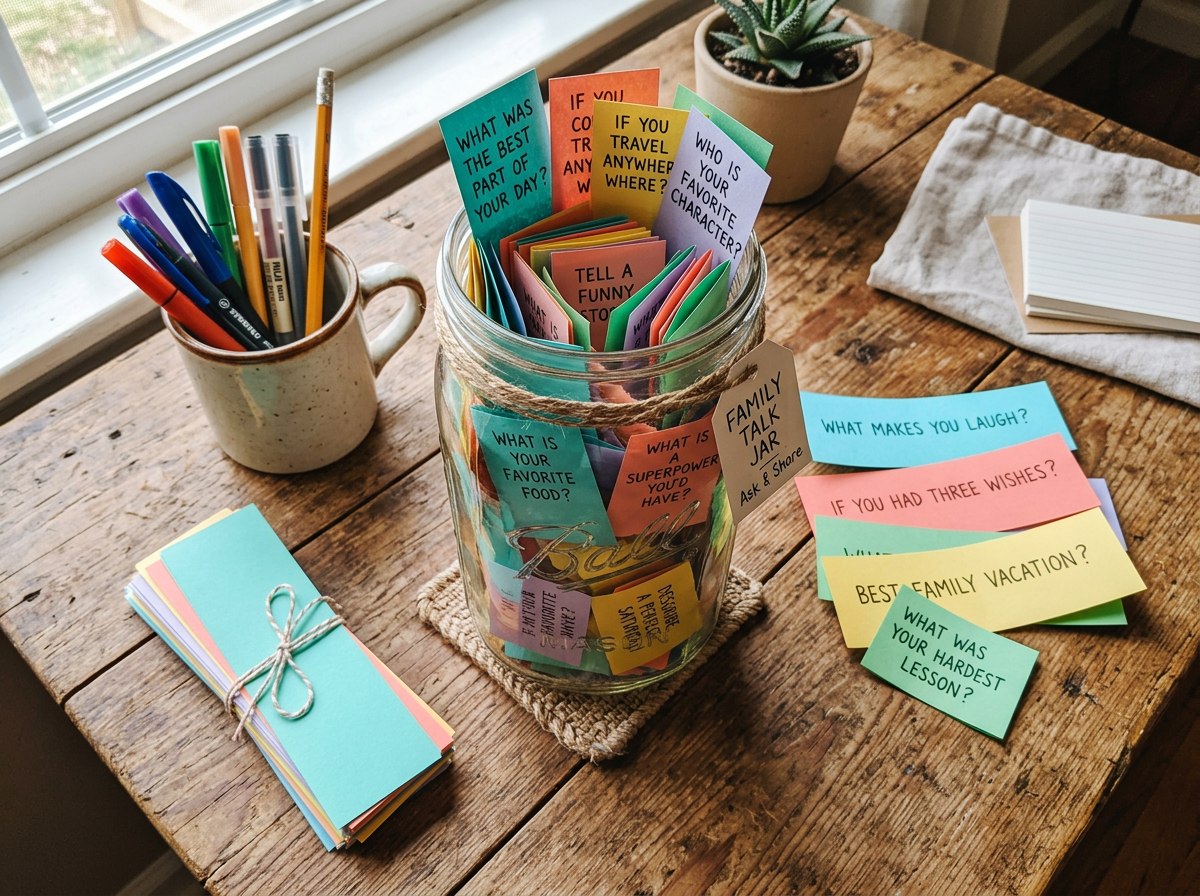
A simple DIY conversation jar can transform your family dinners
Two Truths and a Wish
A family-friendly twist on the classic party game. Each person shares:
- One true thing that happened today
- One true thing about themselves
- One wish they have
This variation reveals hopes and dreams while practicing vulnerability and active listening as family members guess which statement is the wish.
High-Low-Buffalo
Share three things each night:
- High: Your best moment or something that went well
- Low: Something challenging or disappointing
- Buffalo: Something you’re looking forward to (buffalo = "buffalo head down, charging forward")
This ritual creates space for the full range of emotions—positive, negative, and anticipatory—normalizing the fact that all days contain mixtures of experiences.
Conversation Jar DIY
Create a tangible system for dinner table conversation starters:
- Get a mason jar or decorative container
- Cut colorful paper into strips
- Have each family member write 5-10 conversation starters
- Draw one slip each night at dinner
- Involve kids in creating and decorating the jar
The tactile experience of drawing a slip creates anticipation and ownership. When kids create questions themselves, they’re more invested in the answers.
Story Building
One person starts a collaborative story with exactly three words. Each person adds three words, building around the table. The results are often hilarious, creativity-sparking, and reveal each person’s personality through how they advance the narrative.
Example progression:
- Person 1: "The giant cat…"
- Person 2: "…decided to visit…"
- Person 3: "…the moon because…"
- Person 4: "…he wanted to…"
This game builds collaboration, creativity, and listening skills—everyone must pay attention to continue the story coherently.
Rose, Thorn, Bud
Similar to High-Low-Buffalo but with nature imagery that resonates with many families:
- Rose: Something beautiful or positive from your day
- Thorn: something prickly or challenging
- Bud: something with potential that’s developing
This variation particularly resonates with children who understand gardens and growth.
Theme Nights
Create predictability while maintaining variety:
- Monday Memories: Share a favorite family memory
- Tuesday Travel Dreams: Where would you go and why?
- Wednesday Would-You-Rather: Classic imaginative questions
- Thursday Thankfulness: Gratitude-focused conversation starters
- Friday Funny: Share the funniest thing that happened this week
Themes reduce decision fatigue—everyone knows what’s coming while keeping conversations fresh.
Overcoming Scheduling Challenges: Making Family Dinner Happen
The research on family dinner benefits is compelling, but the reality of modern family life can make shared meals feel impossible. The data validates this struggle: 29% of families eat together every night, 23% manage 4-6 nights, and 16% pull off 2-3 nights. You’re not alone in finding this challenging.
Among families who find shared meals difficult, 65% cite scheduling as the biggest obstacle. Between work commitments, children’s activities, and the general chaos of managing multiple schedules, dinner often becomes an afterthought rather than a priority.
The Weeknight Drop-Off Reality
Cooking patterns reveal a predictable challenge: 60% of households cook Sunday and Monday, but only 50% are still cooking by Friday night. The week begins with good intentions and energy but devolves into takeout, eating on the run, or scattered schedules as exhaustion accumulates.
Solutions for this pattern include:
- Weekend meal prep that makes weeknight assembly fast
- Flexible "dinner" times—some families share late-afternoon snacks or evening snacks together when early dinners aren’t feasible
- Accepting imperfection—3-4 nights per week of quality shared meals beats 7 nights of stressed, rushed meals
Alternative Meal Times
Dinner isn’t the only option for meaningful family meals:
Breakfast conversations: Even 15 minutes of morning connection over cereal or toast can incorporate dinner table conversation starters. Many families find mornings less rushed than evenings.
Weekend brunch: When weeknight chaos prevents dinner, designate weekend meals for deeper conversation. Saturday morning pancakes with conversation starters can become a cherished ritual.
"Threshold time" conversations: The 15 minutes after school or work, before dinner prep begins, sometimes offers easier connection than the dinner hour. Parents and children are transitioning between worlds and often more willing to share.
Quality Over Quantity
Research shows that shared meals matter more than long meals. Twenty minutes of genuine, device-free connection beats an hour of distracted co-presence where everyone is physically together but mentally elsewhere.
The critical elements aren’t duration or gourmet food—they’re:
- Consistency: The predictability of regular shared meals
- Presence: Being genuinely engaged rather than distracted
- Conversation: Meaningful interaction through dinner table conversation starters
Practical Implementation Tips
- Schedule dinner like any other important commitment and protect it fiercely
- Communicate the "why" to family members so they understand the value beyond nutrition
- Start small—commit to 2-3 nights per week rather than an unsustainable 7
- Use conversation cards or apps to reduce the mental load of coming up with questions
- Involve kids in prep—they’re more invested in meals they helped create
Remember: 84% of adults say they wish they could eat more meals with others. Your efforts to prioritize shared meals are building something genuinely valuable, even when logistics make it challenging.
Digital Conversation Tools: From Jars to Apps
While DIY conversation jars offer charm and tangible engagement, digital solutions provide advantages that modern busy families increasingly rely on. The evolution from physical conversation cards to mobile apps represents more than convenience—it’s about meeting families where they are with tools that fit their reality.
The Physical Conversation Jar Approach
Traditional conversation starter jars offer tangible benefits:
Pros:
- Hands-on, tactile experience that children enjoy
- Customizable with family-specific questions
- One-time cost (mason jar + paper slips)
- No screens required during dinner
Cons:
- Limited to questions you’ve written or found elsewhere
- Repetition becomes inevitable over time
- Requires ongoing maintenance to refresh content
- Not accessible when eating out or traveling
- Easy to forget or leave behind
The Rise of Conversation Cards Apps
Digital conversation starter platforms have emerged to address these limitations, offering advantages that physical products can’t match:
Access and variety: Apps like Convo Cards provide hundreds of dinner table conversation starters across themed categories—far more than any physical jar could hold. When one question falls flat, another is immediately available.
Categorization: Digital platforms organize conversation starters by occasion, age group, topic, and mood. You can filter for "tweens," "gratitude," "family bonding," or "deep thinking" depending on your needs that evening.
Progress tracking: Some apps track which questions you’ve used, favorite those that sparked great conversations, and suggest similar conversation starters based on what works for your family.
Always accessible: Mobile apps work anywhere—at home, at restaurants, on road trips, waiting for appointments—providing conversation starters whenever connection opportunities arise.
Cost Comparison: Physical vs. Digital Solutions
| Option | Initial Cost | Long-term Cost | Content Variety | Accessibility |
|---|---|---|---|---|
| DIY Conversation Jar | $5-15 (jar + paper) | Free (time investment) | Limited by your creativity | Home only |
| Physical Card Sets | $20-30 (one-time) | $0 | Fixed set (50-200 cards) | Must remember to bring |
| Premium Conversation Apps | $18-70/year | Subscription fee | Updated regularly | Always in pocket |
| Convo Cards | Free tier available | $4.99/year premium | 18+ themed packs, updates | Any device, anywhere |
The digital advantage becomes clear when considering content volume and flexibility. Physical card sets offer a fixed experience—once you’ve worked through the deck, there’s nothing new. Digital platforms provide regular content updates, with premium members often getting early access to new question packs.
The Hybrid Approach
Many families successfully combine both methods:
- Start with DIY: Create a conversation jar together as a family activity
- Observe what works: Note which conversation starters spark the best discussions
- Upgrade strategically: Add an app for variety, travel, and themed content
- Customize based on age: As children grow, their conversation starter needs evolve—apps make this adaptation seamless
Why Digital Works for Busy Families
Modern families need conversation tools that:
- Require zero prep time (no writing questions on slips after exhausted days)
- Work in multiple settings (home, restaurants, road trips, waiting rooms)
- Accommodate different ages (questions that work for both 7-year-olds and 17-year-olds)
- Prevent repetition (endless variety so conversations stay fresh)
- Fit seamlessly into life (always in your pocket, nothing to remember or pack)
Digital conversation starters check all these boxes, explaining their growing popularity among families seeking consistent connection without adding complexity to already-full lives.
Creating Your Family’s Unique Dinner Conversation Tradition
The most effective dinner table conversation starters aren’t universal—they’re personalized to your family’s communication style, values, and culture. Creating a sustainable ritual requires assessment, experimentation, and adaptation.
Assess Your Family’s Communication Style
Every family has a conversational personality. Matching dinner table conversation starters to your natural style increases success:
The Jokesters: If your family bonds through humor, lean into funny prompts, "would you rather" scenarios, and lighthearted questions. Laughter creates connection, even if deep topics emerge less frequently.
The Deep Thinkers: Some families naturally gravitate toward philosophical discussions, ethical dilemmas, and future-focused questions. These families thrive on conversation starters that invite analysis and perspective-sharing.
The Storytellers: If your family shares history through anecdotes, focus on memory-based questions like "What’s your favorite childhood vacation memory?" or "Tell me about a time when…"
The Debaters: Families that enjoy intellectual engagement might prefer opinion-based questions, hypothetical scenarios, and topics that invite respectful disagreement and discussion.
There’s no wrong style—only what works for your particular family dynamic.
Start Small: The Two-Week Trial
Habit research shows that specific triggers and realistic commitments lead to faster behavior change. Rather than overhauling every dinner immediately:
- Choose 3-5 conversation starters from this post that feel right for your family
- Commit to two weeks of using them at shared meals
- Assign a "conversation starter" role to a different family member each night
- Debrief weekly: What worked? What fell flat? What should we try next?
This small, time-bound approach reduces pressure and allows for iteration.
Build Ownership Through Participation
Children and teens are more invested in conversation starters they help create:
- Let kids take turns choosing or creating dinner table conversation starters
- Create family-specific questions like "What’s your favorite Watson family memory?" or "What do you love most about our Sunday pancake tradition?"
- Rotate facilitation so different people lead the conversation each night
- Celebrate wins explicitly: "That was such a great conversation about X. I loved hearing everyone’s thoughts."
When conversation is a shared endeavor rather than a parent-driven activity, resistance decreases and engagement increases.
Adapt and Evolve
Conversation starters that worked beautifully with 8-year-olds will fall flat with 14-year-olds. Families must evolve their approach as children grow:
| Age Range | Conversation Focus | Example Starters |
|---|---|---|
| Ages 5-8 | Concrete, imagination, feelings | "What made you smile today?" |
| Ages 9-12 | Friendship, school, growing up | "What’s something you’re good at that most people don’t know?" |
| Ages 13-17 | Values, opinions, future | "What’s one thing you’d change about the world if you could?" |
| Adults | Reflection, connection, meaning | "What’s something you learned about yourself this year?" |
The most successful dinner table conversation traditions aren’t static—they grow with the family.
Building a Lasting Family Dinner Ritual: Your Action Plan
The research is clear, the benefits are compelling, and the tools are accessible. The question becomes: Will you transform dinner from obligation into opportunity?
Let’s recap what the science tells us about dinner table conversation starters:
- Meal sharing predicts well-being as strongly as income and employment, according to the 2025 World Happiness Report
- Social meals stimulate bonding neurochemicals—endorphins, oxytocin, and dopamine—creating genuine biological connection
- Regular family dinners correlate with lower rates of depression, anxiety, substance abuse, and multiple problem behaviors
- 91% of parents report their families are less stressed when they eat meals together
- 80% of teenagers say dinner is their prime conversation time with parents
- Countries with frequent shared meals (11+ weekly) show stronger social support and lower loneliness
These aren’t just nice-to-have benefits—they’re fundamental to family well-being and children’s long-term mental health.
Your Next Step: Choose Your Approach
Option 1: Start Tonight (Free)
Choose 2-3 conversation starters from this post and try them at your next family meal. No prep, no cost, just commit to asking one specific, open-ended question instead of "How was your day?"
Option 2: Create a DIY System (Low Cost)
Make a conversation jar this weekend. Involve the family in writing questions on paper slips. Decorate a mason jar together. Draw one question at each dinner.
Option 3: Go Digital (Convenience)
Try a conversation cards app that offers themed question packs, favorites tracking, and hundreds of dinner table conversation starters. Many offer free tiers so you can test before committing.
The Long-Term Payoff
Research shows that teens who eat regular family dinners have better mental health outcomes for years to come—even after they leave home. The conversation habits you build now become the foundation for lifelong relationship skills.
Your invitation to join thousands of families transforming dinner time doesn’t require perfection. Countries with frequent shared meals (11+ per week) see real benefits—and every meal together is a win, even when conversations are awkward or interrupted.
Tonight’s Question
Try this one question at dinner tonight and see what unfolds:
"What’s something you learned today that surprised you?"
Listen fully to the answers. Follow up with genuine curiosity. Notice how the energy shifts when everyone knows their thoughts truly matter.
Then, do it again tomorrow. And the next day. Build the ritual, one conversation starter at a time.
The table is set. The research is clear. The only missing ingredient is you.
Leave a Reply