Conversation Starter Games for Adults Who Hate Small Talk
You’re sitting at a dinner party, surrounded by people, yet the conversation has stalled somewhere between "How’s work?" and "Nice weather we’re having." The silence stretches. Someone checks their phone. Everyone feels it—the distinct discomfort of surface-level chatter that goes nowhere. If you’ve ever found yourself in this moment, wishing for a way to bypass the awkwardness and connect meaningfully, you’re not alone. The science confirms what we’ve all felt: small talk isn’t just boring—it’s actually making us less happy.
Why Small Talk Makes Us Miserable: The Surprising Science
Groundbreaking research reveals that the quality of our conversations directly impacts our well-being. A 2010 study in the journal Psychological Science found that the higher the percentage of conversation that is small talk, the lower the participants’ well-being, whereas the higher the percentage of substantive conversation, the higher their well-being. The researchers discovered that people who engaged in more meaningful conversations reported higher levels of happiness and life satisfaction, while those stuck in small talk experienced the opposite effect.

We’ve all been here: the painful silence when small talk runs its course
"A 2010 study in the journal Psychological Science found that the higher the percentage of conversation that is small talk, the lower the participants’ well-being, whereas the higher the percentage of substantive conversation, the higher their well-being."
Yet we persist in small talk, largely due to a fundamental misunderstanding of how well we know each other. Psychology research reveals an "illusion of understanding" phenomenon: people believe they comprehend others 85% of the time, but actual understanding is only 44%. This gap means we often assume our conversations are adequate when they’re actually scratching the surface.
Charles Duhigg, author of Supercommunicators, has spent years analyzing what makes conversations connect. His research identifies a crucial pattern: the most effective conversation starters ask about feelings and values rather than facts, followed by genuine follow-up questions.
"If you want to be good at making small talk and forging deeper connections, ask people to describe how they feel about their life rather than the facts of their life, and then ask lots of follow-ups."
The stakes are higher than mere social awkwardness. Stanford research confirms that social connection leads to a 50% increased chance of longevity, strengthens the immune system, helps recover from disease faster, and reduces inflammation. Our conversation habits aren’t just social niceties—they’re health behaviors.
The Post-Pandemic Conversation Revolution: Why Everyone’s Seeking Deeper Connections
The cultural landscape shifted dramatically in recent years, with meaningful connection becoming a priority for millions. Pinterest data captures this transformation: searches for "deep conversation starters" have risen 185% on the platform since 2022. "Questions for couples to reconnect" was up 480% while "hot seat questions" saw an 825% increase.
"According to Pinterest, searches for ‘deep conversation starters’ have risen 185% on the platform since 2022. ‘Questions for couples to reconnect’ was up 480% while ‘hot seat questions’ saw an 825% increase."
This surge isn’t merely a social media trend. In 2023, the US Surgeon General declared loneliness a national epidemic, comparable in health impact to tobacco use and obesity. The pandemic forced millions into isolation, but it also transformed our relationship with vulnerability. Post-pandemic, people report greater comfort discussing mental health, personal challenges, and authentic experiences—creating unprecedented appetite for conversation starters that facilitate genuine connection.
Conversation card games have proliferated as a response. Dinner party hosts now routinely break out curated decks alongside appetizers. Friends gather specifically for "card nights" focused on deep dialogue rather than strategy games. The market has exploded with options ranging from couples-focused intimacy builders to team-building workplace tools.
Conversation Starter Games That Transform Awkward Gatherings
Structured conversation games provide the psychological safety many adults need to bypass small talk. The game format gives permission to be vulnerable—everyone’s playing by the same rules, reducing the social pressure of asking deep questions spontaneously.

The difference a conversation game can make: genuine engagement and connection
Classic conversation games that work reliably:
- Two Truths and a Lie: Reveals surprising facts while inviting curiosity and detective work
- Would You Rather: Explores values and priorities through hypothetical choices
- Ten Things in Common: Builds connection through shared discoveries
- Never Have I Ever: Creates opportunities for storytelling and vulnerability
- Hot Seat Variations: Progressive questioning that deepens naturally
Modern card games have refined these concepts into sophisticated tools for connection. We’re Not Really Strangers uses progressive levels of intimacy, guiding groups from reflection to connection to meaningful questions. Let’s Get Deep offers relationship-focused prompts for couples. Esther Perel’s Where Should We Begin brings a therapist’s insight to game night, with questions designed by a renowned relationship expert.
The key innovation in contemporary conversation cards is depth progression. Rather than diving immediately into heavy topics, well-designed games ease participants deeper naturally. Each question builds trust for the next, creating momentum toward authentic dialogue.
Icebreaker Questions That Actually Work (Without Being Cringe)
The difference between effective conversation starters and cringe-worthy icebreakers comes down to psychology. Dr. Andrea Bonior, psychologist and author of Doomsday Parenting, explains that the best questions create comfort without judgment.
"You want open-ended questions that make people feel comfortable and excited to share, but not judged or put on the spot. And if it’s right for the vibe, it doesn’t hurt to give people opportunities to be a bit—but not overly—vulnerable."
Effective icebreaker questions share several characteristics:
They offer choice in vulnerability levels: "What’s something that made you smile this week?" allows for light answers or deeper sharing, depending on comfort.
They invite feelings, not just facts: Instead of "What do you do for work?", try "What’s the most rewarding part of your work?" or "If you could switch careers tomorrow, what would you choose?"
They connect to universal experiences: "What’s a tradition from your childhood you’ve carried into adulthood?" taps into family dynamics and personal history most people enjoy exploring.
They avoid therapeutic territory: Social gatherings aren’t therapy sessions. Questions about mental health challenges or family trauma can backfire in group settings, no matter how well-intentioned.
Examples of conversation starters that work across settings:
- "What’s something you’ve changed your mind about in the last few years?"
- "What’s the best piece of advice you’ve ever received?"
- "What’s a skill you’d love to master if time weren’t a factor?"
- "What’s a small risk that paid off for you in a big way?"
- "What’s something you used to believe that you now think is completely wrong?"
Matching Conversation Games to Your Social Setting
One-size-fits-all approaches fail with conversation starters. The right game or question pack depends entirely on context, group familiarity, and gathering purpose.
Casual Friend Hangouts and New Groups
Lighter, fun-focused games work best when people are just getting to know each other. High-energy options like Two Truths and a Lie or fast-paced Would You Rather keep things moving without demanding vulnerability. The goal is breaking the ice, not breaking down walls.
Established Friend Groups and Dinner Parties
Here’s where deeper question packs shine. Groups with existing trust can handle more substantive conversation starters. Consider themes like "life transitions," "values and beliefs," or "future dreams and fears." Progressive depth cards work especially well—start with lighter questions over appetizers and move deeper as the evening progresses.
Team Building and Professional Settings
Workplace conversation starters need to balance personal connection with professional boundaries. Focus on shared experiences rather than personal challenges. Effective prompts include:
- "What’s a project you’ve worked on that you’re genuinely proud of?"
- "What’s something about your work style that surprised your colleagues?"
- "What’s the best collaboration you’ve experienced in your career?"
Digital platforms like Convo Cards offer team-building specific packs designed for professional contexts, with questions that build camaraderie without crossing into inappropriate territory.
Couples and Date Nights
Relationship-focused conversation cards can transform date nights from routine to revelatory. Couples-specific packs like those from Esther Perel or Couply guide partners through topics they might never raise spontaneously: childhood memories, relationship expectations, fears and dreams, appreciation and gratitude.
Family Gatherings
Multi-generational settings require questions accessible to everyone from teens to grandparents. Focus on shared history and universal experiences:
- "What’s your favorite family tradition and why?"
- "What’s a piece of family history everyone should know?"
- "What’s something you’ve learned from another family member that changed how you see things?"
The Health Benefits of Choosing Deeper Conversations
The case for moving beyond small talk extends beyond social satisfaction. Stanford’s Center for Compassion and Altruism Research and Education (CCARE) has documented compelling connections between social conversation and physical health.
"Social connection is a pillar of lifestyle medicine. Humans are wired to connect, and this connection affects our health. [It] leads to a 50% increased chance of longevity, strengthens your immune system, [and] helps you recover from disease faster."
The research reveals specific mechanisms at work:
Immune system strengthening: Quality social interactions boost immune function, making the body more resistant to illness and infection.
Inflammation reduction: Chronic loneliness contributes to systemic inflammation, a risk factor for numerous diseases. Meaningful conversation and connection counteract this effect.
Faster disease recovery: Patients with strong social connections and support networks recover from illness and surgery more quickly than isolated individuals.
Longevity impact: The 50% increased longevity associated with social connection rivals well-established health behaviors like exercise and nutrition.
Conversation games aren’t merely entertainment—they’re accessible tools for building the social connections that demonstrably improve health outcomes. Regular use of conversation starters can create routine opportunities for the substantive interactions that research links to better physical and mental health.
Digital Conversation Cards vs. Physical Decks: What Works Best?
The conversation starter market has bifurcated into digital platforms and physical card decks, each offering distinct advantages.
Digital Conversation Platforms
Advantages:
- Instant accessibility: Web-based platforms like Convo Cards require no app downloads—access from any device browser
- Variety and breadth: Digital platforms offer 18+ themed packs covering every occasion from date night to team building
- Cost effectiveness: Premium access typically runs $4.99/year versus $20-30 for physical decks
- Portability: Your entire conversation library lives in your pocket, available anytime
- Progress tracking: Apps like Convo Cards save favorites and track used questions
- Regular updates: Digital platforms add new content, with premium members getting early access
Considerations:
- Screen time during gatherings can feel antithetical to connection
- Digital interfaces may be less intuitive for passing around groups
- Battery dependence creates vulnerability
Physical Card Decks
Advantages:
- Tactile experience: The physical act of drawing cards adds ritual and anticipation
- Screen-free socializing: No devices at the table maintains presence
- Group accessibility: Easier to pass around without technical barriers
- Aesthetic appeal: Many physical decks feature beautiful design elements
Considerations:
- Higher cost per deck ($20-30 for single-purpose sets)
- Limited variety—most physical decks serve one specific occasion
- Portability challenges—requires remembering to bring the deck
- Static content—no updates or new question additions
Hybrid approaches often work best: Use digital platforms for exploration and discovery, then invest in 1-2 favorite physical decks for occasions when screen-free socializing is a priority.
Building Your Conversation Starter Toolkit: Go-To Resources
Creating your personalized conversation game collection doesn’t require a significant investment. Strategic building based on your social patterns ensures you’ll have the right tools for any gathering.
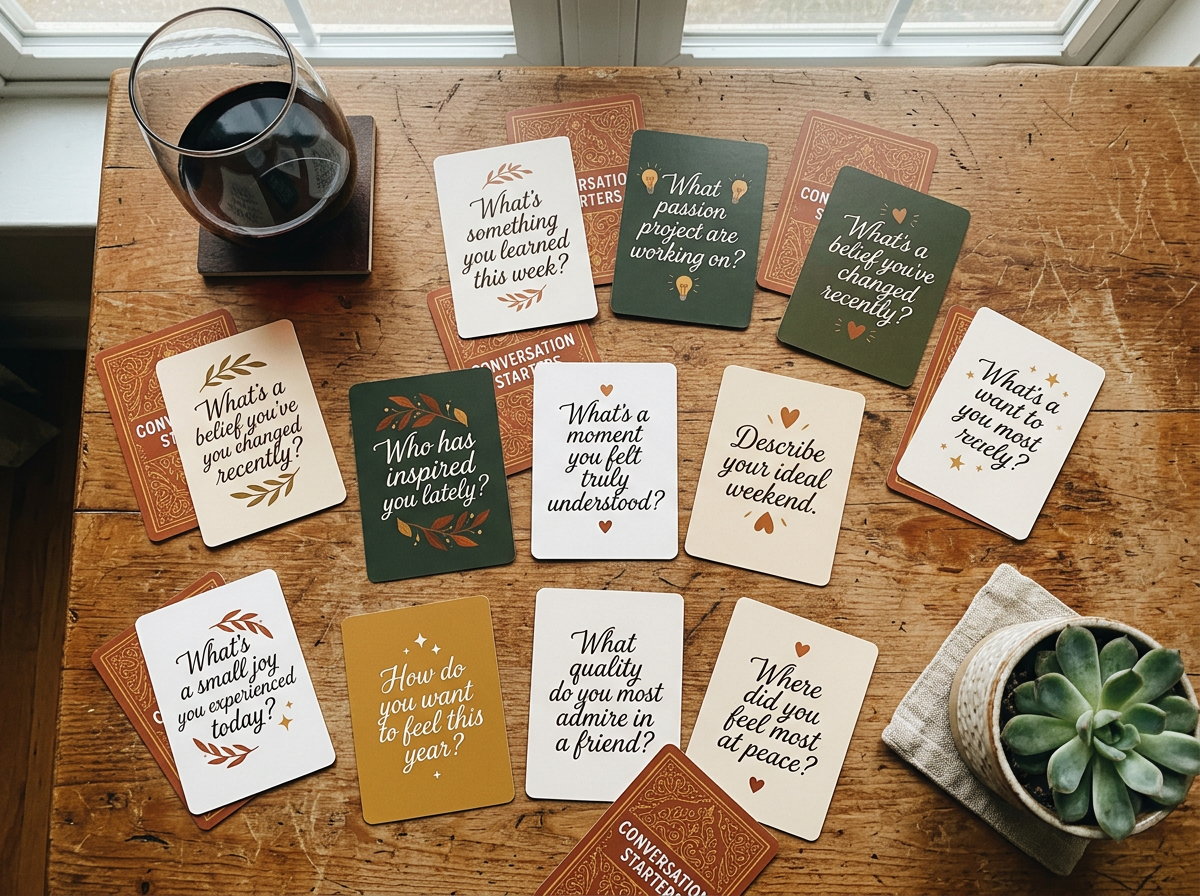
Physical conversation cards can transform your gatherings from awkward to authentic
Start with freemium digital platforms: Apps like Convo Cards offer free basic access that lets you explore different themes and question styles before committing financially. Test question packs with your friend group, family, or team to see what resonates before upgrading to premium features.
Invest strategically in physical decks: After discovering which themes your group enjoys most, purchase 1-2 high-quality physical decks for occasions when you want a tangible, screen-free experience. Choose versatile decks that work across multiple situations rather than highly specialized single-use sets.
Create custom questions: The best conversation starters often come from your own group dynamics. Keep notes on which prompts generate the most engaging discussions, then create your own variations. Digital platforms with favorites and progress tracking make this easier by showing you which questions return to again and again.
Build by occasion: Differentiate your toolkit by social context:
| Occasion | Digital Advantage | Physical Advantage |
|---|---|---|
| Casual hangouts | Quick access from phone, no prep needed | Group ritual of passing cards around |
| Date nights | Intimate, private browsing with partner | Special occasion feel, screen-free focus |
| Team building | Professional themes, easy to share via screen | Tangible activity for in-person workshops |
| Family gatherings | Age-appropriate filters, broad variety | Generational bridge, nostalgic appeal |
Expert Tips for Natural Conversations Beyond the Cards
Conversation games serve as excellent training wheels for deeper social skills, but the goal is developing the ability to engage authentically without props. Communication experts and therapists offer strategies for transitioning from game-based dialogue to spontaneous meaningful conversation.
Master the follow-up question: Charles Duhigg’s research on supercommunicators identifies follow-up questions as the primary differentiator between casual conversation and connection. When someone shares an experience or opinion, resist the urge to pivot to your own story. Instead, ask: "What was that like for you?" or "How did that change your perspective?" or "What surprised you most about that experience?"
Notice what energizes your group: Pay attention to which conversation starters create visible engagement—leaning forward, active listening, spontaneous follow-up questions. Return to those themes organically in future gatherings without needing cards. "You know, I was thinking about what you said last time about [topic]…"
Read comfort levels in real-time: Not every conversation starter lands perfectly with every group. Watch for crossed arms, delayed responses, or attempts to change the subject. Similarly, notice when energy rises—people sharing more than asked for, spontaneous laughter, genuine curiosity about others’ answers. Use these signals to calibrate when to push deeper or when to pull back to safer territory.
Build the deep conversation muscle: Like any skill, meaningful conversation takes practice. Regular use of conversation games reduces social anxiety and builds confidence in authentic engagement. Over time, you’ll develop intuition for which questions work in which contexts, making spontaneous deeper dialogue feel more natural and less risky.
The ultimate goal isn’t perfect conversation—it’s authentic connection. Conversation starter games are simply tools for creating opportunities to be seen and known by others. Used wisely, they help us move past the exhausting small talk that drains our social energy and into the substantive dialogues that sustain us.
Conclusion
The research is clear: conversation starters aren’t just social lubricants—they’re pathways to better health, deeper relationships, and increased happiness. As we navigate a post-pandemic world hungry for connection, the tools we choose matter. Whether through digital platforms like Convo Cards, beautifully designed physical decks, or simply the courage to ask better questions, the opportunity to transform our conversations is always available.
The next time you find yourself trapped in small talk’s awkward silences, remember: deeper dialogue isn’t just possible—it’s what we’re wired for. The right conversation starters are simply the bridge from where we are to where we could be: seen, heard, and genuinely connected.
Leave a Reply