Category: Uncategorized

  • Make Better Social Connections Your New Year Resolution

    Make Better Social Connections Your New Year Resolution

    Make Better Social Connections Your New Year Resolution

    91% of New Year’s resolutions fail. Only 9% of Americans who set them keep their commitments through the entire year, and the average resolution lasts just 3.74 months. Yet every January, millions of people pledge to lose weight, save money, and hit the gym, while the single strongest predictor of their happiness sits neglected on the back burner. The 85-year Harvard Study of Adult Development found that positive relationships, not fitness or finances, are the most consistent driver of a long, healthy, fulfilling life. This post makes the case for a different kind of resolution in 2026: a commitment to deeper conversations and stronger connections with the people who matter most.

    Two friends sharing a meaningful conversation at a cozy coffee shop, leaning in attentively with warm smiles
    Meaningful conversations don’t happen by accident — they require intention and the right prompts.

    Why your New Year resolution should be about social connection, not just fitness

    About 79% of New Year’s resolutions focus on health improvement. "Spend more time with loved ones" consistently ranks among the top goals Americans set each January, but it gets treated as a secondary priority, something to squeeze in around the gym sessions and budget spreadsheets. The research says we have that backwards.

    The Harvard Study of Adult Development, which has tracked hundreds of lives since 1938, found that satisfaction with relationships at age 50 predicted physical health at age 80 better than cholesterol levels. The study’s directors, Robert Waldinger and Marc Schulz, introduced the concept of "social fitness": the idea that relationships, like physical fitness, need regular intentional exercise. You would not expect to stay in shape without working out. The same applies to your connections with other people.

    This is where relationship building questions come in. A resolution to have one meaningful conversation per week is specific, measurable, and grounded in decades of research on human well-being. It is also a resolution you are statistically more likely to keep.

    The Harvard discovery: relationships predict health better than cholesterol

    The Harvard Study of Adult Development is the longest-running study of human happiness ever conducted. Over 85 years of data, one finding has appeared more consistently than any other:

    "The most consistent finding we’ve learned through 85 years of study is: Positive relationships keep us happier, healthier, and help us live longer. Period." — Robert Waldinger and Marc Schulz, directors of the Harvard Study of Adult Development, via CNBC

    This is not a soft, feel-good conclusion. The data showed that relationship satisfaction at age 50 predicted who would be healthy at age 80 more accurately than cholesterol levels, blood pressure, or any other medical marker the researchers tracked. Social isolation raises the risk of heart disease by 29% and stroke by 32%.

    The U.S. Surgeon General took the rare step of issuing a formal public health advisory on loneliness in 2023, declaring it an epidemic. Approximately half of U.S. adults experience measurable loneliness, and its mortality impact is comparable to smoking 15 cigarettes per day. As Waldinger put it in the Harvard Gazette:

    "Loneliness kills. It’s as powerful as smoking or alcoholism."

    The American Psychological Association reinforced this concern in its 2025 Stress in America report, subtitled "A Crisis of Connection." The findings were stark: more than half of respondents reported experiencing loneliness daily, 70% said their closest relationships do not provide enough emotional support, and 94% of highly lonely adults reported physical stress symptoms. Yet 92% agreed that relationships are their primary source of meaning and purpose.

    The gap between how much people value relationships and how well they tend to them is the exact gap that conversation starters are designed to fill.

    Why conversation goals beat typical resolutions (and actually stick)

    The psychology of goal-setting explains why most resolutions collapse by February. Research from Drive Research found that 62% of resolution-makers feel pressured to set them, and externally pressured goals have significantly lower success rates. When you resolve to go to the gym because everyone else is doing it, you are starting from a place of obligation, not desire.

    Self-Determination Theory, one of the most thoroughly researched frameworks in motivational psychology, identifies three psychological needs that drive sustained behavior change: autonomy (choosing the goal freely), competence (feeling capable of making progress), and relatedness (feeling connected to others). Conversation-based goals satisfy all three naturally. You choose who to talk to and what to ask. You can see and feel progress almost immediately. And the activity itself builds connection.

    There is also a structural advantage. A study published in PLOS ONE found that approach-oriented goals succeed at a rate of 58.9% after one year, compared to 47.1% for avoidance goals. "Have one meaningful conversation per week" is an approach goal. It asks you to do something. "Stop eating junk food" is an avoidance goal. It asks you to resist something. The difference matters.

    The biggest advantage may be timing. Fitness and diet goals deliver rewards slowly, which is why people quit. Conversation goals deliver warmth, enjoyment, and a sense of belonging right away. You leave a good conversation feeling better than when you started, and that immediate reward reinforces the habit.

    The 36 questions principle: why structured prompts build real closeness

    Using conversation starters to deepen relationships is not just a nice idea. It has decades of clinical research behind it.

    A couple having an intimate deep conversation on a cozy sofa in warm evening light, fully engaged with each other
    Structured prompts like the 36 Questions principle create the kind of closeness small talk never will.

    Psychologist Arthur Aron demonstrated in a now-famous 1997 study that structured, escalating self-disclosure through guided questions builds genuine interpersonal closeness between strangers in under an hour. His 36 Questions study proved that mutual vulnerability, shared gradually through back-and-forth personal questions, is the mechanism that creates deeper bonds. Small talk does not do this. Reciting facts about your week does not do this. Deliberate, progressive self-disclosure does.

    The Gottman Institute, founded by relationship researchers John and Julie Gottman, found similar patterns in long-term couples. Couples who regularly update what the Gottmans call "Love Maps," a detailed knowledge of their partner’s inner world, have stronger emotional bonds and more stable relationships. Communication rituals, meaning regular, structured conversation habits, are among the strongest predictors of long-term relationship satisfaction.

    This body of research validates why curated deep conversation starters outperform unstructured chatting. When you sit down with your partner or a friend and ask a question designed to surface something real, you are following the same proven mechanism that Aron used in his lab. The structure does the heavy lifting. You just have to show up and answer honestly.

    Month-by-month conversation challenges for deeper relationships

    A year-long resolution needs structure to survive past January. The following plan breaks the year into four themed quarters, each focused on a different set of relationships and gradually escalating in depth. The principle comes from Aron’s research: start accessible, build gradually, and let each conversation create momentum for the next.

    January through March: Foundation months

    Focus on your closest relationship, whether that is a partner, spouse, or best friend. Use couples conversation starters to revisit shared memories, talk about what you appreciate in each other, and dream about the year ahead. Sample questions: "What is a moment from last year that you think about more than you expected?" and "What is something you want us to do together that we have never tried?"

    April through June: Family deepening months

    Bring deep conversation starters to family dinners. Explore intergenerational stories that you have never asked about. Questions like "What was the hardest decision you had to make as a parent?" or "What did you want to be when you were my age?" can open conversations that have been waiting decades to happen.

    July through September: Friendship months

    Move friend hangouts past the surface. After the usual catching up, introduce a question that reveals something new: "What is something you are afraid to admit right now?" or "When was the last time you changed your mind about something important?"

    October through December: Reflection and reconnection

    Revisit the conversations from earlier in the year. What did you learn? What surprised you? Set intentions for the next cycle. These months are about consolidating the gains and recognizing how the relationships in your life have shifted.

    A diverse group of family and friends gathered around a dinner table sharing an animated, joyful conversation
    From family dinners to friend hangouts — one connection resolution covers every relationship in your life.

    Each month’s challenge follows the Aron principle of progressive self-disclosure. The questions start accessible and gradually invite more vulnerability. Convo Cards offers 18+ themed question packs organized by occasion and topic, so you always have prompts ready for any monthly challenge without needing to prepare them yourself.

    Weekly check-in routines: couples conversation starters that work

    Consistency beats intensity. A 15-minute weekly conversation with your partner will do more for your relationship than a single two-hour deep dive every few months. The Gottman Institute’s research on communication rituals supports this: regularity matters more than depth per session.

    Here is a simple weekly check-in framework:

    1. Pick one night. Same night every week. Make it non-negotiable.
    2. Set a timer for 15 to 20 minutes. No phones, no television, no distractions.
    3. Use rotating prompts. Mix categories so the conversations stay fresh.

    Sample couples conversation starters for weekly check-ins:

    • "What drained you this week?"
    • "When did you feel most connected to me?"
    • "What is something I do not know about your inner world right now?"
    • "What are you looking forward to next week?"
    • "Is there anything you need from me that you have not asked for?"

    Rotating through gratitude, dreams, challenges, and intimacy categories keeps the check-ins comprehensive. Each session updates your Love Maps, giving you a current picture of where your partner is emotionally and mentally.

    Convo Cards’ favorites feature lets you save the questions that sparked the best conversations, so you can build a personalized library over time and revisit the ones that mattered most.

    Beyond couples: deep conversation starters for family, friends, and teams

    A conversation resolution is not just for romantic relationships. The same principles work across every connection in your life.

    Family dinners

    Replace "How was school?" with questions that invite a real answer: "What is something that surprised you this week?" or "When did you feel proud of yourself?" Children and teenagers open up when the question is specific and genuinely curious, not a reflexive interrogation.

    Friend group hangouts

    Most friend groups default to the same topics every time they meet. Deep conversation starters about values, life transitions, and shared history can surface things you never knew about people you have known for years. Try: "What is something you have been thinking about but have not said out loud yet?"

    Team building

    Google’s Project Aristotle found that psychological safety, meaning team members feel safe being vulnerable with each other, is the single strongest predictor of team performance. Structured prompts build that trust. A team offsite that includes intentional conversation questions creates connections that carry back into daily work.

    One resolution covers all of these relationships simultaneously. Convo Cards’ multi-occasion question packs mean you are prepared for a date night, a family dinner, a friend hangout, or a team offsite without buying four different products or downloading multiple apps.

    How to track your relationship growth all year long

    Habit tracking significantly improves goal adherence. This is well-established in behavioral research, and it applies to social fitness the same way it applies to physical fitness. The reason most resolutions die in February is that people have no system for seeing their own progress.

    What to track

    • Conversations had (aim for three meaningful ones per week)
    • New things you learned about the people in your life
    • Moments of vulnerability shared
    • Relationship milestones reached (a first real conversation with a parent, a breakthrough with a partner, a reconnection with an old friend)

    When to celebrate

    Check in at months 1, 3, 6, and 12. Look back at what has changed. Did you learn something about your partner that you did not know in January? Did a friendship deepen because you asked a better question? Did a family conversation open a door that had been closed for years?

    Convo Cards lets you save favorites and track which question packs you have explored, creating a visible record of your investment in the people around you. Seeing that record grow is itself a motivator to keep going.

    Start your connection resolution today

    91% of resolutions fail. But conversation-based social connection goals have something most resolutions lack: clinical research behind them, immediate emotional rewards, and a structure that makes progress visible from day one.

    Here is how to start. Open Convo Cards on any device. No account is required to begin, no app download, no onboarding process. Pull up a free question pack and have one meaningful conversation within the next 24 hours. That is the entire first step.

    Start with the free basic question packs. When you are ready for more, unlock all 18+ themed packs for $4.99 per year. That is less than the cost of a single physical card set from most competitors, and it covers every relationship and occasion in your life for the full year.

    The Harvard Study’s directors put it simply:

    "Taking care of your body is important, but tending to your relationships is a form of self-care too. That, I think, is the revelation." — Robert Waldinger, director of the Harvard Study of Adult Development, via Harvard Gazette

    Make 2026 the year you take that seriously. Pick a question. Start a conversation. Let relationship building questions be the resolution you actually keep.


  • How Conversation Starters Defuse Political Tension at Family Dinners

    How Conversation Starters Defuse Political Tension at Family Dinners

    How conversation starters defuse political tension at family dinners

    A 2025 study by the American Psychological Association found that 69% of Americans say their closest relationships don’t provide enough emotional support, and 62% cite societal division as a major stress source. That stress plays out most acutely at family dinners, where people who love each other but disagree on politics gather around the same table. If your family meals have become anxiety-inducing minefields rather than moments of connection, you’re far from alone. The good news is that family conversation starters offer a research-backed way to change the dynamic.

    The political tension epidemic at family dinners

    The numbers from 2025 and 2026 paint a stark picture of what political division is doing to American families.

    A diverse multi-generational family gathered around a wooden dinner table with warm golden lighting, a smartphone displaying a conversation starter app visible in the center of the table
    Family conversation starters create structure that helps tense dinners become moments of genuine connection.

    Pew Research reported in February 2026 that 56% of American adults have stopped talking to someone about political or election news because of something that person said, up sharply from 45% just one year earlier.

    "A rising share of Americans (56%) say they have stopped talking to someone about political or election news, whether in person or online, because of something they said. This is up from 45% who said the same in 2024." — Pew Research Center, February 2026

    The American Psychiatric Association found that 21% of Americans have become estranged from a family member over political disagreements. Twenty-two percent have blocked a family member on social media, and many skip family events entirely to avoid political tension.

    A UC Irvine study published in May 2026 went further: 37% of Americans report having experienced what researchers call a "political breakup," meaning they ended a relationship with a friend or family member over political differences.

    Family dinners that should be sources of warmth and connection have become high-stakes events where one wrong word can trigger an argument. The strategy most families default to, avoiding politics entirely, isn’t working. People are getting lonelier and more isolated, and the spaces where cross-political interaction still happens naturally, mainly family gatherings, are eroding.

    Why raw willpower fails: the science behind structured conversation starters

    Telling yourself to "just not talk about politics" rarely works. The neuroscience and psychology of political conflict explain why, and they also point toward a better approach.

    Professional mediator Seth Izen, writing for WBUR Cognoscenti in May 2026, made an observation that reframes the entire problem:

    "Most conflict, including political conflict, is less about irreconcilable values and more about the inability to feel heard. When people genuinely feel heard, something shifts. The temperature drops. Conversation becomes possible." — Seth Izen, mediator, WBUR Cognoscenti, May 2026

    If the core issue is that people don’t feel heard, then simply avoiding topics doesn’t address the need. People still want to be understood; they just don’t have a productive outlet for it at the dinner table.

    Dr. Joseph Shrand, a psychiatrist writing in Psychology Today, identified a neuroscience-based de-escalation principle that builds on this:

    "The brain cannot sustain anger when it feels respected. Because we all want to feel valuable, and respect leads to value, you always have the opportunity to remind someone of their value." — Dr. Joseph Shrand, M.D., Psychology Today, November 2024

    Structured prompts that demonstrate genuine curiosity naturally signal respect. When you ask someone a thoughtful question and actually listen to the answer, you’re telling them they matter. That interrupts the anger cycle before it can spiral.

    Research published in PMC confirms this isn’t just intuition. Organized conversation frameworks measurably improve polarization metrics and bridging attitudes across the political spectrum. NPR’s reporting on politically divided families found the same thing from a practical standpoint: spouting facts or bombarding family members with articles doesn’t change anyone’s mind. Mutual respect and a genuine desire to understand are the prerequisites for any productive exchange.

    This is exactly what dinner table conversation starters do. They create conditions of curiosity, respect, and structure that neuroscience and mediation research say defuse conflict.

    Setting ground rules before the gathering: a pre-dinner playbook

    Therapists who work with politically divided families consistently recommend one thing: establish ground rules before the gathering, not after tensions have already flared. Once an argument starts, it’s much harder to redirect.

    Here’s a practical playbook you can use:

    1. Agree on a neutral signal. Before the dinner, agree with your family on a word, gesture, or signal that anyone can use to pause or redirect a conversation that’s getting heated. This could be as simple as "let’s take a breather" or a hand gesture everyone recognizes.

    2. Set a shared intention. Make it explicit that the goal of the gathering is connection and understanding, not winning arguments or changing minds. Saying this out loud, ideally before people sit down to eat, sets the tone.

    3. Frame around what you do want to discuss. Instead of just banning certain topics, focus on meaningful conversation topics that unite rather than divide. Ask what people want to talk about: memories, travel, books, dreams, hobbies.

    4. Introduce a conversation tool as a shared activity. Bring a deck of conversation cards or pull up a digital conversation starter platform on your phone. When everyone agrees to participate in advance, the tool becomes a collaborative activity rather than a reaction to conflict.

    The key is getting buy-in before anyone arrives. If the conversation starter feels like an intervention after a fight breaks out, it won’t land well. If it’s presented as something fun the family is trying together, it works.

    Conversation cards as neutral territory: redirecting heated debates

    Mediators use a concept called "neutral territory" to describe how a third-party tool changes the dynamic of a conflict. When two people are arguing face to face, the interaction is adversarial. Each person is trying to win. But when a conversation card introduces a question, the card itself, not either person, drives the conversation.

    Conceptual illustration of two people at a dinner table divided by tension, with a glowing conversation card floating between them as a bridge of warm light symbolizing how conversation starters bridge political divides
    A conversation card acts as neutral territory — an external prompt that shifts the dynamic from adversarial to curious.

    This shift matters because it removes defensiveness. No one feels singled out or challenged directly. Instead of responding to an attack, both people are responding to a neutral prompt that invites reflection.

    When a political debate starts escalating at the dinner table, drawing a conversation card redirects the energy. It moves people out of attack-and-defend mode and into curiosity mode. The card functions as an external circuit breaker that everyone has already agreed to respect.

    UC Irvine’s 2025 research on curiosity found that structured prompts designed to foster genuine curiosity about others’ perspectives significantly improved political conversations and relationships. The structured prompt forces a pause, introduces a new topic, and gives everyone a moment to reset emotionally.

    Digital conversation starters make this tool even more accessible. You don’t need to carry a physical deck of cards or remember to pack them. The intervention is always in your pocket, ready on any phone, the moment a conversation starts to spiral.

    Finding shared values across political lines

    Therapists who specialize in political conflict in families recommend focusing on shared foundational values before engaging on specific policy disagreements. Most families share more values than they realize: safety, fairness, opportunity, community. The political arguments are surface-level disagreements that often mask the same underlying concerns.

    PBS News Weekend reported on this dynamic:

    "Research finds that when we share stories with one another, we might not end up agreeing, but we respect each other’s positions more and often discover more common ground than we would otherwise." — PBS News Weekend, December 2024

    This is why the framing of your questions matters so much. A prompt that asks "What’s your position on X?" invites a political stance and a debate. A prompt that asks "What experience shaped your view on community?" invites a personal story. The first leads to arguments. The second leads to understanding.

    The goal isn’t to eliminate disagreement. That’s unrealistic in most families. The goal is to build enough mutual respect that disagreement doesn’t threaten the relationship. When family members understand each other’s stories, they can hold different political views without seeing each other as enemies.

    Specific question frameworks for de-escalating political conflict

    Here are five concrete question types you can use the next time a political conversation starts heating up at a family dinner. Each one is designed to redirect the energy without dismissing what anyone feels.

    The story bridge

    Ask a family member to share a personal experience related to the topic instead of debating policy positions. "How did you come to feel so strongly about that?" shifts the conversation from abstract argument to personal narrative. People argue with positions; they share stories.

    The values anchor

    "What’s the most important thing you want for your community?" This question surfaces shared values that transcend party lines. Most people, regardless of politics, want safety, fairness, and opportunity for the people they care about.

    The curiosity flip

    "What’s something about your perspective you wish more people understood?" This channels the desire to be heard into a structured, respectful exchange. It gives people the floor to explain themselves without anyone having to concede a point.

    The common ground question

    "What’s an area where you think people on both sides actually agree?" This trains the brain to look for unity rather than division. It’s surprisingly effective at lowering the temperature because it reframes the conversation from opposition to shared concern.

    The temperature check

    When things are genuinely getting too hot, draw a completely unrelated prompt. A question about a favorite trip, a childhood memory, or a dream vacation acts as a deliberate pattern interrupt that resets the emotional baseline. This is where having conversation cards or a digital prompt ready makes a real difference.

    Convo Cards offers 18+ themed question packs, including family and relationship categories, with ready-made prompts designed for exactly these moments. You can browse by occasion and pull a question that fits the mood at the table.

    The real stakes: what political estrangement costs families

    The cost of getting this wrong isn’t just an uncomfortable evening. It’s permanent damage to relationships that can’t be replaced.

    The APA’s 2025 data shows the physical toll is severe. Among those stressed by societal division, 83% experienced at least one physical symptom. Depression and sadness affected 65%, nervousness and anxiety affected 60%, and fatigue affected 53%.

    "More than half of Americans say they experience loneliness in their daily lives, and nearly seven in ten report that their closest relationships do not provide enough emotional support." — Austen Riggs Center analysis of APA 2025 Stress in America survey, November 2025

    Nearly one in five Americans has lost a family relationship entirely over politics. These aren’t temporary disagreements that blow over. They’re permanent fractures. Family dinners and holiday gatherings are among the few remaining spaces where people with different political views still interact face to face. Protecting those spaces matters more than ever.

    The avoidance strategy, just not talking about it, isn’t working either. Pew data shows avoidance is rising year over year, and APA data shows loneliness is at crisis levels. The answer isn’t fewer conversations. It’s better ones.

    Conversation starters are a small investment that protects something priceless: family relationships that can’t be rebuilt once they’re severed.

    How digital family conversation starters make reconnection accessible

    Everything discussed in this article comes down to one practical question: what can you actually do before your next family dinner?

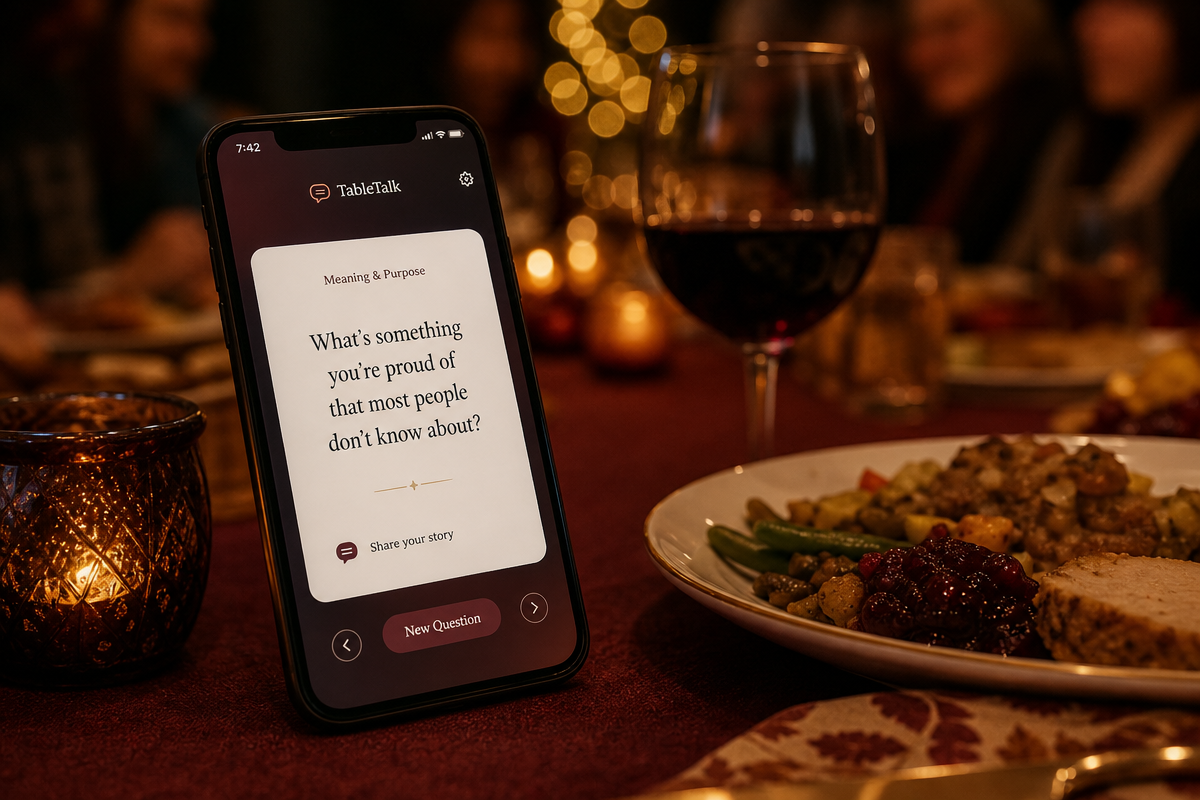
    Close-up of a smartphone on a dinner table next to a plate of food and glass of wine, displaying a conversation starter app with a question card, warm bokeh lights in the background
    Digital conversation starters are always in your pocket — ready the moment a family dinner needs a redirect.

    Digital conversation starters remove every common barrier to implementation. No physical cards to remember, no app downloads, no planning ahead. You open a browser on any phone at the dinner table and you have a prompt ready.

    Convo Cards lets anyone start for free with no account required. You can try the approach with zero commitment before a family gathering. If it works, premium access unlocks all 18+ themed question packs, including family and relationship categories, for $4.99 per year. That’s less than a single coffee, making it the most affordable conversation tool available.

    The platform also includes progress tracking and a favorites feature, so families can save prompts that sparked great conversations and build on them over time. The best questions become part of your family’s ongoing dialogue.

    Before your next family dinner, pull up Convo Cards on your phone, pick a question pack, and set the conditions for connection instead of conflict. The research is clear: structured prompts create the respect and curiosity that defuse political tension. The only thing left to do is try it.

  • Conversation Starters That Transform Book Clubs Into Real Community

    Conversation Starters That Transform Book Clubs Into Real Community

    Conversation Starters That Transform Book Clubs Into Real Community

    Book club events on Eventbrite jumped 31% in 2024. Silent book clubs more than doubled. Romance-fantasy clubs quadrupled. And yet, when you ask members what keeps them coming back, the answer is rarely the book itself. According to a BookBrowse survey of more than 5,000 members, 97% say "provoking good conversation" is a primary criterion in book selection. The book gets people in the door. The conversation is what makes them stay.

    This matters because loneliness is now a measurable public health problem. An APA poll from November 2025 found that a majority of U.S. adults identify societal division as a major stress source. AARP research the same year showed men reporting loneliness rates of 42%. Community formats like book clubs are filling a gap that keeps widening, and the quality of the conversations happening inside them determines whether those communities hold together or fade after three meetings.

    This article covers how conversation starters can change that: icebreakers for new members, thematic prompts that connect books to real life, strategies for stalled discussions, inclusivity techniques for introverts, and digital tools that make all of it easier.

    From plot summaries to real connection: How deep conversation starters change the game

    There is a well-known study in social psychology, cited by NeuroLaunch, that reveals something striking about how humans build closeness. Strangers who work through a carefully sequenced set of progressively personal questions feel closer to each other after 45 minutes than couples who have dated for months.

    A diverse group of five adults engaged in animated book club conversation in a cozy living room with warm lighting, books, and mugs of tea on a side table
    The book gets people in the door — the conversation is what makes them stay.

    "Structured self-disclosure is so potent that strangers who answer a carefully sequenced set of personal questions can feel closer to each other after 45 minutes than couples who have dated for months." — NeuroLaunch, 2025

    That same principle applies to book clubs. Deep conversation starters shift the discussion from "what happened in chapter four" to "how does this story connect to something you have actually lived through." The book becomes a launching pad, not a script.

    BookBrowse’s research also debunked a stubborn stereotype: successful clubs are not just excuses to drink wine. Their data shows that the most satisfied clubs spend at least 40 minutes on substantive discussion per meeting. The wine might be there. But people are showing up for the talk.

    The same survey found that 91% of members value being exposed to books they would not otherwise read. What makes an unfamiliar book rewarding is not the reading alone. It is the discussion that unpacks it. Psychology Today reinforced this in 2026 research, finding that pre-planning conversation topics around things people enjoy discussing builds connection through mutual attention, shared interests, authenticity, and respect.

    Icebreaker questions that welcome new members without the awkwardness

    Ijanae Dawkins, 26, founded the Book and Sip chapter in Philadelphia. She told NBC News about a pattern she sees every month:

    "I have people every month come up to me at the book parties, and they’re like, ‘Oh my gosh, I was so shy coming into it. This is my first book party. I made three new friends and we’re going out next weekend.’"

    That kind of transformation does not happen by accident. The first 10 minutes of a meeting set the tone for everything after. A good icebreaker question signals that this is a space for authentic sharing, not a seminar on literary analysis.

    Here are four icebreaker conversation starters designed for book clubs:

    1. What is a book that changed how you see the world, even if you read it years ago?
    2. If you could have dinner with any author, living or dead, who would it be and what would you ask?
    3. What is a book you pretend to have read but never actually finished?
    4. What is one book you think everyone in this room should read before the end of the year?

    These questions work because they are personal but low-stakes. Nobody needs to have finished the current book to answer. They also tap into what Eventbrite found about younger members: 79% of Gen Zers and millennials want events that blend multiple interests. Questions that connect reading to travel, food, or personal passions appeal to people who are there for the social experience as much as the literature.

    Niche communities understand this intuitively. Queer book clubs grew 82% in recent years, according to 1000 Libraries Magazine. Identity-based reading groups attract people specifically seeking inclusive spaces, and welcoming icebreakers reinforce that sense of belonging from the first minute.

    Connecting book themes to real life with meaningful conversation topics

    The strongest book club discussions do not stay inside the book. They use the book’s themes as a bridge to personal experience.

    The framework is straightforward. For each book, identify two or three core themes: justice, family, identity, ambition, betrayal, forgiveness. Then design prompts that ask members to connect those themes to their own lives.

    For a memoir, try: "When have you faced a crossroads similar to the one the author describes? What did you choose?"

    For literary fiction: "Which character’s decision did you most relate to, and which one did you find hardest to understand?"

    For historical fiction: "What surprised you most about how people in this era lived? Does any of it feel relevant to your life today?"

    BookBrowse’s survey found that 73% of members actively seek challenging books and 55% want controversial titles. Meaningful conversation topics give members the courage to tackle difficult reads because they know the discussion will have structure and purpose.

    Davina Morgan-Witts, publisher of BookBrowse, put it directly in Publishers Weekly:

    "The vast majority of book club members describe their groups as vital and fun aspects of their lives. They enjoy a sense of community and, often, personal friendships, but above all else, and counter to what some believe, they value intellectual challenge and growth."

    A layering strategy for thematic questions

    Good facilitators layer their questions in three stages:

    Overhead view of an open book surrounded by colorful handwritten conversation starter cards, coffee mugs, and a small potted plant on a table
    Thematic question cards layered from plot to personal can transform a surface-level chat into something memorable.

    1. Text-based (literal): What happened in the book? What did you notice?
    2. Interpretive (analytical): What do you think the author intended? What themes emerged?
    3. Personal (experiential): How does this connect to something in your own life?

    This progression builds safety before vulnerability. Members warm up with factual observations, move into analytical territory where disagreement is about ideas rather than identity, and arrive at personal sharing with enough trust established to be genuine.

    Keeping conversation flowing: Rescue strategies when the discussion stalls

    Every book club has experienced it. The discussion starts strong, then at the 15-minute mark, it dies. Everyone suddenly finds their wine glass fascinating.

    Pivot questions are the answer. These are conversation starters designed to reignite flow when the room goes quiet:

    • What would you have done differently in the protagonist’s situation?
    • Did any passage make you reconsider something you believed to be true?
    • Which character do you think got what they deserved, and which did not?
    • If you could ask the author one question, what would it be?

    The "didn’t-finish-the-book" reality

    Someone always shows up without finishing the book. That is fine. Prompts that work for skimmers include questions about the book’s premise, its opening chapter, the title, or even the cover design. "What did you expect from this book before you started reading? How did the reality compare?" works whether someone read 300 pages or 30.

    Handling heated debates

    BookBrowse found that 98% of members consider respect for others’ opinions critical to the experience. When a debate gets tense, a structured reframe question restores equilibrium. "Can you help me understand your perspective on that?" redirects energy from argument to curiosity. It works because it is genuinely hard to stay defensive when someone is asking to understand you better.

    The one-word check-in technique

    When discussion stalls completely, ask each member to describe the book in one word. Then dig into why each person chose their word. It is fast, low-pressure, and it surfaces surprising insights. The person who says "claustrophobic" and the person who says "liberating" are about to have an interesting exchange.

    Leveling the playing field: Making book clubs work for introverts and all personality types

    Free-form discussion has a built-in problem. The people most comfortable talking dominate. The people least comfortable talking stay quiet, leave feeling unheard, and eventually stop coming.

    Structured conversation starters fix this. NeuroLaunch described the mechanism clearly:

    "Structured questions don’t disadvantage introverts, they level the playing field. The extrovert who would dominate free-form mingling has to wait their turn. The introvert who would stand quietly near the snack table suddenly has something specific and interesting to say." — NeuroLaunch, 2025

    The principle is turn-taking. When a prompt is on the table, everyone expects to answer. This removes the ambiguity of when to speak, which is what paralyzes introverts most. They are not shy about their opinions. They are uncertain about the rules of engagement.

    Practical facilitation tips

    • Use round-robin formats where each person answers in turn, with the option to pass.
    • Allow written reflections before spoken discussion. Members jot down their response for two minutes, then share. This gives processing time to people who think before they speak.
    • Mix large-group discussion with pairs or trios. Introverts often speak freely in smaller configurations.

    Since 98% of members value respect for others’ opinions, structured formats reinforce this norm by giving each person equal airtime rather than rewarding whoever speaks first and loudest. This matters enormously for identity-based and niche book clubs, which thrive when structured prompts create safety for sharing personal experiences that connect to the reading.

    How a conversation starter app enhances both in-person and virtual book clubs

    The old way of preparing book club questions involved scrolling through publisher discussion guides, printing questions, bringing the paper to the meeting, and losing it somewhere between the car and the couch. The new way is different.

    MakeUseOf and WIRED have both highlighted the growing category of conversation starter apps, noting specific book club use cases. A conversation starter app lets facilitators pull curated, themed prompts on any device, anytime. No printing, no prep fatigue, no frantic Googling 20 minutes before people arrive.

    Virtual and hybrid meetings

    As remote and hybrid book clubs became a permanent fixture, digital tools solved a specific problem: making sure remote participants had equal access to prompts on their screens rather than straining to hear a question read aloud across a room.

    A hybrid book club meeting with two people at a kitchen table with books and a laptop showing video call participants, warm kitchen lighting with plants on the windowsill
    Hybrid meetings can feel just as connected when the right tools bridge the distance.

    Convo Cards: An affordable option

    Convo Cards offers curated question packs covering 18+ themes, including conversation starters designed for group discussions. At $4.99 per year, it costs a fraction of what competing platforms charge (which range from $18 to $70 per year). The free tier is genuinely useful, so facilitators can try it at their next meeting with zero commitment.

    The platform is web-based, so there is no app download required. Members can pull it up on any phone or laptop. Favorites and progress-tracking features let book clubs save their best prompts and track which themes they have explored over the course of a year. This is particularly useful for clubs that want to avoid repeating questions or want to build a curated archive of their strongest discussion starters.

    Building your book club’s conversation toolkit: From first meeting to lasting friendships

    Allison Yates, 33, founded Read & Run Chicago. She told NBC News:

    "Reading is such an escape. But really what people want is to feel something deeply, and it slows us down a lot in a time when everything is digital and everything is fast-paced."

    Book clubs are not really about books. They are about belonging, intellectual growth, and authentic connection. The book is the excuse. The conversation is the point. Dawkins’ story of shy newcomers walking out with three new friends is not exceptional. It is what happens when you give people structured, meaningful prompts and a room where they feel safe enough to answer honestly.

    A simple action plan

    Try two or three conversation starters at your next meeting. Notice the shift in engagement. Pay attention to who speaks up who normally stays quiet. Then explore themed question packs for ongoing variety so your discussions stay fresh month after month.

    Visit Convo Cards to access free conversation starters today, or upgrade to premium for $4.99 per year to unlock all 18+ question packs covering relationships, hobbies, adventures, and more.

    Every lasting friendship started with a single conversation. Your next book club meeting could be the one that turns a room of acquaintances into a real community.

  • Hello world!

    Welcome to WordPress. This is your first post. Edit or delete it, then start writing!