How to Host a Dinner Party That Sparks Real Conversation
Your guests arrive buzzing with energy. Drinks are poured, the food smells incredible, and the first twenty minutes flow naturally. Then, somewhere between the second course and dessert, the conversation loops back to work commutes, the weather, and whatever streaming show everyone is watching this week. The evening doesn’t fall apart, but it never quite takes off, either. The fix? A deliberate approach to dinner table conversation starters that guides your guests from surface-level chat into genuinely memorable dialogue.
Verywell Mind named dinner parties a top trend for 2025, framing them as a remedy to what they described as "relentless consumerism and the pressure to see and be seen." The cultural moment is right. What hosts need now is a practical framework: guest list curation, strategic seating, a course-by-course conversation structure, and the right digital tools to eliminate awkward lulls.
The science of shared meals: why dinner conversations matter more than ever
Hosting meaningful dinner conversations is not just a nice-to-have. It is a practice with measurable effects on human wellbeing, backed by major research institutions.

A thoughtfully set table is the foundation of great dinner party conversation.
The 2025 World Happiness Report found that sharing meals is one of the strongest predictors of life satisfaction ever measured:
"Sharing meals proves to be an exceptionally strong indicator of subjective wellbeing – on par with income and unemployment. Those who share more meals with others report significantly higher levels of life satisfaction and positive affect, and lower levels of negative affect."
The same report revealed a sobering trend about how often people eat alone:
"In 2023, roughly 1 in 4 Americans reported eating all of their meals alone the previous day – an increase of 53% since 2003. Dining alone has become more prevalent for every age group, but especially for young people."
The U.S. Surgeon General’s Advisory on Loneliness and Isolation went further, equating prolonged social disconnection to smoking 15 cigarettes a day in terms of its impact on physical health. The World Health Organization reinforced this connection in June 2025, linking social connection to reduced risk of early death.
What this means for hosts is simple: when you bring people to your table and arm yourself with great dinner table conversation starters, you are doing something that genuinely matters. You are countering a loneliness epidemic that has hit younger adults hardest, many of whom came of age during the pandemic and feel socially stunted. The intentional, present gathering is exactly what Verywell Mind described when they said:
"People are drawn to dinner parties because they are intimate, intentional, and force you to truly be present. They’re a remedy to relentless consumerism, the need to ‘see and be seen’, and the pressure we feel to always be putting ourselves out there."
Curating the perfect guest list for conversational chemistry
Great conversations start before anyone sits down. They start with who you invite.
Group size matters
Aim for 6 to 10 guests. This range is the sweet spot for dinner parties because it allows for one flowing conversation at the table or natural breakouts into smaller groups during cocktails and after-dinner drinks. Fewer than six can feel intimate to the point of pressure if the energy lags. More than ten splinters the table into side conversations that never reconnect.
Balance personality types
Every great dinner party needs two kinds of people. Connectors are outgoing guests who carry conversations, fill silences without panic, and make newcomers feel welcome. Depth personalities are quieter, more thoughtful guests who ask follow-up questions that take a conversation somewhere unexpected. You need both. A table full of connectors feels loud but shallow. A table full of depth personalities risks long, uncomfortable silences.
Mix familiar faces with new connections
Invite guests who do not already know each other but share overlapping interests. A travel writer, a chef, and an entrepreneur who just returned from Japan will find plenty to talk about. Avoid homogeneous groups where everyone works in the same field, which narrows the conversation funnel to shop talk that excludes half the table.
Think of yourself as a conversation matchmaker. Which guests will bring out surprising sides of each other? Who has a story that will prompt someone else’s? That intentionality is what separates a forgettable dinner from one people reference for months.
Strategic seating: how to arrange guests for maximum engagement
Seating is the most underrated tool a host has. Where people sit shapes who they talk to, how deep the conversation goes, and whether anyone gets left out.
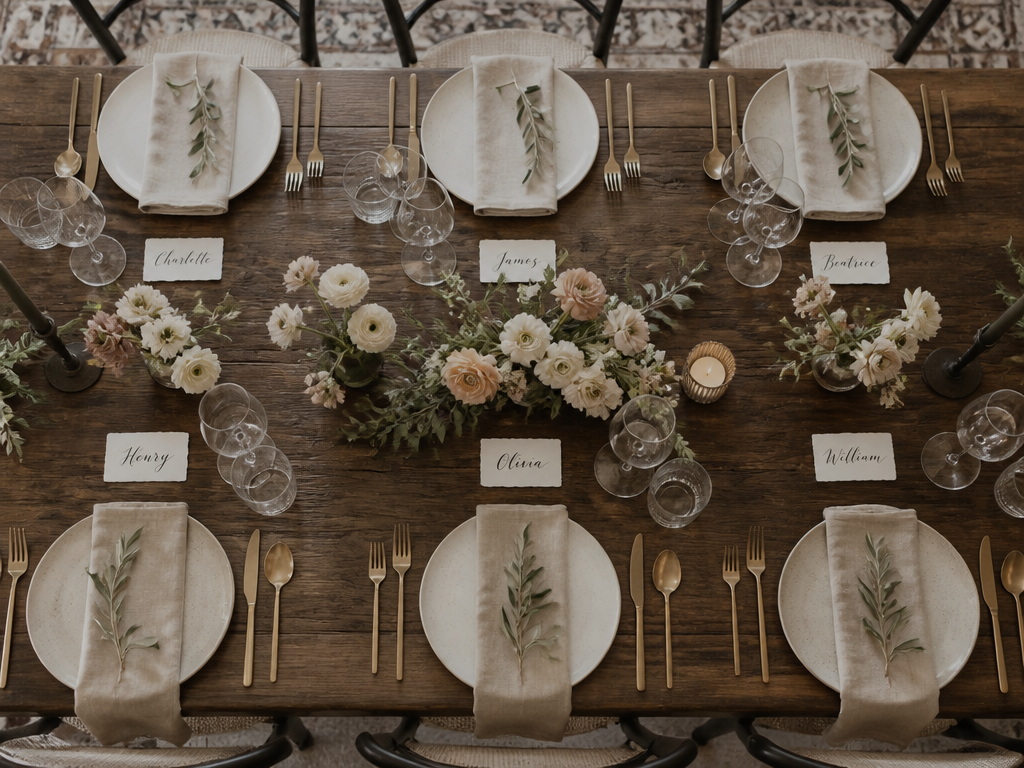
Place cards signal intentionality and give you control over the social geometry of the evening.
The golden rule: separate couples and established pairs. Seating partners or close friends next to each other lets them retreat into their comfort zone and kills cross-table conversation. Split them up. It forces everyone to engage with someone new and prevents the clique formation that sinks dinner party energy.
For larger parties with multiple tables, assign an outgoing guest as a "table host" at each one. Their job is to keep energy flowing, draw quieter guests into the conversation, and make sure no one is sitting in silence.
Place introverted or reserved guests next to warm, curious conversationalists, not next to other quiet people. A guest who asks genuine questions can draw out even the most hesitant dinner companion.
Your own seating matters too. Sit where you can read the room’s energy. If a conversation stalls or veers into uncomfortable territory, you need to be positioned to steer things gently in a new direction.
Use place cards. They signal intentionality. Guests notice and appreciate that you have thought about their experience, and place cards give you full control over the social geometry of the evening.
A course-by-course guide to dinner table conversation starters
This is the core framework. Match the depth of your questions to the progression of the meal, the same way each course builds on the one before it.
Cocktails and appetizers: light icebreaker questions
The goal here is to warm up the group with low-stakes prompts that get people talking before anyone sits down. Keep it playful.
- "What is the best meal you have ever had, and where were you?"
- "If you could live in any city for a year, where would you be?"
- "What is something you have tried recently that you were surprised you liked?"
These questions work because they invite stories, not one-word answers. Everyone has an opinion about food and travel, and the responses reveal personality without asking for anything too personal too soon.
Main course: personal but not heavy
Once people are seated and comfortable, transition to questions about passions, formative experiences, and current inspirations. These go deeper but stay energizing.
- "What is something you are working on right now that excites you?"
- "Who has had the biggest influence on the way you think?"
- "What is a skill you do not have but have always wanted to learn?"
The Gourmet Host puts it well:
"The best dinner party questions are open-ended, easy to answer, and spark stories rather than one-word replies. The key is to match the question’s depth to the vibe of the evening – lighter questions early, deeper ones after dessert."
Dessert and after: reflective and philosophical
Save the big questions for when guests are relaxed, full, and comfortable with each other. This is where the most memorable conversations happen.
- "What is something you have changed your mind about recently?"
- "If you could go back and give your 20-year-old self one piece of advice, what would it be?"
- "What does a perfect day look like for you, from start to finish?"
Pacing: the make-or-break skill
How you deliver questions matters as much as which questions you choose. Rapid-fire prompts turn dinner into an interrogation. The Gourmet Host warns:
"Shoot too many questions too fast, and it will start to feel like an interrogation. But with the right pacing, even a simple, funny question can lead to a good story that everyone remembers."
Read the room. After someone shares something personal, give the table a beat to sit with it. Use the improv technique of "Yes, and…" to build on responses. If a guest mentions a trip to Portugal, do not redirect with a new question. Ask a follow-up that deepens the thread: "What surprised you most about Lisbon?" That is how a single prompt can carry twenty minutes of genuine conversation.
How to introduce conversation cards naturally
Many hosts hesitate to use structured prompts because they worry it will feel forced. The fear is legitimate but manageable with the right approach.
Wait for a natural lull. Do not interrupt flowing dialogue to introduce a question. Wait for a genuine pause, the kind where people are reaching for their drinks and looking around the table. That is your window.
Frame it casually. You might say, "A friend told me about this question recently and I have been dying to ask people," or "I came across these conversation cards and thought they would be fun for tonight." Present the prompt as something you are genuinely curious about, not as a structured activity.
Own your role as host. You invited everyone. You have social permission to steer the evening. Deliver your question with confidence rather than apology, and guests will follow your lead.
Do not go around the table systematically. That feels like a team-building exercise. Let guests volunteer to answer or pass naturally. Some of the best moments come from the person who was not planning to share but got pulled in by someone else’s story.
Use cards as a backup, not a script. Pull out a question when energy dips, not on a timer. The tool exists to rescue lulls, not to replace organic conversation.
Physical card decks have been the traditional option: TableTopics runs $20 to $25, and Talking Point Cards cost $29.95. Digital alternatives are changing the math. Convo Cards, at $4.99 per year, puts the same functionality on your phone with no deck to carry and no app to download.
Digital conversation cards: your secret weapon for natural lulls
The biggest challenge for hosts is having the right question ready at the right moment. You can memorize a list, but under the pressure of a live dinner party, most people draw a blank. Digital conversation cards solve this problem.
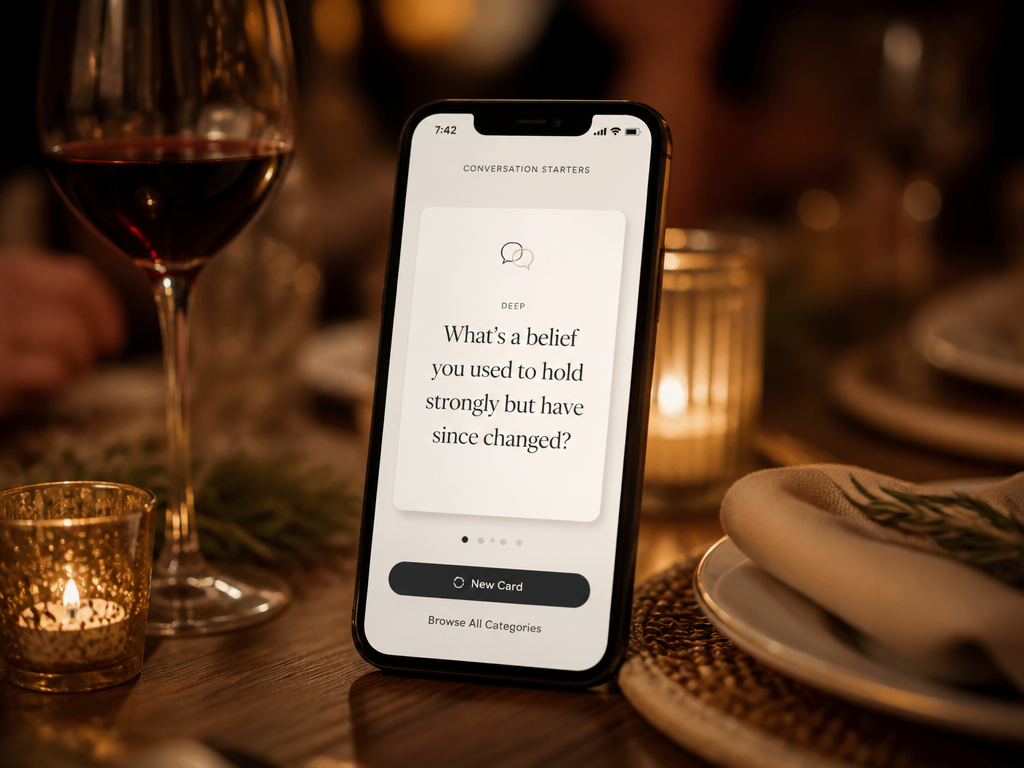
Digital conversation cards let you pull the perfect question from your phone — invisibly and instantly.
Convo Cards organizes question packs by occasion and topic, so hosts can pull up the perfect prompt whether the moment calls for an icebreaker, a laugh, or a philosophical pivot. The platform is web-based, which means it works on any device with no app store download required. You open a browser, tap a pack, and you have a curated question in seconds.
The free tier gives you real access to get started. Premium unlocks all 18+ question packs for $4.99 per year, which is dramatically less than physical decks or couples-focused apps that run $18 to $70 annually. A favorites and progress-tracking feature lets you save questions that landed well and build a personal repertoire for future gatherings.
The practical advantage is speed and invisibility. When a lull hits between the main course and dessert, you glance at your phone, find a question, and introduce it smoothly. No one at the table needs to know it came from a tool. It just feels like you are a remarkably thoughtful host with great timing.
The complete dinner party hosting timeline
Great conversation requires great infrastructure. Here is how to set the stage from start to finish.
One week before
Send invitations early enough that guests can plan. Design a menu that can be largely prepped ahead: braises, make-ahead sides, pre-batched cocktails. If you are stuck in the kitchen all evening, you cannot host the conversation.
Arrival
Greet each guest with a drink already in hand. This immediately lowers social friction and gives nervous guests something to do with their hands. The first drink is the universal icebreaker.
The first 15 minutes
Use light icebreaker questions during the cocktail window, before everyone sits down. This warms up the group and establishes a tone of genuine conversation rather than small talk.
During dinner
Deploy the course-by-course conversation framework. Appetizers get the light questions, the main course goes deeper, and dessert opens the door to reflection.
Post-dinner
Move to a different space. The couch, the patio, the kitchen counter. A physical shift signals permission to relax and get more personal. Some of the best conversations happen here, away from the formality of the table.
Closing ceremonies
End with intention. A round where each guest shares one thing they appreciated about the evening, a collective toast, or simply a warm, unhurried goodbye at the door. This ritual leaves guests feeling fulfilled and eager for the next invitation.
From icebreakers to deep talks: your dinner party toolkit
Meaningful dinner parties are built on intentional choices: a well-curated guest list, strategic seating, and a course-by-course conversation framework that meets people where they are and gradually invites them deeper. The science is clear that this work matters. When you bring people to your table and guide them past small talk, you are actively countering the loneliness epidemic and boosting wellbeing for everyone in the room.
Great conversation is not a talent you are born with. It is preparation. Having the right dinner table conversation starters ready removes the pressure of thinking on your feet and lets you focus on what actually matters: being present with your guests.
Explore Convo Cards’ free question packs to start building your hosting toolkit today. Premium unlocks the full library of curated question packs for less than $5 per year, giving you an instant repertoire for every occasion, from casual friend hangouts to milestone celebrations.
The best dinner parties are not remembered for the food or the decor. They are remembered for the conversations that made everyone at the table feel truly seen.
Leave a Reply