Category: Uncategorized

  • Conversation Starters for Retirement Communities and Senior Living

    Conversation Starters for Retirement Communities and Senior Living

    Four in ten adults aged 45 and older report feeling lonely, according to AARP’s 2025 study on social connections. Among adults in their 60s specifically, 41% say they are lonely, up sharply from 32% in 2018. For the millions of older adults living in retirement communities and senior living facilities, structured conversation starters are a simple, low-cost intervention with an outsized impact on well-being. They are not a luxury or a pastime. They are a public health tool.

    The loneliness epidemic in senior living: why conversation starters matter now

    The U.S. Surgeon General has formally identified loneliness and social isolation as a priority public health problem. The scale is staggering. Approximately 7.7 million community-dwelling adults aged 65 and older are socially isolated, and 28% of seniors live alone, totaling more than 14.7 million people nationwide.

    A diverse group of older adults engaged in lively conversation in a bright, sunlit common room of a senior living community, some holding conversation cards and smiling.
    Structured conversation opportunities transform common rooms into spaces of genuine connection.

    Research presented at the American Association for Geriatric Psychiatry frames the risk in stark terms:

    "Loneliness is a significant biopsychosocial stressor with a mortality risk comparable to smoking more than 15 cigarettes a day and more harmful than alcoholism, obesity and lack of physical activity."

    The World Health Organization recognizes loneliness as a critical issue during the UN Decade of Healthy Ageing (2021-2030). This global recognition means that structured social engagement tools, including conversation cards and prompted discussion activities, are more relevant than ever for senior living environments.

    For activity directors, family members, and senior living administrators, the takeaway is clear: creating regular opportunities for meaningful conversation is one of the most accessible interventions available. No prescriptions. No specialized equipment. Just good questions and a willingness to listen.

    The hidden health costs: how social isolation drives cognitive decline

    The medical consequences of loneliness extend well beyond emotional distress. According to the Health Resources and Services Administration (HRSA), social isolation is linked to a 50% higher risk of dementia, a 32% increased risk of stroke, and a 29% increased risk of heart disease.

    Loneliness increases the risk of premature death by nearly 30%. In older adult populations specifically, isolation is associated with a 26% increased risk of premature mortality.

    Hearing loss compounds the problem. Up to 50% of people over 75 experience some degree of hearing impairment, which makes spontaneous conversation harder and pushes many seniors further into withdrawal. Unstructured social interaction requires rapid processing, quick topic shifts, and the ability to pick up on conversational cues. For someone with hearing challenges, that cognitive load is exhausting.

    This is where structured conversation prompts change the equation. When a question is written down or displayed on a screen, the person has time to read it, process it, and formulate a response at their own pace. The scaffold reduces anxiety and removes the pressure of thinking of something to say on the spot.

    The science of meaningful conversation topics: reminiscence therapy and brain health

    The idea that talking about memories can improve brain function is not wishful thinking. It is supported by a growing body of research on reminiscence therapy, which uses guided conversation prompts to encourage older adults to share life stories and personal history.

    A 2025 systematic review and meta-analysis published in Archives of Gerontology and Geriatrics confirmed that reminiscence therapy improves cognitive function in older adults with cognitive impairment. Multiple randomized controlled trials have shown similar results: reminiscence interventions reduce depression symptoms, improve verbal skills, and enhance memory recall.

    Graying With Grace, a resource on aging well, summarizes the research:

    "Research in this area consistently shows that regular life review and structured reminiscence is associated with slower rates of cognitive decline in older adults. Storytelling specifically, constructing a narrative, sequencing events, recalling details, gives the brain a meaningful workout."

    Longitudinal studies reinforce the connection between social engagement and brain health. One major study found that more social activity was associated with less cognitive decline over an average follow-up of 5.2 years. Social engagement slows cognitive decline by approximately 14% in older adults with depressive symptoms. Seniors who regularly share their stories report higher life satisfaction, improved self-esteem, and better overall mental health.

    Conversation cards are a practical delivery method for these benefits. They provide structured prompts rooted in the same principles that make reminiscence therapy effective: inviting people to reflect on their lives, construct narratives, and share experiences with others.

    Conversation cards as icebreakers: breaking through social barriers

    Moving to a retirement community is one of the most socially disruptive events in a person’s life. Residents leave behind neighbors, routines, and social networks built over decades. They arrive in a new environment where they must, in effect, start over socially.

    Close-up of two senior adults' hands holding colorful conversation prompt cards over a café table with coffee cups in a warm, softly lit retirement community lounge.
    Simple prompt cards give residents a low-pressure entry point into meaningful dialogue.

    For shy residents, newcomers, or those who have lost spouses and friends, the prospect of walking into a common room and striking up a conversation can feel impossible. Conversation cards give these residents a tool to participate without the pressure of spontaneous interaction.

    Bridge Senior Living, a senior living resource platform, describes the value of structured questions this way:

    "Icebreaker questions are more than just conversation starters; they are bridges to understanding and connection. They offer caregivers, family members, and adult children an opportunity to foster empathy with older adults."

    Pluss Communities, which publishes activity guides for retirement villages, recommends gentle icebreaker activities to help residents connect over shared interests. Their guidance emphasizes inclusion:

    "Ensure no one is left out, especially newcomers or those who are shy or less socially active."

    Well-designed conversation cards create equitable participation. Everyone at the table gets a turn. Quieter residents have a structured opening to speak, while more talkative residents have a reason to listen. The format prevents dominant voices from overwhelming the group and ensures that everyone has a chance to share.

    Practical ways to use conversation starters across senior living settings

    Conversation cards work across four primary contexts in retirement communities. Each setting calls for a slightly different approach.

    Communal dining

    Meals are natural social time, but too many communal dinners dissolve into silence or surface-level chatter. A single question card placed at each table transforms the dynamic. Residents who sit together day after day without really knowing each other suddenly have a reason to share stories, compare experiences, and laugh together.

    Group activities

    Book clubs, walking clubs, craft sessions, and hobby groups can integrate themed question packs to deepen discussions. A gardening group might pull questions about nature, seasons, and favorite outdoor memories. A book club could use prompts about life-changing books, childhood reading habits, or stories that shaped participants’ worldviews.

    Intergenerational visits

    When grandchildren or great-grandchildren visit, conversation often stalls. Kids do not know what to ask, and seniors may feel unsure how to relate. Prompts that invite older adults to share historical experiences bridge that gap. Questions about the first television they watched, what school was like in the 1950s, or how they celebrated holidays as children give younger visitors a natural entry point into their family history.

    A young adult and an elderly woman sitting together in a garden at a senior living facility, looking at a tablet with a conversation starter app and smiling warmly at each other.
    Digital conversation tools bridge generational gaps and spark unexpected bonds.

    One-on-one family visits

    Family visits can feel repetitive when the same questions come up every time. Conversation cards about childhood memories, career milestones, and life advice give families fresh material. Adult children who have heard the same stories for years may discover new ones when a well-crafted prompt surfaces a memory that had not come up before.

    How activity directors can build a conversation card program

    For activity directors looking to launch a structured conversation program, a few practical steps will set the foundation.

    Start small. Introduce a "conversation corner" at communal dinners. Place one question card per table as a low-pressure entry point. Residents can engage with it or not, but the option is always there.

    Create themed nights. A "Decades Night" could focus on memories from the 1950s, 60s, and 70s. An "Adventure Night" invites travel stories. A "Family Roots Night" explores heritage, traditions, and ancestry. Themed nights give residents something to look forward to and help activity directors plan ahead.

    Integrate into existing activities. Rather than creating standalone events, add conversation cards to activities already on the calendar. Bingo nights, happy hours, and craft sessions can all incorporate a round of prompted questions. This approach requires no additional scheduling and reaches residents who might not attend a separate discussion group.

    Train staff facilitators. The facilitator’s job is to keep participation balanced. Gently redirect residents who dominate the conversation and invite quieter members to share. The goal is not to pressure anyone, but to make sure the format works as intended: everyone gets a turn.

    Track engagement. Pay attention to which themes generate the most conversation. Rotate popular topics and introduce new packs regularly to keep the experience fresh.

    Go digital. A digital conversation starter app displayed on a shared screen or tablet eliminates the need to manage physical card inventory. Staff can switch themes instantly, and the same platform works across multiple activity rooms.

    Why a digital conversation starter app is ideal for senior living

    Tablets and shared screens are already common in senior living facilities. A web-based conversation starter app takes advantage of existing hardware with no new equipment to purchase.

    The operational advantages over physical card sets are significant. There are no cards to lose, replace, or carry between activity rooms. Digital platforms allow instant theme switching, so an activity director can move from travel stories to family memories without leaving the room. Regular content updates keep activities fresh without reordering products.

    Cost matters for activity departments operating on tight budgets. Physical conversation card sets typically cost $20 to $30 each. Specialized apps range from $18 to $70 per year. Convo Cards offers premium access at $4.99 per year, making it one of the most affordable options available. The free tier includes real, usable content with no account required to start.

    Screen-sharing capability lets activity directors project one question for large group discussions or display multiple cards in a carousel format. Because Convo Cards is web-based, there is no app store download required. Staff can open prompts on any device in seconds.

    Meaningful conversation topics that resonate with older adults

    Not all questions work equally well with seniors. The best prompts tap into long-term memories, which remain strong even as short-term memory fades. Here are question categories and examples that consistently generate rich conversation.

    Life story prompts

    • "What was your first job, and what did it teach you?"
    • "Tell me about a time you had to be brave."
    • "What is the hardest thing you ever did?"

    Wisdom sharing prompts

    • "What advice would you give your younger self?"
    • "What is the most important lesson life has taught you?"
    • "What do you know now that you wish you had known at 30?"

    Relationship and family prompts

    • "What traditions did your family have growing up?"
    • "Who influenced you the most as a young person?"
    • "What did your grandparents teach you?"

    Lighter icebreakers for new groups

    • "What is a hobby you have always wanted to try?"
    • "What is the best trip you have ever taken?"
    • "What is your favorite meal to cook or share?"

    Balance deeper prompts with lighter ones in each session. A session that opens with a fun, easy question and gradually moves toward more reflective topics maintains energy and respects different comfort levels.

    Building a culture of connection

    The research is unambiguous. Loneliness carries a mortality risk comparable to smoking 15 cigarettes a day. Social isolation increases dementia risk by 50% and premature death risk by nearly 30%. Conversation starters will not solve these problems alone, but they are a proven, low-cost, immediately deployable tool that addresses the root cause: people need to talk to each other.

    Structured conversation is not a one-time activity. It is a daily wellness practice that compounds over time. Onward Living, a senior living resource, puts it this way:

    "Regular engaging discussions help preserve cognitive functions, strengthen intergenerational bonds, and create valuable connections. These exchanges also enable caregivers to better understand seniors’ needs, leading to more personalized care."

    If you are an activity director, family caregiver, or senior living administrator, the next step is simple. Visit Convo Cards and try the free tier with no account required. For full access to all 18+ question packs, premium is $4.99 per year. Share this resource with colleagues, family members, and anyone responsible for the well-being of older adults in your community.

    Every conversation started is a connection made. In senior living, those connections can change a life.

  • How to Mix Friend Groups at Parties Using Conversation Prompts

    How to Mix Friend Groups at Parties Using Conversation Prompts

    You invited your college roommates, your coworkers, and your neighbor who brings over sourdough every other Tuesday. Three separate clusters formed within twenty minutes, and nobody crossed the invisible line between the kitchen and the living room until someone needed a bottle opener.

    Roti Brown, who writes the Flavor Garden newsletter on hosting, puts it plainly:

    "A good party feeds you. A great one rearranges your social map just a little: two people leave knowing each other who didn’t when they arrived."

    Most hosts cross their fingers and hope natural mingling handles the rest. It rarely does. Unstructured small talk between strangers tends to plateau at weather, jobs, and how they know the host. But there is decades of research showing that a simple tool, well-timed conversation prompts, can short-circuit that pattern and get strangers talking like old friends within a single evening.

    The science behind this comes from psychologist Arthur Aron, whose landmark study at UC Berkeley (now hosted by the Greater Good Science Center) demonstrated that strangers who took turns asking escalating personal questions felt as close as long-term friends after just 45 minutes of reciprocal self-disclosure. As the Science of People team summarized:

    "Research shows that structured social games trigger a psychological loop called reciprocal self-disclosure, where sharing personal information back and forth builds trust and closeness faster than ordinary conversation. Psychologist Arthur Aron proved that strangers who answered escalating personal questions felt as close as long-term friends in just 45 minutes."

    That principle is exactly why icebreaker questions work at mixed-group parties. They give people a ready-made framework for vulnerability that organic conversation almost never reaches on its own. This post covers specific strategies, timing frameworks, and digital tools to transform any gathering where different social circles collide.

    Curate before you prompt: designing a guest list that wants to connect

    Before you deploy a single conversation starter, look at your guest list. The foundation of a successful mixed-group party is who you put in the room and how you arrange that room.

    A house party at golden hour where three distinct groups of guests cluster separately in a warm living room and kitchen before mingling begins.
    The moment before mingling: clusters form fast without a little structural nudge.

    The golden ratio for a mixed guest list

    Treat your guest list like a tablescape. Balance personality types intentionally rather than inviting everyone you know and hoping for the best. A reliable formula:

    • Anchors: 3 to 4 close friends who know each other and bring steady energy to the room. They keep conversation moving when things stall.
    • Clusters: 2 to 3 small groups of people who already know each other in pairs or trios. They arrive with built-in comfort but need a nudge to engage outside their circle.
    • Wild cards: 1 to 2 people who know almost nobody but bring an interesting perspective or story. They spark unexpected conversations precisely because they don’t fit the existing social graph.

    Pair complementary personalities when you can. A funny friend paired with a quiet observer gives the observer something to react to. A chatty creative paired with a thoughtful introvert creates a natural back-and-forth. These pairings do half the icebreaking work before any question gets asked.

    Design your physical space

    Create a gathering spot that is not the kitchen. A casual food station, a drink table, or a dessert spread in a corner away from the main cooking area gives guests something to do with their hands. People linger longer when they have a physical reason to stand somewhere, and lingering is where mingling happens. Environmental design removes the awkwardness of approaching a stranger because both people have a shared excuse: they are both getting a snack.

    Icebreaker questions that actually work for strangers (the three-level vulnerability framework)

    Not all conversation starters are created equal. Asking "What is your biggest regret?" to someone who walked in five minutes ago will shut down the room. The secret is matching the question’s vulnerability level to where the group is in the evening.

    Two guests from different friend groups laughing and leaning into an animated conversation across a candlelit dinner table.
    Escalating questions can turn strangers into fast friends in a single evening.

    Green, yellow, red: matching intensity to the moment

    Think of conversation starters in three tiers:

    Level Vulnerability When to use Example
    Green Low First 30 minutes, strangers, large groups "What’s the best thing that happened to you this week?"
    Yellow Moderate Mid-party, after the room has warmed up "What’s a hobby you’ve always wanted to try?"
    Red High Late in the evening, only with trusted groups "What’s something you’ve changed your mind about in the last year?"

    The golden rule: the earlier in the party, the lower the vulnerability. Green questions at the start. Yellow once people have laughed together. Red only when trust has been established. Using high-vulnerability questions with mixed acquaintances too early almost never works because nobody has the relational footing to answer honestly.

    As the team at Party.pro puts it:

    "The question matters less than the timing, the level of vulnerability it asks for, and how you facilitate the moment."

    Timing: when to ask matters more than what you ask

    For a typical two-hour party, experienced hosts recommend running structured conversation prompts at three moments: approximately 10 minutes in, 40 minutes in, and 65 minutes in. These map to natural energy lulls where groups need a spark.

    A simple question at the right moment beats a brilliant one asked too early. The first question you ask in a social setting often determines whether the group opens up or retreats into surface-level pleasantries for the rest of the night.

    Fun questions to ask friends and newcomers at every party stage

    A party has a natural energy arc. Match your conversation starters to that arc using a three-act structure.

    Act one: arrival and appetizers (light and playful)

    Keep it breezy. You want quick laughs and easy stories, not therapy.

    • "What’s the most spontaneous trip you’ve ever taken?"
    • "What’s your go-to karaoke song?"
    • "What’s a food everyone seems to love that you secretly can’t stand?"

    These green-level prompts get people talking without demanding anything personal. The goal is momentum.

    Act two: the main event (story-inviting, moderate vulnerability)

    Once the room has relaxed, move to yellow-level prompts that invite real stories.

    • "What’s something you’re proud of that you never get to talk about?"
    • "What’s the best advice you’ve ever received?"
    • "What’s something you’re working on getting better at?"

    These questions work because they ask for a narrative, not a one-word answer. People love telling stories about themselves when given a genuine opening.

    Act three: dessert and beyond (return to playful)

    Energy naturally dips after the main course. Resist the urge to go deeper. Instead, bring the mood back up with prompts that are fun but slightly more imaginative than Act One.

    • "If you could instantly master one skill, what would it be?"
    • "What’s a movie you can quote start to finish?"
    • "What’s the next trip you want to take?"

    Round-robin format: give everyone equal airtime

    Use a round-robin format for at least one prompt during the evening. Each guest answers the same question in sequence. This format prevents dominant personalities from monopolizing the conversation and ensures quieter guests get their turn without having to fight for it.

    Round-robin questions also create shared reference points. If everyone answers "What’s your go-to karaoke song?" during Act One, you can be sure someone will reference those answers an hour later. Those callbacks compound throughout the night, making the structured conversation investment pay off repeatedly.

    Structured mixer activities that rotate conversations naturally

    Single questions are powerful, but structured activities physically move guests around and force cross-pollination between groups who would never gravitate toward each other on their own.

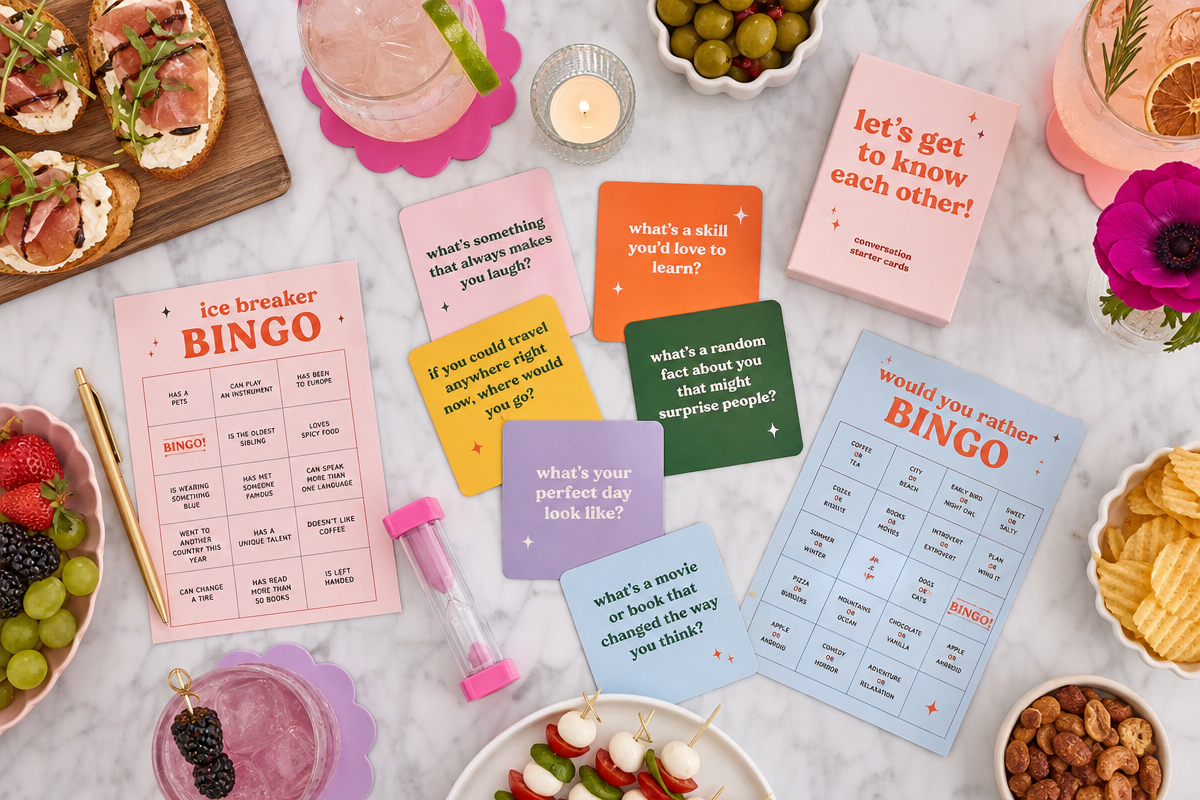
    Overhead view of conversation starter cards, bingo game cards, cocktails, and appetizers arranged on a modern party table.
    Conversation cards and mixer games give guests a ready-made excuse to interact.

    Human Bingo and "find someone who" games

    For parties of 10 or more, Human Bingo is one of the most effective mixer formats. Create a grid of traits and experiences, and give each guest a copy. Their job is to find someone in the room who matches each square.

    Example prompts for the grid:

    • "Has been backpacking in another country"
    • "Speaks three or more languages"
    • "Has met a celebrity"
    • "Can play a musical instrument"
    • "Has lived in more than two cities"

    These low-pressure missions give guests a structured excuse to walk up to a stranger and start talking. The conversation starter is built into the game. Research on group dynamics backs this up: participants who feel connected to the group early engage with the entire social experience more fully. Early mixer activities pay dividends for the whole party.

    Speed-introducing

    For smaller groups, try speed-introducing. Pair guests up, give them a conversation card with a single prompt, and set a timer for three minutes. When the timer goes off, rotate partners. After three or four rounds, everyone has had a structured one-on-one with several people they might not have approached otherwise.

    Keep all mixer activities optional but inviting. The goal is to provide structure for people who need it, not to force participation and create resistance.

    How to use digital conversation cards to run your party

    Physical conversation card decks have a problem. They require advance preparation: printing, cutting, organizing, and remembering to bring them out. As the team at Party Qs noted:

    "Using printable conversation starter cards requires advance preparation, including printing, cutting, and organizing the cards. This additional effort can be seen as a drawback, especially when compared to the digital alternative."

    That friction matters. Hosts who plan to use cards often skip the activity entirely because they forgot to prep or the moment passed by the time they found the deck.

    The spontaneity advantage

    Digital conversation prompts eliminate the barrier. You pull up the right question on your phone the moment you sense a lull, not ten minutes later after digging through a box. This spontaneity is the whole point. The right question always depends on reading the room in real time, not pre-planning what you think will work on Friday afternoon.

    Web-based platforms like Convo Cards let hosts browse curated question packs organized by occasion, from date night to friend hangouts to team building. You can switch themes mid-party as the energy shifts, moving from light appetizer prompts to deeper story questions without missing a beat.

    Because it runs in a browser, there is no app download required. Any guest can pull up a prompt on their phone, which turns conversation cards into a collaborative activity rather than a host-only tool. Hand your phone to someone and say "pick the next one." That small act of participation does more to include a wallflower than any direct prompt.

    Facilitation techniques: making wallflowers feel included

    Every party has at least one person who stands near the wall with a drink, smiling politely, waiting for an opening that never comes. The host’s job is to create that opening.

    The Guardian reported on this directly in their March 2025 piece on hosting and social anxiety:

    "On the night, hosts can support anxious guests and ease the initial awkwardness by introducing some structure, such as a game, quiz or other focal point, or being a bit more assertive with introductions."

    Assertive introductions

    Do not say "This is Sarah." Say "This is Sarah. She just got back from Portugal and she’s also really into rock climbing." Now the other person has two immediate conversation threads to pull on. You have done the hardest part, finding common ground, for them.

    Reducing cognitive load is the whole game. Anxious guests who might otherwise stand alone benefit enormously from having a ready-made reason to participate. Structure does that. A round-robin where everyone answers eliminates the pressure of deciding whether to jump in. You just go when it is your turn.

    Check in privately with quieter guests in the first twenty minutes. Walk them into a conversation cluster yourself, stay for the first exchange, and then excuse yourself once they are engaged. A two-minute investment from you can change their entire evening.

    Real-world scenarios: housewarmings, birthdays, and dinner parties

    Housewarming

    Guests are often strangers seeing your space for the first time. Use home and place-themed conversation starters: "What’s the first thing you’d hang on the wall in a new place?" or "What does home smell like to you?" Place a question card at the food station so guests encounter it naturally while grazing.

    Birthday party

    The guest of honor’s different friend circles collide in one room. Start with "How do you know the birthday person?" as a green-level icebreaker, then escalate to story rounds: "Tell us your favorite memory with the guest of honor." People bond quickly over their shared connection to the same person.

    Dinner party

    A seated format is tailor-made for the three-act structure. Run light prompts during appetizers, deeper questions during the main course when everyone is settled and comfortable, and playful ones over dessert to re-energize before people start thinking about leaving.

    Team building or work event

    Use professionally curated conversation cards that balance personal and career-focused questions. "What project are you most proud of this year?" sits alongside "What’s a skill you’re trying to build?" The goal is rapport without crossing professional boundaries.

    Every scenario benefits from the same timing framework (10 minutes, 40 minutes, 65 minutes) and the three-level vulnerability system. Adjust the content to fit the crowd; the structure stays the same.

    Your party mixing blueprint: from awkward to unforgettable

    The formula comes down to four components working together:

    1. Strategic guest curation with the anchor-cluster-wild card ratio
    2. Environmental design that creates natural gathering spots away from the kitchen
    3. Timed conversation prompts at 10, 40, and 65 minutes that match the party’s energy arc
    4. The three-level vulnerability framework (green to yellow to red, never skipping ahead)

    The best hosts are not the ones with the most charisma. They are the ones who remove friction and create structure that makes connection feel inevitable. Icebreaker questions, timed well and matched to the room, do exactly that.

    Your next party can be the one where people leave with new contacts in their phone, not just full plates. Pull up Convo Cards on your phone, read the room, and ask the right question at the right moment. No prep, no printing, no app download. Just better conversations.

  • Daily Conversation Habits That Prevent Relationship Drift

    Daily Conversation Habits That Prevent Relationship Drift

    Research consistently identifies communication breakdown as the leading driver of divorce, with studies finding it cited in 53 to 68% of marriage dissolutions. A Your Tango survey pegged the number at 65%, and Belu and O’Sullivan’s 2024 psychological study confirmed the same pattern across multiple datasets. The problem is rarely a single dramatic event. It is gradual, silent, and cumulative: a process researchers call relationship drift, one that can take 15 or more years to fully manifest. The antidote is not an annual grand gesture or a vacation. It is small, consistent daily conversation habits reinforced by thoughtful relationship building questions.

    Why couples drift apart

    Relationship drift doesn’t announce itself. It unfolds in stages, often over more than a decade, and by the time most couples seek therapy, they have already waited an average of six years after problems began. That delay allows small cracks to widen into structural fractures.

    Illustration of relationship drift showing two people in a living room turned away from each other, one looking at a phone and the other gazing out a window, with emotional distance between them
    Drift often begins silently – two people sharing a space but not a moment.

    The five stages of drift

    Researchers and couples therapists describe drift as a five-stage progression:

    1. Fading admiration, where compliments and positive attention decline
    2. Loss of curiosity, where partners stop asking questions about each other’s inner lives
    3. Emotional withdrawal, where vulnerability feels risky or unrewarding
    4. Parallel lives, where schedules overlap but emotional overlap shrinks
    5. Full "roommate marriage," where the relationship functions logistically but lacks intimacy

    Early warning signs are easy to dismiss: fewer check-ins throughout the day, nicknames dropping out of use, warm tones replaced by neutral ones. Gottman Institute research shows that emotionally disengaged couples drift apart over 15 or more years unless the cycle is interrupted.

    The pursue-withdraw dynamic

    Drift often accelerates through a pattern called the pursue-withdraw cycle. One partner pursues connection, the other withdraws, and the pursuing partner reacts by either escalating or shutting down. The loop reinforces itself with each iteration, and without intervention, emotional distance compounds year over year.

    A 2024 study published in PMC on couples’ everyday communication put it plainly:

    "Habitual, everyday moments make up the bulk of couple interactions and are theorized to be pillars of relationship maintenance."

    The implication is clear: what couples do on ordinary Tuesday evenings matters far more than what they do on Valentine’s Day. Daily micro-habits of conversation are where drift is either built or broken.

    The science of connection: what Gottman’s Love Lab reveals

    John Gottman’s research at the University of Washington Love Lab produced some of the most cited findings in relationship science. After observing thousands of couples over decades, his team could predict which couples would stay together and which would divorce with roughly 94% accuracy.

    The core discovery was the concept of "bids for connection." A bid is any small attempt to connect: a comment about something on TV, a sigh after a long meeting, a touch on the shoulder, a question about what to have for dinner. Every bid presents the partner with a choice to turn toward (respond), turn away (ignore), or turn against (respond irritably).

    "The couples who were still together had turned toward each other’s bids 86% of the time. The couples who had divorced had turned toward each other’s bids only 33% of the time." – Gottman’s Love Lab research, University of Washington

    That 53-point gap is one of the most striking findings in relationship research. The difference between couples who last and couples who divorce is not frequency of conflict, grand romantic gestures, or even time spent together. It is the cumulative pattern of responses to tiny, forgettable moments.

    Couples therapist Figs O’Sullivan describes the mechanism:

    "The fate of your relationship is not determined by the big things. It is determined by what happens in the smallest, most forgettable moments of your day."

    This insight reframes daily conversation from a mundane routine into the single most important relationship variable couples can control.

    5 daily conversation habits that keep couples connected

    The research points to specific, repeatable habits that take minutes each day but compound into lasting intimacy. Here are five worth adopting.

    A couple sitting close together on a cozy couch in soft morning light, engaged in a heartfelt conversation over coffee, turned toward each other with warm attentive body language
    Small, consistent moments of connection are the antidote to drift.

    Habit 1: the 5-minute morning check-in

    A brief daily check-in of 5 to 10 minutes produces measurable relationship results. CoupleWork.ai, a relationship coaching platform, frames this as a low-commitment experiment:

    "Most people feel the shift before they can articulate why. The most effective approach is a low-commitment experiment: ‘Let’s try it for one week, ten minutes a day.’"

    The structure is simple. Share one thing you are looking forward to today, one thing you are worried about, and one thing you appreciate about your partner. The whole exchange takes under five minutes but creates a reliable anchor of connection before the day’s demands take over.

    Habit 2: the gratitude exchange

    Couples who regularly express gratitude are more likely to stay together, feel closer, demonstrate greater commitment, and handle conflict more constructively. The practice does not require elaborate praise. It means naming one specific thing your partner did in the last 24 hours that you are thankful for.

    Specificity matters more than frequency here. "Thank you for making coffee this morning and bringing it to me" carries more weight than a generic "thanks for everything."

    Habit 3: turning toward bids

    This is the most research-backed habit on this list. The goal is to notice your partner’s small attempts at connection throughout the day and respond to them. If they mention a coworker’s name, ask a follow-up question. If they sigh while reading their phone, check in. If they touch your arm while walking, lean into the contact.

    You do not need to hit 86% perfection immediately. Awareness is the first step. Once you start noticing bids, your response rate tends to climb naturally.

    Habit 4: one deep question per day

    Most couples default to logistical talk: schedules, chores, kids, errands. Transactional conversation keeps the household running but does not build intimacy. Asking one meaningful question per day, using structured relationship building questions, interrupts that default.

    Arthur Aron’s self-expansion model, built on his famous 1997 study of 36 questions, demonstrated that structured, progressively intimate questions generate measurable increases in closeness between partners. You do not need to ask all 36 at once. One thoughtful question at dinner or before bed is enough to shift the conversation from surface to substance.

    Habit 5: the end-of-day emotional debrief

    "How was your day?" is a fine starting point, but most couples stop there. The emotional debrief goes one layer deeper: What was the best part of your day? What drained you? Is there anything weighing on you that you haven’t mentioned?

    This signals genuine interest and creates space for vulnerability that routine check-in questions do not reach.

    Using relationship building questions to replace small talk

    The reason structured questions work is straightforward: they bypass the conversational ruts couples fall into. After years together, partners can predict each other’s responses, which makes daily conversation feel repetitive. Deliberate questions break that pattern.

    The progressive intimacy model

    Aron’s 36 questions escalate from surface-level ("Given the choice of anyone in the world, whom would you want as a dinner guest?") to vulnerable ("What is your most treasured memory?"). The escalation model works because it mirrors the natural pace at which trust deepens. Jumping straight to deep questions feels invasive. Starting light and building gradually feels organic.

    Practical question types

    You can structure relationship building questions throughout the day without it feeling like an interrogation:

    • Morning intention questions: "What’s one thing you’re hoping to accomplish today?"
    • Midday appreciation prompts: "What’s something your partner did today that made your life easier?"
    • Evening reflection questions: "What surprised you today, and how did you feel about it?"

    Each takes under two minutes. The key is shared timing and mutual participation. Both partners should answer, not just one person asking while the other responds.

    Why everyday questions matter more than anniversary surprises

    The PMC (2024) research on everyday couple communication found that routine interactions are the "pillars of relationship maintenance," not occasional events. A weekly candlelit dinner with no meaningful conversation will not offset seven days of logistical-only exchanges. The questions you ask daily matter more than the gifts you give yearly.

    The weekly check-in framework

    Daily habits build the foundation. A weekly check-in provides the structure to go deeper. Therapy experts recommend 15 to 20 minutes as the sweet spot: long enough to address real topics, short enough to maintain as a consistent practice.

    Recommended structure

    A effective weekly check-in covers five areas:

    1. Appreciation exchange: Each partner shares one specific thing they appreciated about the other this week.
    2. Logistics sync: A brief review of upcoming schedules, commitments, and shared responsibilities.
    3. Emotional temperature check: How are you each feeling about the relationship right now? What is working? What feels off?
    4. One challenge or growth area: Identify something you want to work on together, whether it is communication, intimacy, or a shared goal.
    5. Plan for connection: Decide on one intentional activity for the coming week, even if it is as simple as a phone-free walk.

    Gottman’s research on conflict shows that a "soft start-up" approach, where conversations begin gently and with curiosity rather than criticism, dramatically reduces defensive responses. This is why the check-in begins with appreciation: it primes both partners for constructive dialogue.

    For couples who struggle with what to ask, curated weekly question packs from platforms like Convo Cards provide structure and remove the mental load of inventing topics each week.

    Deep conversation starters for date nights and everyday moments

    Date night questions are often treated as a special-occasion activity. But couples who maintain ongoing curiosity about each other report higher satisfaction and slower drift. The goal is to make deep conversation starters a regular tool, not a once-a-month event.

    Surface versus deep questions

    Surface question Deep conversation starter
    What do you want for dinner? What’s something you’re proud of this week that you haven’t told me about?
    How was work? What part of your day felt most energizing, and what drained you?
    Did you pay the electric bill? What’s one thing you’re looking forward to this month?
    What time do you need to leave? What’s something you’ve been thinking about but haven’t brought up yet?

    The difference is not complexity. It is whether the question invites your partner to share something internal rather than report something external.

    Digital tools are validated by research

    A 2025 study published in JMIR mHealth examined the Paired app, a digital conversation tool for couples. The findings were notable:

    "Of those who had used Paired for >1 month, 64.3% agreed that their relationship felt stronger since using the app." – JMIR mHealth Study, 2025

    A separate 2025 meta-analysis confirmed that digital interventions broadly improve relationship satisfaction among couples. This validates web-based and app-based conversation tools as effective alternatives or supplements to traditional therapy.

    For couples who find therapy intimidating, expensive, or hard to schedule, conversation starter platforms offer a low-friction entry point. No appointment needed. Just a phone and a few minutes.

    Warning signs of relationship drift

    Identifying drift early gives couples the best chance to reverse it. The five stages provide a diagnostic map.

    Behavioral warning signs to watch for

    • Fewer unprompted check-ins throughout the day
    • Nicknames and pet names falling out of use
    • Neutral or flat tone replacing warmth in casual exchanges
    • Conversations limited to logistics: schedules, chores, bills, kids
    • Loss of shared laughter and inside jokes
    • Physical touch declining to functional contact only

    How to reverse drift

    The most effective reversal strategy starts small. Rather than overhauling your entire relationship overnight, begin with the low-commitment experiment approach: 10 minutes a day for one week. Add a structured weekly check-in. Introduce relationship building questions into your routine.

    The goal is to rebuild the "pillars of relationship maintenance" that the PMC (2024) study identified. Those pillars are everyday moments of connection. Restoring them requires consistency, not intensity.

    Most couples wait six years after problems begin to seek therapy. The couples who fare best are the ones who address drift early, before resentment builds and withdrawal becomes habitual.

    How digital tools make daily habits effortless

    Consistency is the hardest part of any relationship habit. Couples often start strong and lose momentum within weeks. Digital tools solve this problem by removing the friction of remembering what to ask and when.

    Research from Mosaic’s State of Digital Intimacy (2026) found that consistency in communication matters more than speed or frequency. Digital platforms support that consistency through reminders, curated content, and progress tracking.

    The 2025 meta-analysis on digital interventions confirms that app-based and web-based tools produce measurable improvements in relationship satisfaction. The JMIR Paired study showed effectiveness across diverse demographics, not just a narrow user segment.

    What Convo Cards offers

    Convo Cards provides curated date night questions and deep conversation starters through a mobile-friendly web platform. The key advantages:

    • No app download required: Access directly from any browser
    • No account needed to start: Begin with free question packs immediately
    • Freemium model: Free basic access with premium upgrade at $4.99/year
    • 18+ curated question packs organized by occasion and topic
    • Progress tracking and favorites saving for ongoing conversations

    At $4.99 per year, Convo Cards sits at a fraction of the cost of competing platforms. Specialized couples apps like Couply charge $69.99/year, and Deeper Talks runs $18 to $30/year. Physical conversation card sets from TableTopics or Talking Point Cards cost $20 to $30 as one-time purchases. Convo Cards covers date nights, family time, friend hangouts, and team building in a single platform.

    Your 30-day plan to build conversation habits

    Here is a concrete, week-by-week roadmap to put these habits into practice.

    A couple at a bright kitchen table doing a morning check-in ritual, smiling and holding hands across the table with notebooks and tea mugs in warm natural light
    A 30-day plan turns intention into ritual – one check-in at a time.

    Week 1: establish the baseline

    Start with 5-minute daily check-ins using two to three relationship building questions. Focus on consistency over depth. Use the low-commitment experiment framing: try it for one week, ten minutes a day.

    Week 2: add gratitude and bid awareness

    Continue the daily check-in. Add the gratitude exchange each morning or evening. Begin noticing your partner’s bids for connection throughout the day and consciously choosing to turn toward them. Track your response rate informally.

    Week 3: introduce the weekly check-in

    Add a 15-minute weekly conversation using the five-part framework: appreciation, logistics, emotional temperature, growth area, and connection plan. Use curated couples conversation starters to provide structure if you feel stuck.

    Week 4: deepen and personalize

    Incorporate deep conversation starters into your date nights or weekend time. Evaluate which daily habits are sticking and which feel forced. Adjust your routine to fit your relationship naturally.

    Getting started

    The research is consistent and clear: the fate of your relationship is determined by what happens in the smallest, most forgettable moments of your day. Start reclaiming those moments with Convo Cards’ curated question packs. No account is required to begin. When you are ready for full access to all 18+ question packs, premium is $4.99 per year.

    Visit convo.cards to start your first conversation today.

  • How Conversation Starters Help You Reconnect With Old Friends You’ve Lost Touch With

    How Conversation Starters Help You Reconnect With Old Friends You’ve Lost Touch With

    Ninety percent of people have lost touch with someone they still care about – yet when researchers gave them the time, the contact information, and an open invitation to send a message, barely a third actually did. What stands between us and the friendships we miss isn’t busyness or indifference. It’s hesitation. And the right conversation starters for friends may be the single most effective tool for dissolving it.

    This guide breaks down what the latest research reveals about why we procrastinate on reaching out, why that procrastination is costing us more than we realize, and how structured conversation prompts can bridge the gap between wanting to reconnect and actually doing it.


    Why Reconnecting With Old Friends Feels Impossible (The Science of Hesitation)

    A landmark 2024 study published in Nature Communications Psychology by researchers at Simon Fraser University and the University of Sussex surveyed approximately 2,500 participants across seven surveys. The findings were striking: while 90% of respondents had someone they’d lost touch with and still cared about, 70% were neutral or negative about the idea of reaching back out – even when they felt warmly about the friendship.

    Two friends reuniting joyfully at a cozy cafe after years apart, sitting across from each other with coffee cups in warm golden light
    The moment of reconnection – research shows it’s the reaching out that feels hardest, not the reunion itself.

    "We found that the majority of participants (90 per cent) in our first study had lost touch with someone they still care about. Yet, a significant number (70 per cent) were neutral, or even negative, about the idea of getting back in touch in that moment, even when they felt warmly about the friendship." – Professor Lara Aknin, Simon Fraser University

    Even when participants wanted to reconnect, had contact information, and were given time to draft a message, only 28-37% actually sent one.

    The Real Barriers Aren’t What You Think

    The SFU/Sussex team found something counterintuitive: people were as reluctant to reach out to an old friend as they were to strike up a conversation with a stranger – or even pick up a bag of garbage. The top reported barriers were:

    • Fear the friend won’t want to hear from them (the most common)
    • "It’ll be too awkward after all this time"
    • Guilt about letting the friendship lapse
    • Being "too busy" – actually the lowest-cited reason

    Dr. Gillian Sandstrom of the University of Sussex framed the stakes plainly:

    "With research finding that it takes more than 200 hours of contact to turn a new acquaintance into a close friend, we wanted to find out if and why people were overlooking another pathway to meaningful connection: reviving pre-existing close friendships."

    That insight – that rebuilding an old friendship is exponentially more efficient than building a new one – sets up the central promise of this article: conversation starters for friends can dismantle the psychological barriers that keep us from reconnection.


    The Loneliness Epidemic: Why We Need Old Friends More Than Ever

    The personal hesitation to reconnect doesn’t exist in a vacuum. It sits at the center of a documented public health crisis.

    The Statistics Are Alarming

    In 2023, the U.S. Surgeon General issued a formal advisory declaring loneliness a public health epidemic:

    "Lacking social connection is as dangerous as smoking up to 15 cigarettes a day, and even more dangerous than the well-known risks associated with obesity and physical inactivity." – U.S. Surgeon General Vivek Murthy

    The research backs this up at scale. A landmark meta-analysis by Holt-Lunstad et al. covering 148 studies and 308,849 individuals found that people with adequate social relationships had a 50% greater likelihood of survival compared to those with poor or insufficient social connections.

    Pew Research’s 2024 survey found that roughly 1 in 5 American adults reports having no close friends – nearly double the rate from the early 1990s. For men under 30, that figure rises to 1 in 4. The "friendship recession" is especially stark for men: only 26% of adult men reported having six or more close friends in 2024, compared to 55% in 1990.

    An APA poll conducted in November 2025 found that 69% of U.S. adults said they needed more emotional support in the past year than they received – up from 65% in 2024. The need for reconnection is growing, not shrinking.

    The Vicious Cycle of Loneliness

    Research by Qualter et al. (2015) reveals a cruel irony: loneliness itself distorts social perception, making people more likely to interpret others as rejecting or unavailable. This cognitive distortion further discourages reaching out, deepening isolation.

    A person sitting alone in a dimly lit modern apartment, looking hesitant while holding a smartphone with the screen glowing, contemplating whether to send a message to an old friend
    The hesitation is real – studies show up to 70% of people feel neutral or negative about reaching out, even to friends they still care about.

    This is exactly why external tools that lower the barrier to reconnection – like conversation starter cards – are so critical. They bypass the distorted internal monologue and shift focus to a shared, structured prompt.


    How Conversation Starters for Friends Break the Awkwardness Barrier

    If the problem is psychological, the solution must be psychological too. Three key research findings explain why conversation starters are uniquely effective.

    1. We Dramatically Underestimate How Appreciated Our Outreach Is

    Dr. Peggy Liu of the University of Pittsburgh conducted 13 experiments published in the Journal of Personality and Social Psychology (2022) examining how people calibrate their expectations when reaching out:

    "People significantly underestimate how much others will appreciate being reached out to. The more surprising the attempt of social connection, the greater it will be appreciated." – Dr. Peggy Liu, University of Pittsburgh

    This finding directly contradicts the #1 fear people report – that old friends won’t welcome the message. The data shows the opposite: the more time has passed, the more appreciated the outreach.

    2. We Think We Need a "Legitimate Reason"

    The SFU study found that participants believed only a narrow set of reasons justified reconnecting – a birthday topped the list, followed by a shared memory. Conversation starter products solve this problem directly: the question itself becomes the reason.

    Sending a message like "I found these conversation starters and one made me think of you" provides exactly the kind of "legitimate excuse" people feel they need.

    3. External Prompts Bypass Cognitive Distortion

    Loneliness distorts perception (Qualter et al., 2015), making rejection feel more likely than it is. A structured tool – a card, a prompt, a curated question – shifts the locus of action from internal deliberation to an external object. You’re not "being vulnerable out of nowhere." You’re trying out a conversation tool you found.


    The Warm-Up Strategy: Research-Backed Ways to Make First Contact

    One of the most actionable findings from the SFU/Sussex research was the warm-up intervention – and it produced dramatic results.

    The 70% Boost in Reconnection Rates

    Participants who first sent a message to a current friend were 53% likely to then reach out to a lapsed friend. Those who merely browsed social media first reached out only 31% of the time – a difference of more than two-thirds.

    "Over time, old friends can start to feel like strangers. That psychological distance is what people report as their main hurdle to reconnecting." – Professor Lara Aknin, Simon Fraser University

    Warming up closes that psychological distance by priming your brain for social connection.

    Your Step-by-Step Reconnection Framework

    1. Text a current friend first. Send a quick message to someone you talk to regularly. This primes your social brain.
    2. Pick a conversation starter that references a shared memory. Example: "What’s the trip we took that you still think about?"
    3. Send it with low-stakes framing. Try: "No need to reply right away – just saw this and thought of you."
    4. Do it within the same session. Don’t let the warm-up energy fade.

    Convo Cards’ free tier lets you start browsing question packs immediately with no account required, removing every possible friction point from this process.


    Fun Questions to Ask Friends at Reunions and Group Meetups

    Group reunions add complexity – multiple people, varying levels of lapsed contact, different comfort zones. The strategy: start light, escalate gradually.

    A diverse group of old friends laughing together at a sunny outdoor reunion picnic with colorful conversation starter cards on the table
    Conversation starter cards can transform an awkward reunion into genuine reconnection – especially in group settings.

    This mirrors Arthur Aron’s foundational research on building closeness through what he calls "sustained, escalating, reciprocal self-disclosure." You don’t start with the deepest question. You build toward it.

    Fun Icebreaker Questions to Start With

    • "What’s the most unexpected thing that’s happened to you since we last hung out?"
    • "Which of our old inside jokes still makes you laugh?"
    • "If we were all together ten years ago, what’s one prediction you made that turned out completely wrong?"

    Why Groups Make Reconnection Easier

    Group settings distribute the spotlight. No single person feels interrogated. Lapsed friends can re-enter at their own pace, laughing along before being asked anything personal. This natural ramp-up makes group reunions one of the lowest-pressure environments for rekindling old bonds.

    Host tip: Use Convo Cards’ themed packs – the Friend Hangout and Adventures packs work well for group energy. Let people draw cards randomly to add a game-like element. The platform’s mobile-friendly design means you can pass one phone around or let multiple people pull up the site – no app downloads or physical card sets required.


    Deep Conversation Starters That Go Beyond "How Have You Been?"

    "How have you been?" is the enemy of reconnection. It invites a surface-level summary – "Good, you?" – and the conversation stalls. Research on conversation quality confirms this matters.

    Mehl et al. (2010) found that deeper, more substantive conversations are linked to higher life satisfaction and well-being. Moving beyond small talk isn’t just about friendship – it has measurable benefits for your own happiness.

    Better Questions for Real Reconnection

    Instead of… Try…
    "How have you been?" "What part of your life feels most different from how you imagined it would?"
    "What’s new?" "What’s something you’ve changed your mind about since we last really talked?"
    "Miss you!" "What’s something you wish more people knew about who you are now?"
    "We should catch up sometime." "What’s been the hardest thing you’ve navigated that I didn’t get to be there for?"

    The Berkeley Greater Good Science Center notes that reciprocal self-disclosure – revealing increasingly personal information as both people do the same – is a proven method for overcoming barriers to closeness. Taking turns with structured question cards creates this dynamic automatically.

    Deep conversation starters are especially powerful with old friends because both people may have changed significantly. Structured prompts give you permission to explore who you both are now, not just reminisce about who you were.


    Using Conversation Cards for One-on-One Reconnection Hangouts

    Whether it’s a coffee meetup, a walk, or a FaceTime call, one-on-one reconnection requires thoughtful pacing.

    The Three-Part Pacing Framework

    First third – Light and nostalgic. Start with fun questions and shared memories:

    • "What’s something we did together that you haven’t thought about in years?"
    • "What was I like back then that makes you cringe now?"

    Second third – Present-tense curiosity. Move into who they are today:

    • "What’s a typical Tuesday look like for you these days?"
    • "What are you most proud of that I probably don’t know about?"

    Final third – Meaningful reflection. Escalate to deeper prompts:

    • "What’s something you’re still figuring out?"
    • "How have our lives surprised you in different ways?"

    Handling Awkward Pauses

    Silence isn’t failure – it’s just time to draw the next card. Having a structured deck removes the pressure to "perform" a smooth conversation. The card does the work.

    Convo Cards Premium ($4.99/year) lets you save favorite questions and track which prompts sparked the best conversations, building a personalized reconnection toolkit over time. Dr. Liu’s research suggests that leaning into vulnerability is likely to be rewarded with mutual openness – old friends appreciate your outreach far more than you expect.


    Practical Tips: Making Conversation Starters Work for Your Friendship

    Start Digital and Low-Pressure

    Text a conversation starter before suggesting a meetup. This tests the waters without requiring a face-to-face commitment. If the response is warm, propose a hangout. If it’s brief, you’ve still planted a seed.

    Address the "Is It Weird?" Concern

    Frame the cards as a shared activity, not a therapy session. Try: "I found these fun questions to ask friends and wanted to try them with you." This positions the experience as playful rather than heavy.

    Combine Techniques for Maximum Success

    Step Action Why It Works
    1 Message a current friend Activates the warm-up effect
    2 Browse Convo Cards’ free question packs Removes "what do I say?" friction
    3 Pick a prompt tied to a shared memory Provides a "legitimate reason" to reach out
    4 Send it with low-stakes framing Reduces pressure on both sides

    If They Don’t Respond

    Remember Dr. Liu’s finding: appreciation is systematically underestimated. A non-response is far more likely about their circumstances – stress, busyness, their own social anxiety – than about your outreach. You can always follow up gently weeks later.

    Why Convo Cards Specifically

    The freemium model ($4.99/year for premium) means genuine value is free, and the upgrade cost is minimal. One platform covers couples, family, friends, and team building – eliminating the need for multiple products or physical card sets that cost $20-$30 per occasion.


    Your Next Step: Reaching Out Today

    The data is unambiguous. 90% of us have someone we’ve lost touch with. The health risks of disconnection are comparable to smoking 15 cigarettes a day. And the fear of rejection that holds us back is, according to Dr. Liu’s 13-experiment research program, a cognitive illusion – old friends appreciate outreach far more than we predict.

    Here’s your five-minute challenge:

    1. Pick one person you’ve been meaning to reach out to.
    2. Text a current friend first to warm up your social brain.
    3. Browse Convo Cards’ free question packs and pick one prompt.
    4. Send it with a simple framing: "Saw this and thought of you – no pressure to reply right away."

    "Reviving pre-existing close friendships is an overlooked but powerful pathway to meaningful connection." – Dr. Gillian Sandstrom, University of Sussex

    The research says you’re more likely to succeed than you think. The only remaining variable is whether you act on it today.

    Start free at Convo Cards – no account required, mobile-friendly, and ready when you are. Because the conversation starters for friends you’ve been missing are closer than they’ve ever been.

  • Why Blended Families Need Conversation Starters to Build Trust and Unity

    Why Blended Families Need Conversation Starters to Build Trust and Unity

    Why Blended Families Need Family Conversation Starters to Build Trust and Unity

    When Sarah and Mike merged their families, bringing together four children between them, they expected some adjustment period. What they didn’t anticipate was the silence at dinner tables, the hesitation in hallway conversations, and the underlying tension that made their once-comfortable homes feel like uncharted territory. Three months in, Sarah admitted what many blended families experience but few discuss: "We’re living in the same house, but we feel like strangers who happen to share a last name."

    This experience is far more common than most people realize. According to Pew Research Center data, approximately 15% of children in the United States live in blended families, and about 42% of Americans have at least one step-relative-whether a stepparent, stepsibling, or half-sibling. Blended families have become a mainstream family structure, not an exception. Yet despite their prevalence, these families face unique communication challenges that require intentional navigation and the right tools to build lasting connections between all family members.

    Understanding the Modern Blended Family: More Common Than You Think

    The landscape of American family life has shifted dramatically over the past three decades. What was once considered unconventional is now commonplace: millions of families navigate the complex dynamics of step-parenting, co-parenting between households, and helping children adjust to new family structures.

    A diverse blended family gathers around a dining table, engaged in warm conversation. Parents and children of different ages and backgrounds sit together in a cozy, naturally lit room, creating a hopeful scene of connection and unity.

    These families aren’t broken-they’re expanding. But the path to unity isn’t automatic. Consider the Rodriguez family: when David married Elena, combining his two teenage daughters with her elementary-aged son, they discovered that proximity doesn’t equal connection. The girls retreated to their rooms while the youngest struggled to find his place among older stepsisters. Their story illustrates why blending two families requires more than good intentions-it demands structured opportunities for communication and connection.

    "Blending two families together is a beautiful but complex journey. From sibling rivalries to shifting routines, it’s normal to feel like you’re figuring things out one day at a time."

    • Talkspace

    The journey to family unity takes time, patience, and intentional effort. This is where family conversation starters become invaluable tools for creating the connections that might otherwise take years to develop naturally.

    Why Blended Families Face Unique Communication Hurdles

    Unlike nuclear families that evolve organically over years, blended families must build relationships while simultaneously navigating complex emotional landscapes. Several specific challenges make natural conversation difficult:

    Role Confusion and Authority Dynamics

    Stepparents often face uncertainty about their role. Are they authority figures? Trusted mentors? Simply another adult in the household? Children, especially teenagers, may resist stepparent authority, creating friction that affects everyday interactions. This confusion permeates conversations-when a stepparent asks about homework or friends, the question might be met with defensiveness simply because the child questions their right to ask.

    Loyalty Conflicts That Create Silence

    Children in blended families frequently experience loyalty conflicts, feeling torn between biological parents and new family members. A child might hesitate to share exciting news with their stepparent, fearing it might hurt their biological parent’s feelings. They might avoid discussing their experiences in the other household to prevent seeming disloyal. This invisible burden silences conversations that would naturally build connection.

    Grief Processing That Blocks Connection

    The grief from divorce or death of a parent profoundly affects how children open up to new family relationships. Even years after a divorce, children may harbor sadness, anger, or confusion that surfaces as withdrawal, irritability, or reluctance to engage with stepparents or stepsiblings. These emotions create invisible barriers that ordinary conversation struggles to penetrate.

    Sibling Rivalry Intensified

    When stepchildren must compete for parental affection, attention, and even physical space, sibling rivalry intensifies. The question "Who gets Dad’s attention tonight?" or "Whose traditions matter more?" becomes embedded in everyday interactions. This competition colors conversations, making genuine sharing feel risky.

    Adjusting to New Routines and Rules

    Every family has unwritten rules about communication, humor, conflict resolution, and daily routines. When families blend, these unspoken expectations clash. One family might value direct confrontation while another avoids conflict. One household might treat mealtimes as social opportunities while another views them as functional necessities. These differences create friction that healthy communication can help resolve-but only if families have tools to address them constructively.

    The Science of Stepsibling Relationships: Why Bonding Takes Intentional Effort

    Research into stepsibling dynamics reveals why these relationships require different approaches than biological sibling bonds. According to studies reported by NPR, stepsibling relationships initially show less negativity AND less closeness compared to full sibling relationships. This creates both a challenge and an opportunity.

    Consider the Patterson family: when stepsiblings Jake (16) and Marcus (14) first met, they weren’t hostile-just indifferent. They occupied separate spaces, exchanged minimal greetings, and coexisted without real connection. Their parents worried but pushed too hard, forcing "bonding activities" that only increased resistance.

    The mistake? Assuming stepsiblings should immediately function like biological siblings. Research shows this approach backfires.

    "Allowing them to go at their own pace, really honoring their feelings and the speed at which they want to bond, allows them to be much more receptive to bonding with their stepsiblings."

    • NPR Health News

    Stepsibling bonds require intentional activities and shared experiences to develop naturally over time. This doesn’t mean doing nothing-it means providing the right opportunities without pressure. Conversation starters create these opportunities by offering low-stakes ways to discover common interests, shared values, and mutual understanding without forcing premature intimacy.

    Perhaps most encouraging is this finding: children in stable stepfamilies can perform better socially than children in high-conflict nuclear families. This means the effort to build healthy dynamics yields significant rewards, making intentional relationship-building worth the investment.

    How Family Conversation Starters Break Down Communication Barriers

    The psychology behind structured conversation tools reveals why they’re particularly effective for blended families navigating sensitive topics. When questions are provided in advance, when the format is consistent, and when everyone knows they’ll have a turn to speak, anxiety decreases dramatically.
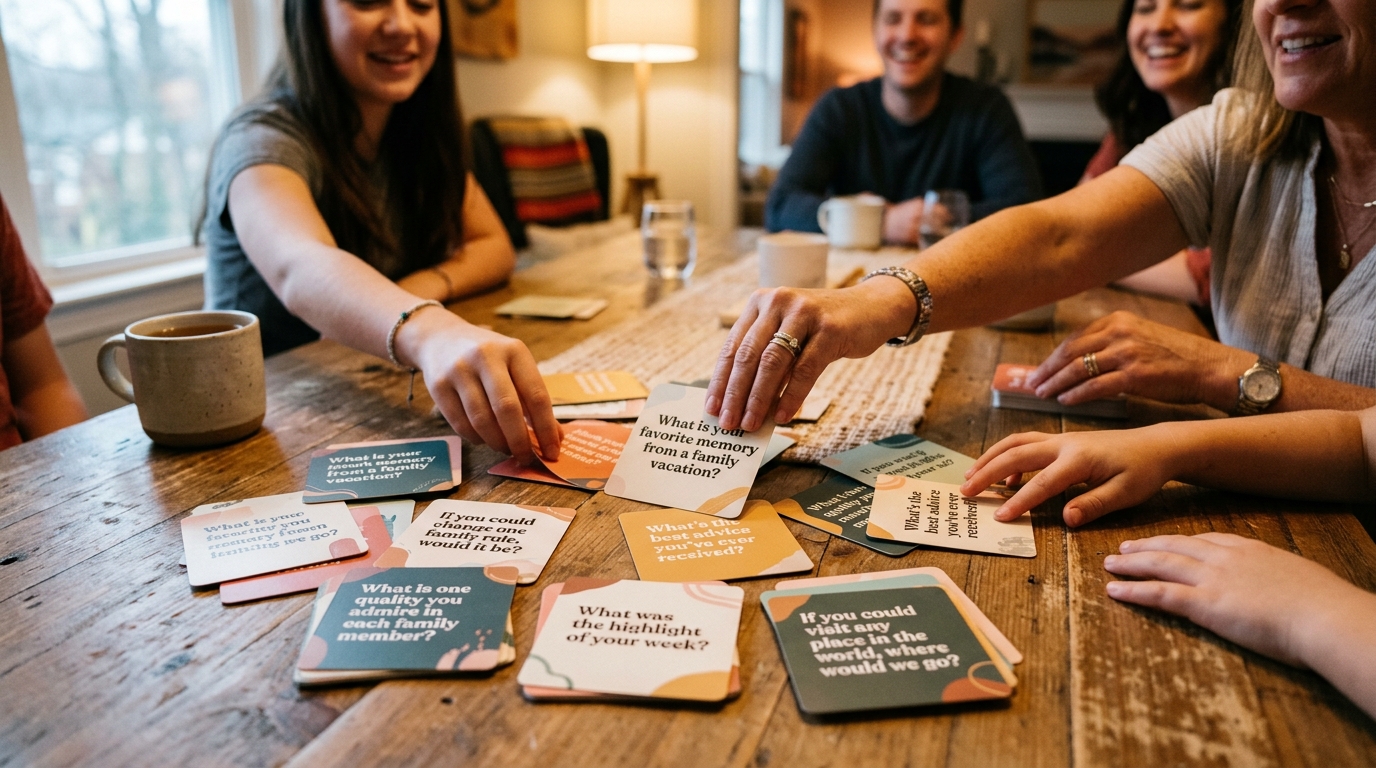
    Close-up view of conversation starter cards spread across a table with multiple family members' hands reaching toward them. The cards feature thoughtful questions designed to facilitate family dialogue, with warm, inviting lighting.

    Creating Non-Intimidating Communication Channels

    Conversation starters provide a structured way for children and adults to express thoughts and feelings without confrontation. Instead of a stepparent asking, "Why are you being difficult?" which triggers defensiveness, they might ask, "What’s something that’s been on your mind lately?" The prompt removes personal accusation while creating space for honest expression.

    Reducing Anxiety Around Sensitive Topics

    Structured communication reduces the anxiety that comes from directly addressing sensitive family topics. When a blended family uses conversation cards, everyone knows what’s coming. There are no surprise questions, no traps, no fear that a casual comment will turn into a conflict. This predictability creates safety.

    Building Communication Skills

    Family conversation cards help build stronger communication skills in children and increase their confidence in sharing thoughts. Consider 12-year-old Emma, who rarely spoke during family dinners until her stepmother introduced conversation cards. The prompts gave her a way to participate that felt safe. Over time, her confidence grew, and she began initiating conversations on her own.

    Teaching Respect for Different Viewpoints

    Guided questions teach children to respect different viewpoints-a crucial skill in blended households. When a conversation card asks, "What’s your perfect weekend?" and each family member answers differently, children learn that diversity in preferences doesn’t threaten relationships. This normalizes difference and builds tolerance for varied perspectives.

    "Communication is key in blended families to foster understanding. This structured and non-intimidating way for children to express their thoughts and feelings helps break down barriers that might exist in the family unit."

    • Family Toolbox & Resources

    Improving Turn-Taking and Listening

    Conversation games improve turn-taking, reduce interruptions, and help each family member feel heard and understood. In blended families where some members might dominate conversations while others withdraw, structured turn-taking ensures everyone has a voice. Over time, this pattern becomes habitual, transforming how families communicate outside formal conversation times.

    Building Trust Between Stepparents and Stepchildren Through Guided Dialogue

    The relationship between stepparents and stepchildren often determines the overall success of family blending. Trust develops gradually, and conversation starters provide a pathway to authentic connection.

    Starting With Genuine Interest

    Open-ended questions about interests, hobbies, and passions show genuine interest in stepchildren’s lives-the foundation of trust. Instead of questions that feel like monitoring ("Did you finish your homework?"), stepparents can ask:

    • "What’s been the most interesting thing you learned at school this week?"
    • "If you could spend a day doing anything, what would you choose?"
    • "What’s something you’re really good at that most people don’t know?"

    These questions signal curiosity rather than control, creating space for stepchildren to share their authentic selves.

    Learning Before Leading

    Stepparents should use conversation starters to learn about stepchildren’s experiences before offering guidance or discipline. When James married into a family with two teenage daughters, he resisted the urge to advise or correct during conversations. Instead, he used meaningful conversation topics to understand their worlds-their friendship dramas, their academic pressures, their dreams. Six months later, when he did offer guidance, they received it because he’d earned the right through listening.

    Understanding the Individual

    Questions about favorite memories, dreams, and opinions help stepparents understand stepchildren as unique individuals, not as extensions of their biological parent or obstacles to family harmony. The Martinez family used conversation cards during car rides, discovering that their stepson loved astronomy while their stepdaughter was passionate about environmental activism. These insights allowed them to connect in ways that generic family activities never would.

    Avoiding Interrogation Dynamics

    The key is avoiding questions that feel like interrogation. "Why did you get that grade?" feels threatening. "What subject do you find most challenging, and why?" feels exploratory. The difference lies in genuine curiosity versus assessment.

    Creating Predictability and Safety

    Consistent, low-pressure conversations create safety and predictability that fosters trust over time. When blended families establish regular conversation rituals-Sunday evening card games, dinner-time questions, bedtime check-ins-stepchildren know what to expect. They can prepare, they can relax, and they can gradually open up.

    Listening Without Judgment

    Stepparents who listen without judgment build the credibility needed for deeper emotional connections. When a stepchild shares something vulnerable during a conversation-card session, the response shouldn’t be immediate advice or correction. It should be acknowledgment. "Thank you for telling me that. I know that wasn’t easy to share." This validation builds the trust required for future openness.

    From Strangers to Allies: Strengthening Stepsibling Connections With Conversation Cards

    Stepsibling relationships have unique potential-they can become sources of support, understanding, and shared experience. But unlike biological siblings, who grow up together from infancy, stepsiblings must build connections amid existing family dynamics, loyalties, and habits.

    Discovering Common Ground

    Conversation cards that focus on shared interests help stepsiblings discover common ground naturally. Rather than forcing activities based on assumed similarities, guided questions reveal genuine connections:

    • "What kind of music do you like, and who’s your favorite artist?"
    • "What’s the best movie you’ve seen recently? What made it good?"
    • "If you could design a video game, what would it be about?"

    When stepsiblings discover shared interests, they have a foundation for relationship that isn’t forced or artificial.

    Choosing Collaboration Over Competition

    Collaborative conversation activities work better than competitive ones when building stepsibling bonds. Instead of games that pit stepsiblings against each other, use prompts that require joint effort:

    • "If we could plan a family vacation together, where would we go?"
    • "What’s something we could teach each other-what skills do we have?"
    • "If we had to solve a family mystery, what roles would we each play?"

    Building Empathy Through Sharing

    Questions about experiences at school, friend drama, and personal challenges create empathy and understanding. When stepsiblings hear about each other’s struggles-bullying at school, pressure to perform academically, social anxiety-they develop compassion. The walls between "your kids" and "my kids" begin to dissolve.

    "With new family dynamics, it’s important to establish a strong family bond from the beginning. A step-sibling can be a great ally in the blended family world. My number one suggestion is just to take time and do relationship-building activities."

    • Kenosis Center

    Respecting Boundaries

    Allow stepsiblings to pass on questions that feel too personal-comfort with vulnerability develops gradually. Not every step-sibling will be ready to share deep feelings immediately, and pushing them creates resistance. Let them choose lighter questions until trust builds.

    Celebrating Unique Strengths

    Celebrating each stepsibling’s unique strengths during conversations builds mutual respect and reduces competition. When families use conversation cards that highlight achievements and talents, stepsiblings see each other as individuals rather than competitors for parental attention. "What’s something you’ve improved at recently?" or "What makes you feel proud?" shift focus from comparison to personal growth.

    Merging Traditions and Creating New Family Rituals Together

    One of the most contentious aspects of blending families involves traditions and rituals. Whose holiday traditions get preserved? Which celebrations matter most? How do families honor multiple heritages, backgrounds, and memories without erasing anyone’s past?

    The Power of Combining Rather Than Choosing

    Merging traditions is critical-combine elements from each family’s past or invent entirely new rituals rather than choosing one over another. The Bennett-Harrison family faced this challenge during their first holiday season together. One family traditionally opened gifts Christmas morning; the other Christmas Eve. Rather than choosing, they created a new tradition: Christmas Eve pajamas and games, Christmas morning stockings and breakfast.

    This approach, facilitated by family discussions about what mattered most to each person, prevented feelings of loss or replacement.

    Conversation Starters for Tradition-Merging

    Conversation starters about holiday memories, favorite traditions, and new celebration ideas reveal what matters most to each family member:

    • "What’s your favorite holiday memory from before our families came together?"
    • "If we could create a brand new tradition, what would it be?"
    • "What’s something you hope we always do as a family, even when we’re older?"
    • "What tradition would you be sad to lose, and what would you be excited to try?"

    Empowering All Family Members

    "Engaging family members in brainstorming fosters new, inclusive, and enjoyable rituals. Regularly reassess rituals to adapt or replace them, ensuring they meet current and future family needs."

    • Psychology Today

    Questions like "What’s one tradition you’d love to start together?" empower children to contribute to family identity. When blended families let all members-children included-participate in creating traditions, ownership and belonging increase.

    Ongoing Evaluation

    Regularly reassess rituals through family conversations to ensure they meet current and future family needs. What worked when children were younger might not serve teenagers. Traditions that served grieving families initially might need revision as healing progresses. Annual conversations about traditions keep them meaningful rather than mandatory.

    Creating Through Collaboration

    Creating new traditions through collaborative decision-making gives all family members ownership and belonging. The Thompson-Williams family holds a yearly "tradition summit" where they discuss what worked, what didn’t, and what they want to try next year. This democratic approach prevents resentment and ensures rituals serve current family needs.

    Navigating Sensitive Topics: Boundaries, Loyalty Conflicts, and Open Communication

    The most challenging aspects of blended family life-boundaries, loyalty conflicts, grief, and adjustment-require careful handling. Direct confrontation often triggers defensiveness. Structured conversation provides an alternative approach.

    Establishing Boundaries Proactively

    Conversation starters help address boundaries and expectations in a structured, less confrontational way. Instead of waiting for conflicts to arise, blended families can use guided questions to establish ground rules:

    • "What makes you feel respected in our family?"
    • "How do you like to be asked for help-directly, with advance notice, or another way?"
    • "What’s something you wish everyone understood about how you like to communicate?"

    These questions surface preferences before they become problems.

    Clarifying Household Expectations

    Questions about household preferences, communication styles, and conflict resolution establish ground rules proactively. The Reynolds family used conversation cards to create a "family agreement" about shared spaces, quiet hours, and guest policies. Because everyone contributed to the discussion, enforcement felt fair rather than arbitrary.

    Creating Space for Loyalty Conflicts

    Help children articulate loyalty conflicts through prompts like "What’s been hard about our family coming together?" without blame. When children can express feeling torn between parents or missing their previous family structure without fear of upsetting anyone, those feelings lose their power to cause distance.

    Teaching Healthy Expression

    Use "I" statement prompts ("I feel valued when…") to teach healthy expression of needs and emotions. Instead of "You never listen to me," conversation cards guide children toward "I feel heard when people put down their phones while I’m talking." This skill-expressing needs without accusation-serves children throughout their lives.

    Reducing Defensiveness

    Discussing difficult topics through guided questions reduces defensiveness and increases openness to solutions. When conflicts are framed as "our family challenge" rather than "your behavior problem," collaboration replaces blame.

    Preventing Escalation

    Regular check-in conversations prevent small misunderstandings from becoming larger conflicts. Many blended families find that weekly conversation-card sessions surface issues while they’re still manageable, preventing the accumulation of resentment that leads to explosive arguments.

    Practical Family Conversation Starters That Work for Blended Households

    The right questions, asked at the right time, transform family dynamics. Here are specific family conversation starters organized by common blended family scenarios:

    Icebreaker Questions for Building Comfort

    These low-stakes questions work well when families are new to structured conversation:

    • "What’s something you’re really good at that most people don’t know?"
    • "What’s the best meal you’ve ever had, and what made it special?"
    • "If you could have dinner with anyone, living or dead, who would it be?"
    • "What’s a small thing that always makes your day better?"

    Bonding Questions for Deepening Connection

    As comfort grows, these questions facilitate deeper sharing:

    • "What’s a fun adventure you’d like our family to have together?"
    • "What’s something you wish everyone in this family knew about you?"
    • "Who do you feel most comfortable with in our family, and why?"
    • "What’s a memory you’ll never forget, for good or bad reasons?"

    Tradition-Building Questions for Creating Shared Culture

    These help families develop rituals and shared identity:

    • "If we could create a new family holiday, what would we celebrate?"
    • "What’s a tradition from your past you’d like to bring into our family?"
    • "What’s something you hope we still do together in 10 years?"
    • "If we had a family motto, what would it be?"

    Understanding Questions for Processing the Blending Experience

    These create space for honest discussion of the transition:

    • "What’s been the easiest part about our family coming together? What’s been the hardest?"
    • "What surprised you about living in a blended family?"
    • "What’s something that’s gotten better since our families merged?"
    • "What do you think people misunderstand about step-families?"

    Future-Focused Questions for Building Hope

    These shift attention toward shared goals:

    • "What’s one thing you’re excited about for our family next year?"
    • "If our family could accomplish anything together, what would it be?"
    • "What kind of relationship do you hope to have with your stepsiblings in five years?"
    • "What’s something you’re looking forward to as we grow as a family?"

    Appreciation Questions for Building Positivity

    Gratitude transforms family dynamics:

    • "Who in this family made you smile recently, and what did they do?"
    • "What’s something someone did for you that you really appreciated?"
    • "Who in this family is really good at making people feel welcome?"
    • "What’s something about our family you’re grateful for?"

    For families seeking structured resources, digital conversation starter platforms like Convo Cards offer organized question packs with themes specifically designed for relationships, family time, and adventures. These platforms provide curated prompts that take the guesswork out of choosing the right questions for each family stage.

    Making Family Conversation Time Successful: Tips for Lasting Results

    Implementing regular family conversations requires strategy. Here are evidence-based practices for success:

    Timing Is Everything

    Schedule regular conversation times during low-stress moments like car rides, dinners, or weekend mornings. Avoid times when family members are rushed, tired, or hungry. The Garcia family found that Sunday afternoon conversations worked best-everyone was relaxed, homework was complete, and there was no pressure to rush anywhere.

    Start Short and Build

    Keep sessions short (15-20 minutes) initially to build comfort with the format, especially with reluctant family members. Teenagers, in particular, may resist lengthy emotional discussions. Brief, regular conversations feel more manageable than marathon sessions.

    Create Safety Through Structure

    Create a no-judgment zone where all answers are respected and interruptions aren’t allowed. Establish basic rules: no mocking answers, no arguing about opinions, no forced sharing if someone wants to pass. When families create psychological safety, honesty flourishes.

    Balance Depth and Lightness

    Mix deep questions with light-hearted ones to maintain engagement and prevent emotional fatigue. Not every conversation needs to be profound. Sometimes "What superpower would you want?" is exactly what families need-especially after a stressful week.

    Model Vulnerability

    Parents and stepparents should participate fully, sharing vulnerably to model openness. When adults share fears, mistakes, or vulnerabilities, it gives children permission to do the same. The most successful blended families feature adults who are willing to go first.

    Progress, Not Perfection

    Start with easier topics and progress to deeper conversations as trust and comfort build. There’s no prize for tackling the hardest questions immediately. Let relationships dictate the pace.

    Track Progress and Celebrate Milestones

    Track progress and celebrate milestones in family bonding to maintain motivation and positive momentum. Did the family go a whole month without a major argument? Did a stepsibling pair finally find common ground? Mark these moments-they’re evidence of growth worth celebrating.

    The Long-Term Payoff: Stronger Bonds and Healthier Family Dynamics

    The investment in family conversation starters yields dividends that extend far beyond improved dinner-table discussions. Consider what research and family experience reveal about the long-term impact.

    Stylized illustration showing diverse family members connected by golden glowing threads, symbolizing the building of relationships and trust in a blended family. Each figure maintains their individuality while being woven together in unity.

    Deeper Understanding Across Relationships

    Consistent use of family conversation starters leads to deeper understanding, empathy, and trust across all family relationships. Stepparents who understand their stepchildren’s inner worlds navigate challenges more effectively. Stepsiblings who know each other’s struggles offer support instead of competition. Spouses who discuss their blending process stay united rather than divided.

    Communication Skills for Life

    Children develop stronger communication skills and emotional intelligence that serve them throughout life. The ability to express feelings respectfully, listen without judgment, and navigate difficult conversations isn’t just useful in blended families-it’s essential in romantic relationships, friendships, and professional environments.

    Stability That Helps Children Thrive

    Blended families who communicate openly create stability and belonging that helps children thrive socially and emotionally. Children in high-conflict families struggle regardless of family structure. Children in stable, communicative stepfamilies often outperform peers in high-conflict nuclear families. The variable isn’t family type-it’s family health.

    Accessible and Affordable

    Conversation tools provide a low-pressure, affordable way to invest in family relationships without expensive therapy or programs. At $4.99 per year, digital conversation starter platforms offer exceptional value compared to the $20-30 cost of physical card sets or $18-70 annual subscriptions to specialized apps. This accessibility means families can start building better communication today, without waiting for budget approval.

    Making the Path Smoother

    The journey from strangers to family takes time, but guided conversations make the path smoother and more meaningful. There’s no shortcut to blending families successfully-but there are tools that make the journey less lonely, less confusing, and more likely to arrive at the destination: a unified, connected family where everyone belongs.

    "Blending two families together is a beautiful but complex journey."

    • Talkspace

    It is indeed beautiful-two families becoming one, creating something new out of separate histories. It is also complex, requiring intention, patience, and persistence. Family conversation starters don’t eliminate the complexity, but they provide pathways through it, turning difficult conversations into opportunities for connection, transforming strangers into family, one question at a time.

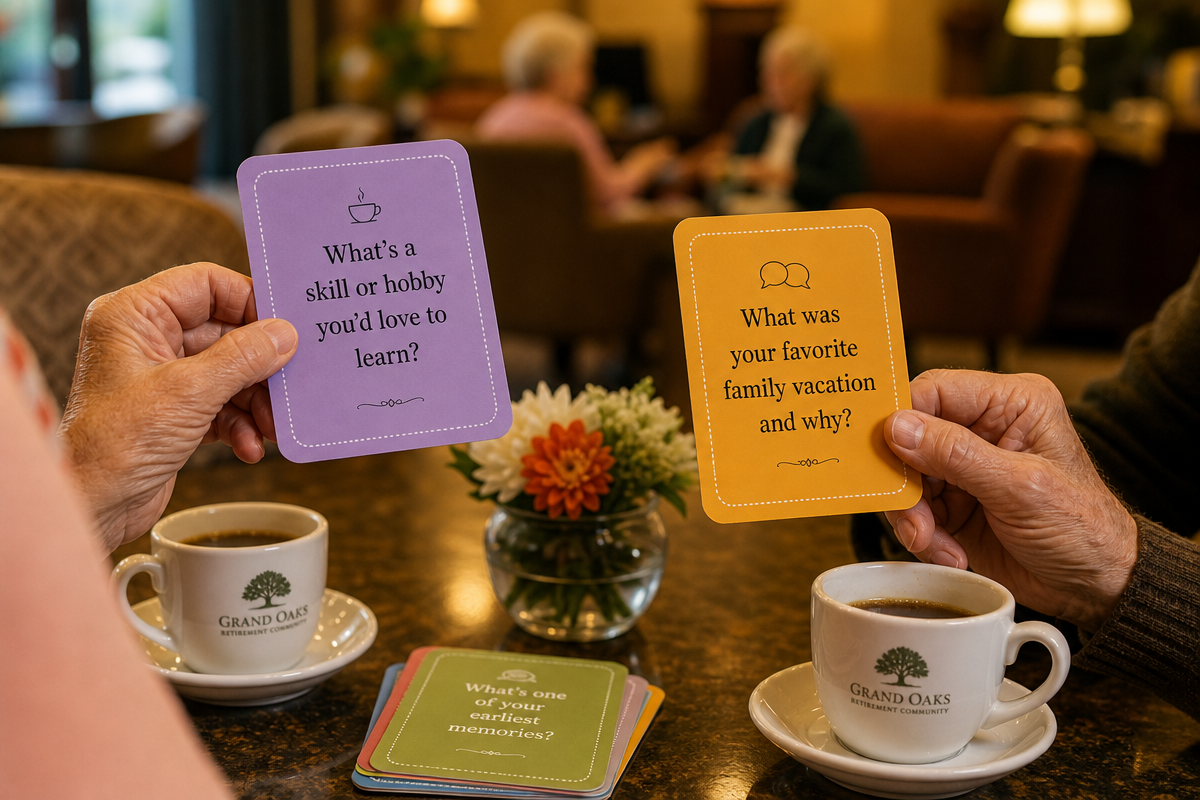
  • Building Hybrid Team Culture When Some Employees Are Remote and Others Are Onsite

    Building Hybrid Team Culture When Some Employees Are Remote and Others Are Onsite

    In late 2025, a manager at a growing tech company noticed something troubling: her remote team members were consistently passed over for promotion, while those who came into the office three days a week advanced more quickly. When she investigated, she found the culprit wasn’t performance-it was proximity. In-office employees naturally had more face time with leadership, more casual interactions, and more visibility in meetings. Her experience isn’t unique. According to recent data, 41% of leaders now identify inequities between in-office and remote employees as a top concern-a significant 8% rise from just the previous quarter.

    As we enter 2026, hybrid work has graduated from emergency experiment to long-term default for knowledge workers. Yet organizations are discovering that maintaining unified culture across physical and virtual spaces requires deliberate, ongoing effort. The challenges are clear: scheduling conflicts, measuring productivity across locations, and most critically, preventing the formation of a two-tier employee experience where proximity determines opportunity.

    The urgency is real. Gallup’s latest data shows only 32% of US employees were engaged at work in 2025-among the lowest recorded levels in decades. Globally, engagement sits at just 21%, creating a staggering $438 billion worldwide productivity loss. For hybrid teams, the risk of fragmentation is particularly acute. Without intentional design, the natural advantages of physical presence create invisible barriers that undermine inclusion, collaboration, and performance.

    Understanding Proximity Bias: The Invisible Threat to Inclusion

    Proximity bias occurs when in-office employees naturally receive more attention, opportunities, and recognition than remote colleagues-often without conscious intent. It’s the subtle preference that develops when decision-makers have more visibility and casual interaction with those physically present.

    Conceptual illustration showing proximity bias in the workplace - a remote worker appears faded in the background while in-office employees are prominently featured in the foreground, highlighting the invisible barriers that create inequity between physical and virtual team members.

    The manifestations are pervasive. In-room attendees tend to dominate discussions without meaning to, creating participation imbalances that marginalize virtual participants. Remote workers miss critical relationship-building opportunities that happen in informal spaces-hallway conversations, coffee breaks, post-measure debriefs. Over time, these seemingly small moments accumulate into significant disparities in career advancement, access to influential networks, and visibility for high-profile projects.

    The consequences extend beyond fairness. When proximity bias goes unchecked, it creates a two-tier employee experience that fractures team culture. Remote workers report feeling like second-class citizens, less connected to organizational mission and less invested in collective success. The proximity gap becomes a self-reinforcing cycle: those in the office get more opportunities, which leads to better outcomes, which justifies more opportunities-while remote colleagues stagnate despite equal capability.

    The Business Case for Virtual Team Building Activities

    The financial imperative for addressing hybrid fragmentation is compelling. Virtual and hybrid team-building activities generate $4-6 return for every $1 spent through reduced turnover costs, higher productivity, and improved communication efficiency. Despite common misconceptions that digital connection is inferior to in-person bonding, the data suggests otherwise.

    Virtual team-building events cost approximately 75% less than in-person alternatives, saving an average of $42,000 per session. Despite the lower cost, they deliver up to 12% higher ROI than traditional in-person alternatives. This efficiency stems from reduced logistics, no travel requirements, and the ability to facilitate more frequent, lower-touch interactions rather than expensive quarterly offsites.

    "Organizations that invest in comprehensive engagement programs, including team building, see an 87% reduction in turnover rates."

    The retention impact is particularly significant. Companies running regular connection programs report up to 87% reduction in turnover rates. Teams with high engagement see 36% lower voluntary turnover and 14% productivity increases. Consider the cumulative effect: replacing a knowledge worker costs 1.5-2x their annual salary. For a team of ten employees earning an average of $80,000, reducing turnover from 25% to 10% saves approximately $120,000 annually-far more than the cost of implementing virtual team-building activities.

    The market has taken notice. The US team-building market grew 21.74% year-over-year to $4.74 billion in 2024, with virtual team-building adoption growing 25-fold since the pandemic began. This growth reflects a fundamental shift in how organizations approach team connection-not as optional social events, but as essential infrastructure for hybrid performance.

    Why Traditional Team-Building Fails in Mixed Environments

    Most team-building exercises weren’t designed for simultaneous in-person and virtual participation. Escape rooms, rope courses, and collaborative competitions rely heavily on physical presence and shared space. When hybrid teams attempt these activities, remote workers become observers rather than participants, watching through a screen while their in-office colleagues engage in the primary experience.

    Even less physically intensive activities create exclusion. Activities that rely on shared materials, in-person improvisation, or physical movement disadvantage those joining via video. Without structured facilitation, hybrid activities default to centering in-office experiences-the camera captures the conference room, conversation flows between those seated together, and remote participants struggle to find entry points.

    The result is the opposite of inclusion: team-building that reinforces the very divides it’s meant to bridge. Remote workers withdraw, feeling that connection opportunities aren’t designed for them. In-office employees bond with each other while their virtual colleagues remain peripheral. The exercise compounds the proximity bias it should address.

    Success requires conversation frameworks specifically engineered to bridge the location gap-activities designed from the ground up for equal participation regardless of physical presence.

    Virtual Team Building Activities That Equalize Participation

    Effective virtual team building activities share a common characteristic: they require equal contribution from all participants regardless of location. Rather than relying on physical props or shared space, these activities leverage verbal communication, text-based collaboration, and structured dialogue frameworks that work seamlessly across video and in-person environments.

    Hybrid team engaged in virtual team building activities - in-office employees gather around a large monitor showing multiple video call participants in a grid layout, all smiling and collaborating together in a bright, energetic workplace setting.

    Consider the success of conversation starter platforms and curated question packs. These tools provide structured frameworks for dialogue that don’t privilege either location. A well-crafted question about work challenges, personal values, or problem-solving approaches engages onsite and remote participants equally. Because the interaction happens through verbal or text-based communication, no group has an inherent advantage.

    Proven approaches include:

    • Structured storytelling sessions where each team member shares a brief professional or personal anecdote in response to a curated prompt
    • Collaborative problem-solving exercises using virtual whiteboards where all participants contribute through shared digital workspaces
    • Asynchronous connection activities that accommodate different time zones and schedules, such as shared photo challenges or virtual coffee chats scheduled across time zones
    • Rotating activity leadership where remote and in-office team members alternate facilitation roles, ensuring equal visibility and leadership opportunities

    The key is intentionality. Without deliberate design, hybrid activities naturally default to favoring in-person participants. Successful virtual team-building requires explicit structures that equalize participation-clear turn-taking protocols, prepared questions that work across contexts, and facilitation practices that ensure remote voices aren’t drowned out by in-room dynamics.

    Structuring Hybrid Meetings for Inclusive Dialogue

    Every hybrid meeting presents a choice: will it be inclusive by design, or will it default to centering in-office participants? The difference lies in deliberate facilitation practices that prevent proximity bias from shaping interaction patterns.

    "It’s easy for in-room attendees to dominate the discussion without meaning to. Assigning a facilitator can help make sure both remote and in-person participants are equally engaged."

    Essential facilitation protocols include:

    1. Dedicated facilitator role – Assign someone specifically responsible for ensuring balanced participation, rather than assuming meeting leaders will naturally manage equity
    2. Remote-first mindset – Call on virtual attendees before in-room participants, preventing the natural tendency to solicit input from those physically present first
    3. Advance agenda sharing – Distribute meeting materials and discussion prompts 24-48 hours ahead so remote workers can prepare equally with onsite colleagues
    4. Structured turn-taking – Leverage virtual hand-raise features and explicit speaking order to prevent in-room domination
    5. Rotating facilitation – Ensure remote employees have equal opportunities to lead meetings and shape discussion flow
    6. Location-agnostic icebreakers – Start every hybrid meeting with inclusive opening questions that work across locations

    Consider a weekly team status meeting. Without intervention, in-office participants might exchange casual updates while remote colleagues wait for formal turn-taking. With intentional facilitation, the meeting begins with a structured check-in question, proceeds through a clear agenda that calls on each participant systematically, and includes the facilitator explicitly inviting remote input when in-room side conversations emerge.

    These practices aren’t burdensome-they become habits. Over time, equitable facilitation becomes part of team culture rather than something that requires constant conscious effort.

    Team Building Questions for Hybrid Teams

    The right conversation starters can transform hybrid dynamics. Effective team building questions share three characteristics: they don’t reference physical presence or location-specific contexts, they reveal personal experiences and work styles regardless of where someone sits, and they allow everyone to contribute equally without relying on visual context.

    Examples of location-agnostic questions:

    • "What’s a project you worked on recently that taught you something new about your own working style?"
    • "Describe a time when you had to collaborate across different perspectives to solve a problem-what made it successful?"
    • "What’s one skill you’ve developed during your time here that you’re particularly proud of?"
    • "Share about a mentor or colleague who influenced your professional approach-what did you learn from them?"
    • "What type of work environment helps you do your best thinking, and how can we create more of those conditions?"

    Contrast these with questions that inadvertently privilege in-office workers: "Who in the office do you collaborate with most frequently?" or "What’s your favorite spot in the building for focused work?" These create immediate divides-remote workers can’t answer meaningfully, or they’re forced to acknowledge their exclusion from daily office life.

    Conversation starter apps provide ready-made question frameworks designed for mixed environments. Curated question packs reduce friction and help teams bypass small talk to build authentic connections. Rather than relying on spontaneous conversation that naturally favors those sharing physical space, structured questions ensure consistent, equitable interaction patterns.

    The key is regularity. Structure regular check-in questions as part of meeting cadence to normalize cross-location dialogue. When team building questions become routine rather than special occasions, they reinforce that all locations are equally valued spaces for collaboration and connection.

    Remote Team Icebreaker Questions That Work for Everyone

    Icebreakers set the tone for hybrid interactions. Done poorly, they reinforce divides; done well, they signal that virtual presence is as valid as physical presence. The difference lies in thoughtful design that doesn’t rely on visual context or shared physical experience.

    Effective remote team icebreaker questions:

    • Universal experiences: "What’s a small win from this week that you’re proud of?" or "What’s one thing you’re looking forward to outside of work?"
    • Work-style insights: "Describe your ideal workflow for a complex project-do you prefer deep focus, frequent check-ins, or something in between?"
    • Creative prompts: "If you could instantly master one new professional skill, what would it be and why?"
    • Connection builders: "What’s a book, podcast, or article that changed your thinking about work recently?"

    Each of these works equally well for someone in a conference room and someone joining from a home office. They tap into universal experiences rather than office-specific moments. They’re location-agnostic and don’t reference physical proximity cues.

    Conversation starter platforms for remote teams provide themed icebreakers ready for any occasion-whether kicking off a project, welcoming a new team member, or facilitating regular check-ins. The structure ensures consistency and quality, removing the burden on meeting leaders to constantly invent new prompts.

    Use icebreakers as a consistent practice to reinforce that all locations are equally valued. When every meeting begins with inclusive questions designed for full participation, teams establish patterns of equitable interaction that counteract proximity bias.

    Building Cross-Location Trust Through Intentional Connection

    Trust in hybrid teams requires deliberate design around equitable communication practices. In traditional offices, trust emerges through casual interactions-shared coffee breaks, spontaneous hallway conversations, post-measure debriefs. Hybrid teams lose these natural touchpoints by default. Without them, connection requires intention.

    "Without natural ‘water cooler’ moments, building genuine connections requires intentional effort."

    The solution isn’t to replicate office dynamics digitally-it’s to create deliberately designed social interaction opportunities that work within hybrid constraints. Regular icebreaker questions and structured conversation frameworks create predictable connection touchpoints. When team members know that every meeting will include space for personal interaction, they can prepare and engage fully regardless of location.

    Consistent use of conversation starters builds familiarity that transcends location differences. Over time, teams develop shared reference points and mutual understanding that don’t depend on physical proximity. Remote workers become full participants rather than peripheral observers.

    Leadership plays a crucial role. When executives model inclusive communication behaviors-calling on remote participants first, explicitly soliciting virtual input, acknowledging proximity bias and addressing it directly-they signal that all locations are equally valued spaces for contribution and collaboration.

    Creating a Unified Hybrid Culture: Your Action Plan

    Building inclusive hybrid team culture isn’t a one-time initiative-it’s an ongoing practice that requires consistent attention and iterative improvement. The most successful organizations approach it systematically, implementing multiple strategies that reinforce equitable patterns across the employee lifecycle.

    Professional split-screen illustration of inclusive hybrid team collaboration - diverse professionals in a modern office on the left and remote team members on a video call screen on the right, both sides equally prominent, engaged, and lit, emphasizing equality across physical and virtual workspaces.

    Your implementation roadmap:

    1. Implement Regular Virtual Team Building Activities

    Establish virtual team building activities as a consistent practice rather than occasional events. Weekly or bi-weekly structured conversations create rhythm and predictability. Use conversation starter apps and curated question packs to standardize practices across teams and ensure quality.

    2. Establish Proximity Bias Monitoring

    Include proximity bias assessment as part of regular leadership reviews and promotion decisions. Track engagement metrics separately by location to identify emerging cultural divides. Analyze promotion rates, performance ratings, and high-visibility project assignments to ensure equitable distribution across locations.

    3. Require Inclusive Meeting Facilitation Training

    Provide inclusive meeting facilitation training for anyone leading hybrid team discussions. Cover remote-first mindset, facilitator protocols, virtual hand-raise features, and structured turn-taking. Make these practices part of leadership competencies and performance expectations.

    4. Build Cross-Location Rotation Programs

    Create opportunities for employees to experience both remote and in-office perspectives. Rotation programs build empathy and understanding while ensuring all team members have equal access to relationship-building opportunities and leadership visibility.

    5. Track Engagement Metrics by Location

    Survey employee engagement separately by location to identify emerging disparities. Monitor participation rates in meetings, contribution patterns in collaborative projects, and satisfaction with connection opportunities. Use data to target interventions where proximity bias emerges.

    6. Start Small and Scale

    Begin with weekly team building questions and structured icebreakers. Measure impact on participation patterns and team cohesion. Scale to comprehensive hybrid culture programs as practices prove effective and teams internalize inclusive habits.

    The organizations that thrive in 2026 and beyond will be those that recognize hybrid work not as a challenge to overcome but as an opportunity to reimagine how teams connect, collaborate, and perform. By implementing virtual team building activities with intentionality, equity, and consistency, leaders can build unified cultures that transcend physical boundaries and unlock the full potential of distributed talent.

    The tools exist. The ROI is proven. The question is whether organizations will move from awareness to action-building hybrid team cultures that work for everyone, regardless of where they sit.

  • How Newlywed Couples Can Build Lasting Communication Habits Early

    How Newlywed Couples Can Build Lasting Communication Habits Early

    A longitudinal study tracking 431 newlywed couples over 2.5 years revealed a startling truth: the communication patterns you establish in your first year of marriage will likely determine your relationship’s trajectory for decades. Couples identified as "best communicators" at the start experienced a 9% divorce rate, while those labeled "worst communicators" faced a 22% divorce rate-more than double. The message is clear: early habits aren’t just important-they’re predictive.

    Yet here’s what most newlyweds miss: the first year isn’t about maintaining wedding-day bliss. It’s about what happens when Instagram expectations meet Tuesday night reality. The coping mechanisms, communication styles, and conflict resolution patterns that emerge during those first 12 months tend to remain stable over time. Research shows that problematic communication patterns are often already evident at the time of marriage, making the newlywed period a critical window for intentional skill-building.

    The solution isn’t grand gestures or weekend retreats. It’s something far simpler and more sustainable: structured conversations using relationship building questions. By creating regular space for meaningful dialogue early in your marriage, you can establish patterns that strengthen your bond for the long haul.

    Why the First Year Sets Your Marriage’s Communication Trajectory

    The research on newlywed communication development paints a consistent picture: communication behavior remains remarkably stable over the newlywed years. Hannah C. Williamson’s study in the Journal of Family Psychology found that "early interaction dynamics tend to be enduring and predictive of relationship outcomes." In other words, how you communicate now is how you’ll communicate-unless you take intentional steps to change.

    A newlywed couple sitting together on a comfortable couch in a cozy living room, engaged in meaningful conversation over coffee, creating a peaceful atmosphere of intentional communication
    Creating space for meaningful dialogue early in your marriage establishes patterns that strengthen your bond for the long haul.

    The study identified three distinct communication trajectory groups among newlyweds:

    Communication Type Characteristics Divorce Rate
    Best Communicators High positivity and effectiveness, low negativity 9%
    Middle Group Low levels across all dimensions Intermediate
    Worst Communicators Low positivity and effectiveness, high negativity 22%

    Perhaps most revealing: premarital communication quality already predicts marital distress. The patterns couples bring into marriage often continue without intervention. As the University of Florida’s SMART Couples project notes, "The early years of your marriage are crucial. Research suggests that the patterns we develop early on generally tend to continue, so it’s important to get into good habits from the start."

    This creates both a challenge and an opportunity. The challenge: communication patterns are resistant to natural change. The opportunity: intentional intervention during the newlywed period can establish positive trajectories before problems become entrenched.

    The first year matters precisely because it’s when expectations collide with reality. Couples who believe their marriage will remain as happy as their wedding day are actually less happy long-term-they lack realistic expectations about the work required to maintain connection. The question isn’t whether you’ll face challenges in your first year. It’s whether you’ll develop the communication skills to navigate them together.

    The Top 7 Challenges Newlyweds Face (And How to Talk About Them)

    University of Florida researchers identified seven consistently problematic areas for newlyweds. These aren’t occasional sources of tension-they’re the fault lines where marriages either strengthen or fracture:

    1. Debt and money management
    2. Balancing work and family
    3. Sex frequency and preferences
    4. Time allocation and leisure choices
    5. Dividing household tasks
    6. In-law and family boundaries
    7. Communication and conflict resolution

    What’s striking about these challenges? Most stem from unspoken expectations rather than intentional conflict. You and your spouse arrive at marriage with different assumptions about money, time, household responsibilities, and family involvement-assumptions formed by your upbringing, your single life, and your cultural background. Without structured conversations to surface these differences, resentment builds silently.

    Consider the finding that 75% of the happiest couples treat their spouse with at least as much courtesy as they would a friend. This seems obvious-yet newlyweds often extend more patience and politeness to acquaintances than to their partner. The daily grind of shared living space, financial decisions, and household management can erode basic courtesy unless couples are intentional about maintaining it.

    Financial disagreements warrant special attention. Experts recommend couples never let money conflicts go more than 24 hours without open communication. The research supports scheduling monthly "review meetings" to discuss financial goals and upcoming life events-transforming money from a source of tension into a collaborative project.

    Structured conversations using relationship building questions provide the mechanism to address these challenges systematically. Instead of waiting for conflicts to erupt, proactive couples create regular space to discuss expectations, align on approaches, and build shared understanding across these seven critical areas.

    Relationship Building Questions: The Science of Deeper Connection

    How do simple questions strengthen marriages? Research reveals three key mechanisms that deepen emotional intimacy through regular guided conversations:

    Slowing Down to Ask and Listen

    "Small moments deepen closeness by slowing down, asking gentle questions, and listening with care. Curiosity builds safety when you share fears, dreams, and needs, then respond with empathy." – Marriage.com relationship experts

    The first mechanism is deceptively simple: slowing down. In our distracted, device-filled lives, genuine attention has become scarce. When you ask a meaningful question and then listen-really listen-without preparing your response, you create a moment of focused connection. This signals to your spouse: "You matter. Your inner world matters. I want to understand you."

    Questions act as tools to bypass small talk and access the conversations that actually strengthen bonds. "How was your day?" yields logistical updates. "What made you feel most appreciated today?" invites emotional disclosure. The difference isn’t subtle-it’s transformative.

    Building Safety Through Vulnerable Sharing

    The second mechanism involves creating psychological safety. When you share fears, dreams, and needs-and your spouse responds with empathy rather than judgment-you build trust over time. This safety enables deeper vulnerability in future conversations.

    Curiosity builds safety. Instead of assuming you know your partner’s thoughts, you ask. Instead of judging their perspective, you seek to understand it. Over time, these exchanges create a foundation of security that allows couples to navigate difficult topics without triggering defensive responses.

    Creating Unity Through Aligned Goals

    The third mechanism focuses on shared vision. When couples use questions to explore their individual goals and find alignment-supporting each other’s growth while creating shared objectives-they strengthen their sense of "us." This unity doesn’t eliminate conflict, but it provides a shared context that makes resolution easier.

    A modern young couple sitting at a kitchen table with notebooks and laptop, collaboratively planning their future together in a bright, hopeful setting
    Using structured conversations and relationship building questions transforms vague aspirations into concrete shared goals.

    Regular structured conversations prevent common communication pitfalls by creating dedicated space for meaningful dialogue. Without this intentional space, conversations default to logistics: schedules, to-do lists, household management. While necessary, these exchanges rarely deepen connection. Making relationship building questions a habit early establishes patterns that continue throughout marriage.

    Couples Conversation Starters for Discussing Finances and Future Goals

    Money remains one of the top sources of marital conflict-but it’s also an area where structured conversations can prevent problems before they start. Financial experts recommend specific approaches for newlyweds:

    Monthly Financial Review Meetings

    Schedule a regular monthly meeting to discuss:

    • Current financial status and upcoming expenses
    • Progress toward shared goals
    • Any concerns about spending or debt
    • Adjustments needed in the budget

    Never let financial disagreements go more than 24 hours without open communication. The longer money conflicts fester, the more resentment builds-and the harder they become to resolve.

    Using Couples Conversation Starters Effectively

    The key is moving beyond transactional discussions ("How much did you spend?") to exploratory conversations ("What does financial security mean to us?"). Effective conversation starters help explore:

    • Money histories: "What did you learn about money from your family growing up?"
    • Spending values: "Which purchases make you feel most satisfied, and why?"
    • Debt approaches: "How do you feel about our current debt, and what’s our strategy?"
    • Shared financial vision: "What does financial freedom look like for us in five years?"

    These conversations reveal the deeper values and fears driving financial behavior. You might discover that your spouse’s apparent stinginess stems from childhood financial insecurity, or that your spending reflects a desire to create memorable experiences. Understanding these underlying motivations transforms money from a battleground to a collaborative journey.

    Aligning on Major Life Decisions

    Beyond day-to-day finances, couples conversation starters help align on major life decisions:

    • "Where do we want to be living in 5-10 years, and what steps get us there?"
    • "How do we balance career ambitions with our relationship priorities?"
    • "What’s our timeline for major purchases (home, vehicle, etc.)?"
    • "How do we approach saving for retirement while enjoying life now?"

    These conversations won’t eliminate all financial disagreements-but they’ll ensure those differences occur within a context of shared understanding and aligned goals.

    Date Night Questions That Build Intimacy Beyond the Honeymoon Phase

    The wedding excitement inevitably fades. Tuesday replaces Saturday. Work stress, household chores, and daily logistics crowd out the intentional connection that defined your dating and engagement period. This is where date night questions become essential-not to replace wedding-day romance, but to build sustainable intimacy that endures reality’s return.

    Transforming Date Nights Beyond Logistics

    Many couples default to using date nights for logistical discussions: calendar coordination, decision-making, problem-solving. While necessary, these conversations rarely deepen emotional connection. Effective date nights require dedicated questions that maintain intimacy:

    • "What’s something you’ve been hesitant to share with me lately?"
    • "When do you feel most loved by me, and when do you feel most disconnected?"
    • "What’s a dream you’ve never mentioned, and how can I support it?"
    • "How can we make our relationship a priority during stressful seasons?"

    When wedding excitement fades, structured conversations keep partners engaged and learning about each other. The goal isn’t recreating early relationship intensity-it’s building mature intimacy based on deep understanding and intentional connection.

    Essential Communication Techniques

    Effective conversation requires more than good questions. Communication research highlights several techniques for newlyweds:

    • Active listening: Listen to understand, not to prepare your response
    • "I" statements: Replace "You never…" with "I feel when…"
    • Clarifying questions: Check assumptions before reacting
    • Emotional acknowledgment: Validate feelings before problem-solving

    The last point proves crucial. Jumping straight to solutions when your spouse shares a struggle can feel dismissive. Acknowledging emotions first-"That sounds really frustrating"-creates safety before collaborative problem-solving.

    Preventing the Drift

    Regular check-in conversations during date nights prevent drifting apart during the daily routine. Without this intentional space, couples often wake up years later realizing they’ve become strangers sharing a house. Date night questions provide the antidote: consistent, structured opportunities to deepen understanding and renew connection.

    From Expectations to Reality: Using Deep Conversation Starters to Bridge the Gap

    The gap between wedding expectations and Tuesday night reality shocks many newlyweds. You expected passion and adventure; you got dishes and deadlines. You assumed alignment on major decisions; you discovered profound differences. This reality check isn’t a sign of failure-it’s an invitation to deeper understanding through intentional communication.

    Deep conversation starters reveal differences in communication styles, habits, and coping mechanisms that only emerge after marriage. During dating, you presented your best selves. Now you’re seeing each other tired, stressed, and unfiltered. The question is whether you’ll use this reality as a wedge or a bridge.

    The Power of Focus

    "Whatever you focus on and talk about with regard to your spouse will steer your feelings about your spouse. Either toward the positive-or the negative." – Shaunti Feldhahn, marriage researcher and author

    This insight transforms how newlyweds approach communication. Venting about your spouse’s shortcomings doesn’t just relieve frustration-it reinforces neural pathways associated with anger and resentment. Each complaint strengthens negative focus, creating a self-perpetuating cycle of dissatisfaction.

    Deep conversation starters redirect this focus toward understanding. Instead of "Why are you so messy?" the question becomes "How do you approach household organization, and how did that develop in your childhood?" Instead of "You never listen to me," try "What makes you feel most heard in our conversations?"

    Practical Applications

    Structured conversations help navigate specific newlywed challenges:

    Daily life preferences:

    • "What does a relaxing evening look like for you?"
    • "How do we balance our different energy levels after work?"
    • "What household tasks drain you most, and which ones do you enjoy?"

    Household expectations:

    • "What standard of cleanliness feels comfortable for each of us?"
    • "How do we handle unexpected messes or visitors?"
    • "Who manages which household responsibilities, and do we need to adjust?"

    Conflict styles:

    • "How do you prefer to resolve disagreements-immediately or after cooling down?"
    • "What do you need from me when we’re arguing?"
    • "How do we repair connection after a difficult conversation?"

    These questions reveal the reasoning behind behaviors that might otherwise generate frustration. Understanding that your spouse’s insistence on immediate conflict resolution stems from childhood anxiety about unresolved tension transforms irritation into empathy.

    Family Planning and Boundaries: Questions for Aligning Your Vision

    In-law and family boundaries rank among the top seven newlywed problem areas-yet couples rarely discuss them proactively. The assumption that you and your spouse share identical approaches to family involvement leads to conflict when holiday seasons arrive, parents offer unsolicited advice, or siblings demand attention.

    Proactive Family Boundaries Discussions

    Use structured conversations to explore family dynamics before situations arise:

    Holiday traditions and boundaries:

    • "Which holiday traditions from your childhood do you want to continue?"
    • "How do we balance time between our families during holidays?"
    • "What new traditions do we want to create as a couple?"

    Frequency of family contact:

    • "How often do you envision talking to or seeing your parents?"
    • "What boundaries do we need around unsolicited advice or criticism?"
    • "How do we handle family emergencies or requests for help?"

    Decision-making boundaries:

    • "Which decisions do we make independently, and which involve our families?"
    • "How do we present a united front to our parents even when we disagree?"
    • "What information about our marriage is private versus shareable with family?"

    Clarifying Parenting Expectations Early

    Children magnify existing family dynamics-making early alignment essential. Discussion starters help navigate different approaches:

    • "What did your parents do well in parenting, and what would you do differently?"
    • "What’s our timeline for having children, and how flexible are we?"
    • "How involved should extended family be in our parenting decisions?"
    • "What are our non-negotiables in parenting philosophy?"

    These conversations reveal potentially significant differences in parenting values, discipline approaches, and family involvement. Discovering these differences before pregnancy allows for thoughtful discussion rather than reactive conflict during the stress of new parenthood.

    Navigating Different Family-of-Origin Styles

    Every family has unique patterns-some emotionally expressive, some reserved. Some deeply involved in each other’s lives, some fiercely independent. Discussion starters help couples create shared approaches:

    • "What’s the emotional climate like in your family, and how does that affect our marriage?"
    • "How do we handle it when our families have different expectations for us?"
    • "What boundaries protect our marriage while still honoring our parents?"

    Early alignment prevents conflicts when extended family situations arise later. The newlywed period offers optimal timing for these conversations-before family pressures intensify through pregnancy, career changes, or aging parents.

    Creating Lasting Habits: Making Regular Check-Ins Natural

    Research on premarital counseling shows couples who develop healthy patterns early tend to continue them throughout marriage. The challenge isn’t knowing what to do-it’s building sustainable systems that survive reality’s demands.

    A couple walking hand-in-hand along a peaceful path at golden hour, silhouetted against a warm sunset sky, symbolizing their shared journey forward
    Building lasting communication habits is a journey you take together-one conversation at a time.

    Structuring Your Communication Rhythm

    Effective couples combine multiple conversation types into a sustainable rhythm:

    Weekly check-ins (15-20 minutes):

    • Connection: "What went well this week?"
    • Appreciation: "What did I do that made you feel loved?"
    • Upcoming focus: "What does next week look like, and how can I support you?"

    Monthly financial reviews (30 minutes):

    • Budget review and adjustments
    • Goal progress tracking
    • Upcoming expenses and planning

    Quarterly goal discussions (60 minutes):

    • Relationship satisfaction reflection
    • Life goal alignment check
    • Schedule and priority adjustments

    This multi-layered approach ensures no single conversation feels overwhelming. Weekly check-ins maintain connection; monthly reviews prevent financial surprises; quarterly discussions provide big-picture alignment.

    Building the Habit Muscle

    Start with easier conversations before tackling sensitive topics. Many couples sabotage their communication efforts by diving immediately into their most charged issues-money, in-laws, intimacy. Instead, begin with lower-stakes discussions about daily experiences, preferences, and dreams. As trust and comfort grow, gradually introduce more challenging topics.

    Keep conversations bite-sized initially. A 15-minute weekly check-in that actually happens is far more valuable than a marathon hour of deep conversation that gets cancelled due to fatigue or resentment.

    Leveraging Digital Tools

    Digital platforms like Convo Cards offer fresh questions across multiple life areas-finances, intimacy, family, personal growth-with features to save favorites and track progress. The benefits include:

    • Variety: Rotating questions prevent conversation stagnation
    • Accessibility: Mobile-friendly design supports on-the-go connection
    • Progress tracking: Seeing which topics you’ve discussed builds motivation
    • Low friction: No account required to start removes barriers

    The goal isn’t perfect communication-habits that strengthen your bond daily.

    Communication Pitfalls to Avoid in Your First Year

    While building positive communication habits, newlyweds must also avoid common research-backed pitfalls that undermine marital satisfaction.

    The Venting Trap

    Perhaps the most surprising finding: venting about your spouse to friends increases negative feelings rather than providing relief. Research shows that complaining about your partner activates the brain’s interconnected anger system, strengthening negative associations. Each venting session reinforces resentment pathways, making satisfaction harder to maintain.

    This doesn’t mean you can’t seek support for marital challenges. The key is framing conversations constructively-with trusted friends who encourage understanding rather than fueling anger, focusing on your own reactions and growth areas rather than your spouse’s flaws.

    Assuming Mind Reading Abilities

    " If they loved me, they’d know what I need" reflects a common newlywed fallacy. Expecting your spouse to intuit your needs creates frustration and disappointment. Clear communication about preferences, expectations, and emotional needs isn’t romantic-it’s necessary.

    The alternative? Explicit statements: "I’m feeling overwhelmed and need help with dinner" beats silently hoping your spouse notices your stress and offers assistance. Your partner isn’t a mind reader-and assuming they should be sets both of you up for failure.

    Letting Disagreements Fester

    The research is clear: letting conflicts-especially financial ones-go more than 24 hours without communication increases resentment. The "sleep on it" advice works for temporary emotional regulation, not conflict avoidance. Issues left unaddressed don’t resolve; they calcify into grievance.

    The solution? Regular check-ins that create space for raising concerns before they escalate. A weekly "anything we need to discuss?" question provides a predictable opportunity to address tensions while they’re manageable.

    Losing Curiosity About Your Partner’s Inner World

    Daily logistics have a way of crowding out curiosity. Over time, conversations default to schedules, tasks, and decisions-losing the wonder that characterized early connection. Yet your spouse continues growing, changing, and developing new interests, fears, and dreams.

    Structured relationship building questions reignite this curiosity. They signal: "I’m still interested in knowing you deeply-not just managing life with you efficiently." This intentionality prevents the gradual drift that turns spouses into roommates.

    Your First Year Conversation Roadmap: Essential Questions for Newlyweds

    Building lasting communication habits requires intentionality. Use this month-by-month roadmap to prioritize conversations that strengthen your foundation:

    Months 1-3: Foundation Building

    Daily life expectations:

    • What does a typical day look like for each of us?
    • How do we handle mornings and evenings together?
    • What boundaries around work and personal time do we need?

    Communication preferences:

    • When do you feel most heard by me?
    • How do you prefer to receive difficult feedback?
    • What’s your style during conflict-immediate engagement or processing time?

    Household division of labor:

    • Which household tasks do you enjoy or dislike?
    • How do we handle the mental load of planning and remembering?
    • What standard of order feels comfortable for each of us?

    Money management basics:

    • What’s our approach to joint vs. individual accounts?
    • How do we make decisions about purchases above a certain amount?
    • What are our top three financial priorities this year?

    Months 4-6: Deepening Understanding

    Conflict styles:

    • What did conflict look like in your family growing up?
    • How do we repair connection after disagreements?
    • What behaviors during conflict make you feel unsafe or disrespected?

    Extended family boundaries:

    • How often should we visit or call our parents?
    • What information about our marriage stays private?
    • How do we handle unsolicited advice or criticism from family?

    Intimacy and affection:

    • What makes you feel most loved and appreciated?
    • How do our libidos and expectations around intimacy align?
    • What does affection look like beyond sexual intimacy?

    Time allocation:

    • How do we balance individual hobbies with shared time?
    • What does socializing with friends look like in marriage?
    • How do we protect time for our relationship amid other demands?

    Months 7-9: Future Alignment

    Career and financial goals:

    • Where do you see your career in five years?
    • How do major career decisions affect our shared life?
    • What are we working toward financially-home, family, security?

    Family planning:

    • What’s our timeline for children, and how certain are we?
    • What parenting values do we want to carry from our upbringing?
    • How do we handle fertility challenges or timeline changes?

    Friendship and social balance:

    • Which friendships are most important to maintain individually?
    • How do we build our community as a married couple?
    • What boundaries do we need around friendships that might threaten our marriage?

    Months 10-12: Vision and Reflection

    Long-term vision alignment:

    • What kind of marriage do we want in 10 years?
    • What shared experiences or goals are on our bucket list?
    • How do we want to grow together, not just alongside each other?

    Holiday and tradition planning:

    • Which traditions do we want to continue, create, or retire?
    • How do we handle holiday stress and family pressures?
    • What makes holidays meaningful for each of us?

    Reflection on growth:

    • What have we learned about each other this year?
    • Where have we grown strongest as a couple?
    • What areas need more attention in our second year?

    Making It Sustainable

    Use accessible digital platforms to save favorites and track progress across different conversation categories. The strongest newlywed communication habit isn’t intensity-it’s consistency. Small, regular conversations build more trust than occasional marathons.

    Remember: early communication patterns tend to continue. Building these habits now pays dividends for decades. The research is clear about what predicts marital success-couples who develop healthy communication patterns early tend to maintain them throughout marriage.

    Your first year won’t be perfect. You’ll disagree, misunderstand, and sometimes frustrate each other. But if you build the habit of turning toward each other with curiosity rather than judgment-if you create regular space for meaningful conversation using relationship building questions-you’ll establish patterns that strengthen rather than strain your bond.

    The conversations you start today become the foundation of your marriage tomorrow. Start with one question this week. Then another. Build the habit slowly, intentionally, and with grace. Your future selves will thank you.

  • Conversation Starters for College Students Building Adult Friendships in Class

    Conversation Starters for College Students Building Adult Friendships in Class

    Picture yourself walking into your first lecture of the semester. The room buzzes with conversations, clusters of students already know each other, and you’re standing alone with your backpack, wondering whether to pull out your phone or risk an awkward "hi, is this seat taken?"

    What you’re experiencing isn’t just nerves-it’s a widespread phenomenon that has researchers concerned. Nearly half of U.S. college students report feeling lonely, according to the 2024 American College Health Association survey. In 2023, the U.S. Surgeon General declared loneliness a public health "epidemic"-with young adults among the hardest hit.

    This isolation isn’t happening because students lack social opportunities. It’s happening because the rules of friendship change fundamentally between high school and college, and most students never receive an updated playbook.

    Why College Friendships Feel Harder Than Ever: Understanding the Loneliness Epidemic on Campus

    The transition from high school to college disrupts existing social circles while simultaneously creating pressure to build new connections quickly. Unlike teenage friendships formed through shared proximity and automatic social structures, adult friendships require intentional effort and initiation. This shift catches most students off guard.

    A diverse group of college students sitting together on campus, engaged in warm conversation and laughter, representing genuine friendship connections forming in a university setting.

    College students face unique barriers to connection:

    • Academic pressure that limits social time
    • Living arrangements that may isolate students in single rooms or off-campus apartments
    • Time constraints from work, study, and commuting
    • The paradox of choice in social opportunities-so many options that choosing feels overwhelming

    Compounding these challenges, social media creates an illusion of connection while actually reducing meaningful face-to-face interactions. You might feel connected to hundreds of "friends" online while eating dinner alone in your dorm room.

    The good news? Understanding these dynamics is the first step to overcoming them. Effective conversation starters for friends in college settings aren’t about being charismatic or naturally outgoing-they’re about applying specific, research-backed strategies that work even for introverted or socially anxious students.

    The Hidden Time Investment Formula: What Research Says About Making Real Friends

    Before diving into specific conversation techniques, it’s essential to understand what you’re actually signing up for when you initiate a potential friendship.

    "It takes approximately 50 hours of interaction to move from acquaintance to casual friend, around 90 hours to become a genuine friend, and around 200 hours to become a close friend." – Simply Psychology

    This research from the University of Kansas explains why so many first-week college connections fade. Students often invest 10-15 hours together during orientation week, then wonder why the friendship doesn’t sustain itself. The reality is that you haven’t even reached the casual friend threshold yet.

    Understanding these time commitments helps students feel less discouraged when friendships don’t form instantly. Instead of viewing early interactions as failures, recognize them as progress toward the 50-hour milestone.

    Practical implications of the time investment formula:

    Friendship Stage Hours Required What This Looks Like in College
    Casual friend 50 hours A full semester of studying together, weekly lunch meetups, or semester-long project collaboration
    Genuine friend 90 hours Academic year of regular interaction-classes, clubs, or shared living spaces
    Close friend 200 hours Multiple years of sustained connection through college

    Multi-week classes (6-12 weeks) work better than one-off activities because they provide the repeated exposure needed for the 50-hour threshold. The research suggests prioritizing recurring activities like study groups, clubs, and regular lunch meetups over one-time social events.

    Students should view friendship formation as a gradual investment process rather than an immediate outcome. Each conversation starter, each follow-up question, each invitation represents a deposit in the friendship bank account.

    Conversation Starters 101: What Makes Questions Actually Work for Building Adult Friendships

    Not all conversation starters are created equal. Understanding the psychology behind effective questions can dramatically improve your success rate in college settings.

    The anatomy of an effective conversation starter:

    "For people to feel comfortable, a question needs to strike the balance between being personal, but not intrusive. A good conversation starter should be open-ended, instead of closed." – Goodwall Blog

    This principle-balancing personal interest with appropriate boundaries-distinguishes effective conversation starters for friends from awkward interview-style questions. Open-ended questions avoid yes/no answers and encourage elaboration, creating natural conversation flow.

    Effective icebreaker questions also need to be context-appropriate for the situation. A question that works at a party might feel bizarre in a library, and vice versa. The setting provides the frame for appropriateness.

    The science of accelerated connection:

    The famous "36 Questions" study demonstrated that structured mutual disclosure generates feelings of closeness significantly faster than ordinary conversation. This research revealed that progressive self-disclosure-moving gradually from surface-level to deeper topics-creates intimacy efficiently.

    For college students, this means conversation starters should progressively move from surface-level to deeper topics, allowing both parties to build comfort gradually. Start with shared context (classes, campus events), then move to personal interests, then gradually to more meaningful topics.

    Conversation starters for college settings should reference shared experiences:

    • Classes and coursework
    • Campus events and activities
    • Dining hall food or dorm life
    • Shared challenges (exams, deadlines, weather)

    These context-based questions feel safer than more personal initial approaches while still opening the door to genuine connection.

    Classroom Connections: Using Academic Settings as Natural Icebreakers and Friendship Launchpads

    Academic settings provide some of the lowest-pressure opportunities for initiating friendships in college. The shared context of coursework provides natural conversation starters without requiring creative effort.

    A college student in a lecture hall turning to smile and talk with a classmate, capturing the natural moment of conversation and friendship forming in an academic classroom setting.

    Why classrooms work for friendship formation:

    Classroom settings provide built-in conversation material: commenting on readings, asking about assignments, and discussing upcoming quizzes. You don’t need to invent topics-the course provides them.

    Forming study groups creates structured reasons for repeated interaction, which is essential for moving past the acquaintance stage. Before-class conversations about homework or after-class debriefs about lectures create regular touchpoints without needing formal invitations.

    Shared academic struggles or successes create bonding opportunities-commenting on a difficult test or celebrating a good grade. Course-related discussions provide neutral ground that feels safer than more personal initial approaches.

    Specific classroom conversation starters:

    Before or after class:

    • "What did you think about today’s reading?"
    • "Are you planning to go to the review session?"
    • "Have you taken this professor before?"
    • "Did you understand the last concept, or was it just me?"

    Study group formation:

    • "I’m planning to study for the midterm on Thursday-would you be interested in joining?"
    • "Would you want to trade notes for today’s lecture?"
    • "Are you planning to work on the assignment this weekend?"

    Academic bonding moments:

    • "That test was way harder than I expected-how did you feel about it?"
    • "I’m so relieved that project is done. What’s your next big deadline?"
    • "Have you started thinking about finals yet, or are you in denial like me?"

    These classroom interactions serve as gateway conversations. Once you’ve established rapport through academic discussions, it becomes natural to transition to non-classroom topics and activities.

    Beyond the First Week: Why Your Initial Friend Group Might Not Be Your Best Friend Group

    One of the most consequential friendship mistakes college students make is treating the first few weeks as a definitive social sorting process. Sociologist Janice McCabe’s research reveals why this approach limits long-term friendship potential.

    "Sometimes students will cling onto the first group that they meet. It can be wise to keep connections to multiple groups during that period as you’re getting to know people better-and maybe even as you’re getting to know yourself better." – Janice McCabe, Dartmouth Sociologist

    McCabe identifies the "initial friendship market" in the first few weeks of college when students form rapid connections. Often, students will cling to the first group that accepts them, which can limit opportunities for more compatible friendships.

    Understanding college friendship network types:

    McCabe’s research identifies three primary friendship network patterns in college:

    Network Type Structure Benefits Risks
    Tight-knitters One dense, interconnected friend group Strong support network, deep bonds Limited perspective, high social obligation
    Compartmentalizers Separate clusters for different contexts Diverse connections, lower social pressure Potential isolation between groups
    Samplers Friends collected from various activities Broadest experiences, maximum flexibility Requires more initiative to maintain

    Each friendship network type offers different benefits for academic and social success. Research suggests that sampler networks often provide the richest experiences, though they require more intentional maintenance.

    The strategy:

    Maintaining connections across multiple groups during the first semester helps students discover their authentic social preferences. Rather than investing all social energy in one friend group, spread initial interactions across:

    • Dorm floor neighbors
    • Classmates from different courses
    • Club or activity connections
    • High school friends attending other colleges

    This diversified approach prevents over-investment in potentially mismatched friendships while building a broader social portfolio.

    Propinquity matters:

    Repeated encounters in shared spaces (propinquity) predicts friendship formation. Choose activities based on genuine interest, not just where friends are going. When you enjoy an activity, you’ll attend consistently-and consistency is what moves potential friends toward that 50-hour threshold.

    Conversation Starters for Every Campus Scenario: From Dorms to Dining Halls to Club Meetings

    Different campus environments require tailored conversation approaches. Having ready-to-use scripts for various situations reduces the mental load of initiation and increases your likelihood of following through.

    Dorm floor conversations:

    • "Do you know if there’s a quiet study area in this building?"
    • "Have you tried the coffee in the commons yet?"
    • "Is the laundry room usually crowded on weekends?"
    • "Do you know when the RA is planning a floor event?"

    Dining hall icebreakers:

    • "Is that the new special they’ve been promoting?"
    • "Do you mind if I sit here-all the other tables seem full?"
    • "Have you figured out which dining hall has the best [food item]?"
    • "Is it worth waiting in that line, or should I try somewhere else?"

    Club and activity meeting starters:

    • "What brought you to this club?"
    • "Have you been involved with this organization before?"
    • "Are you thinking about running for any positions?"
    • "How did you hear about this event?"

    Gym and recreation center approaches:

    • "Do you know how busy this area gets around now?"
    • "Have you tried any of the fitness classes?"
    • "Is this equipment usually available, or should I plan differently?"

    Event and party conversation starters:

    • "How did you hear about this event?"
    • "Are you friends with the host, or did you come with someone else?"
    • "Have you been to events like this before?"
    • "What do you think of the music/food/turnout?"

    Library and study space interactions:

    • "Do you know if this floor is for talking or quiet study?"
    • "Is anyone sitting here?"
    • "Do you mind if I study here-I promise I’m quiet?"
    • "How late does this building stay open?"

    The key across all these scenarios is starting with situationally relevant questions before pivoting to more personal topics. This gradual progression feels natural rather than transactional.

    Navigating Social Anxiety: Practical Conversation Techniques for Shy and Introverted Students

    Social anxiety affects a significant portion of college students, yet rarely receives practical guidance in orientation materials. The reality is that many students feel similarly nervous-your internal experience is far more visible to you than to others.

    Set realistic goals for conversation initiation:

    Start with small actions and gradually build:

    1. Week 1: Greet classmates, make brief comments about coursework
    2. Week 2-3: Ask one or two questions per class about assignments or readings
    3. Week 4+: Attempt longer conversations about non-academic topics

    This graduated exposure approach builds confidence while avoiding overwhelming pressure.

    Choose conversation settings that match your social battery:

    Introverts thrive in smaller, quieter contexts and one-on-one conversations-these settings provide the depth that leads to real friendship rather than high-stimulation group environments. Consider these lower-pressure conversation environments:

    • Office hours with professors (also great for academic relationships)
    • Small discussion sections rather than massive lecture halls
    • Organized hobby groups with structured activities
    • Library study areas where talking is permitted
    • Coffee shop meetups rather than loud parties

    Practice conversation starters in low-stakes environments first:

    Build your conversation muscles in situations where stakes are minimal:

    • Asking TAs questions about course material
    • Talking to neighbors in class before the professor arrives
    • Making small talk with lab partners
    • Complimenting someone’s choice in a dining hall line

    Research-backed guidance:

    Organized activities during the first year of college predict higher friendship quality for lonely students because they provide structured opportunities without pressure to initiate. If conversation initiation feels overwhelming, start by joining activities where interaction is built into the format-group projects, discussion-based courses, or activity-based clubs.

    Remember: many students feel the same anxiety. Your nervousness isn’t visible to others, and most people appreciate someone else breaking the ice.

    The Psychology of Friendship Formation: Proximity, Repetition, and Authentic Connection

    Understanding the psychological formula for adult friendship formation helps students engineer conditions that favor authentic bonds.

    The friendship formation formula:

    "Friendships grow through shared experiences and repeated interactions-just as they did in childhood, but now you must be more intentional about creating those conditions." – Psychology Today

    The core components are:

    1. Proximity: Regular presence in the same physical or digital space
    2. Repeated interaction: Multiple encounters across time, not single meetings
    3. Low-stakes environments: Settings that encourage authenticity without performance pressure

    College students often fail at friendship formation because they rely on proximity alone (seeing the same people in class) without investing in repeated interaction or creating low-stakes invitation opportunities.

    Creating friendship-friendly conditions:

    • Proximity: Choose activities, courses, and living arrangements based on genuine interest-enthusiasm creates consistency
    • Repeated interaction: Extend invitations to recurring activities (weekly study sessions, regular lunch meetups) rather than one-off events
    • Low-stakes environments: Prioritize settings where conversation happens naturally (walking to class, getting coffee, studying) over high-pressure social situations

    The authenticity advantage:

    Authenticity accelerates friendship formation. People connect more quickly with genuine responses than with rehearsed or performative conversation. This means:

    • Admitting when you don’t know something ("I have no idea what’s going on in this class")
    • Sharing small struggles ("I’m so tired from that assignment")
    • Expressing genuine enthusiasm ("I actually love this topic")

    These authentic disclosures signal safety and invite reciprocal sharing-building trust faster than polished social performances.

    Cross-difference friendships:

    Cross-difference friendships (with people from different backgrounds, majors, or social circles) don’t happen automatically but require intentionality. Practicing staying in conversations even when uncomfortable builds lasting empathy and connection. These diverse friendships often provide the richest personal growth and networking opportunities.

    Conversation Flow Skills: Moving Beyond the Initial Question to Natural Dialogue

    Effective conversation starters are just the beginning. Real friendship requires the ability to sustain conversations beyond prepared questions into spontaneous dialogue.

    Follow-up questions are the engine of conversation flow:

    After asking an initial question, follow up with genuine curiosity:

    • "Tell me more about that…"
    • "How did that make you feel?"
    • "What happened next?"
    • "Why do you think that is?"

    These follow-ups create natural progression and demonstrate authentic interest-two factors that build rapport quickly.

    Practice linking comments:

    Build conversational bridges by connecting what someone shares to your own experiences:

    • "That reminds me of…"
    • "I’ve had a similar experience with…"
    • "That’s interesting, because…"
    • "I totally get that-something similar happened when…"

    Accept brief silences rather than rushing to fill gaps:

    Pauses can signal that you’re thinking deeply about what was shared. Rushing to fill every silence with talk can actually interrupt the natural rhythm of conversation. Brief silences are normal in comfortable conversations.

    Notice energy and enthusiasm:

    Pay attention to when the other person shows increased energy or enthusiasm. These topics are worth exploring further because they indicate genuine interest. Conversation starters work best when they tap into topics the other person actually enjoys discussing.

    The importance of reciprocal disclosure:

    Good conversation flow involves sharing small personal details as you ask questions, creating mutual vulnerability. This doesn’t mean over-sharing-it means gradually revealing your authentic thoughts and experiences as appropriate.

    Conversation starters are just the opening move. Real friendship develops through the ability to move past prepared questions into spontaneous, authentic dialogue.

    Turning Classmates into Friends: The Art of the Low-Stakes Invitation and Routine Building

    Moving from casual conversation to actual friendship requires intentionality around extending invitations and building shared routines. This is where many potential friendships stall-you have good conversations but never translate them into sustained connection.

    A college student extending a warm invitation gesture with a coffee cup, demonstrating approachable body language and the art of low-stakes social invitations on campus.

    Psychology Today’s consistency rule:

    Psychology Today emphasizes that initiating friendships often requires one person to consistently extend invitations and add potential friends to routines (daily, weekly, or monthly)

    This means someone must take the initiative to create recurring interaction patterns. In many potential friendships, both parties are waiting for the other to initiate-resulting in perpetual acquaintance status.

    Low-stakes invitations create minimal pressure:

    The key is extending invitations that feel easy to accept or decline without awkwardness:

    • "I’m going to study in the library tomorrow if you want to join"
    • "I usually grab coffee between classes on Tuesdays"
    • "I’m planning to check out that new campus event on Friday-interested?"

    These invitations work because they’re framed around activities you’re doing anyway rather than formal social requests.

    The power of routine:

    Inviting potential friends to recurring activities rather than one-off events dramatically increases friendship formation likelihood. Consider establishing routines like:

    • Weekly study sessions at the same time and location
    • Regular lunch meetups after a specific class
    • Consistent gym or workout times
    • Monthly attendance at a particular club meeting

    Building friendship routines reduces the mental load of constantly planning new activities. Creating default hangout times makes friendship maintenance more sustainable.

    Digital conversation starters can bridge physical gaps:

    Between in-person meetings, maintain connection through:

    • Texting about homework or assignments
    • Sharing memes about class experiences
    • Creating group chats for projects
    • Sending interesting articles or events related to shared interests

    These digital touchpoints maintain momentum between face-to-face interactions.

    Structured conversation tools:

    Digital platforms like Convo Cards provide question prompts that take the pressure off initiation while creating meaningful dialogue opportunities. These tools can be particularly helpful during the transition from acquaintance to friend, when conversation topics haven’t naturally developed yet.

    Building Your College Social Portfolio: Why Conversation Practice Creates Lifelong Friendship Skills

    College represents a unique window of opportunity for friendship formation. Never again will you be surrounded by so many peers in similar life stages with shared contexts. But the skills developed now-asking questions, following up, extending invitations-translate directly to professional networking and adult relationship building.

    The conversation skills that transfer beyond college:

    • Initiative: The willingness to start conversations rather than waiting for others
    • Curiosity: Asking genuine questions and following up with interest
    • Authenticity: Being yourself rather than performing a social persona
    • Consistency: Building and maintaining routines that sustain relationships
    • Resilience: Handling social rejection or awkwardness without giving up

    These skills serve graduates in professional networking, romantic relationships, and community building throughout adulthood.

    The portfolio approach to college friendships:

    Think of friendship formation as a portfolio: invest in multiple connections across different contexts rather than betting everything on one social circle. This diversified approach:

    • Provides varied perspectives and experiences
    • Creates backup options when one social context becomes challenging
    • Builds a broader network for future personal and professional opportunities
    • Reduces pressure on any single friendship to meet all social needs

    Start small, start now:

    Nearly half of college students report loneliness. This means conversation starters are in high demand, and your initiative will likely be welcomed more than you expect. The time investment formula applies throughout life-learning to make friends in college prepares you for the 50-90-200 hour journey in post-grad contexts.

    Meaningful friendships begin with simple conversation starters and the courage to ask them. The student next to you in your next class is probably wondering the same thing you are: "Will anyone talk to me today?"

    Be the person who breaks the ice.

  • Using Conversation Starters to Support Friends Going Through Hard Times

    Using Conversation Starters to Support Friends Going Through Hard Times

    When your friend receives a cancer diagnosis, loses their job of fifteen years, or announces they’re divorcing, the silence between "I’m so sorry" and "How can I help?" can feel deafening. You want to show up—to be the kind of friend who makes a difference—but the fear of saying the wrong thing keeps many of us from saying anything at all. This paralysis isn’t uncommon: research shows that while most people genuinely want to support struggling friends, they frequently avoid reaching out due to discomfort with difficult topics or uncertainty about appropriate responses.

    Fun questions to ask friends might seem inappropriate in crisis moments, but thoughtful conversation starters provide exactly the structure needed to navigate these delicate situations. They bridge the gap between wanting to help and knowing how to help, creating frameworks for meaningful connection when both parties feel overwhelmed.

    Why Structured Conversations Matter When Friends Are Struggling

    The challenge of supporting friends through divorce, job loss, grief, and mental health struggles isn’t lack of caring—it’s lack of confidence in how to express that care effectively. Grief experts note that bereaved people often want to talk about their loss, yet friends frequently avoid these conversations due to awkwardness or fear of making things worse.

    Two friends sitting together on a comfortable couch in a cozy living room, engaged in a sincere and supportive conversation. Soft natural light creates a warm, hopeful atmosphere conveying emotional support and genuine connection.

    Structured dialogue helps navigate difficult discussions by focusing on intentional listening rather than finding perfect words. When you have thoughtful conversation starters prepared, you can redirect mental energy from "what do I say?" to being fully present for your friend’s experience.

    The right questions provide frameworks for sensitive check-ins without being intrusive or demanding. They create space for friends to share at their own comfort level while knowing you care—whether that means diving deep into their feelings or finding relief in distraction.

    How Conversation Starters Transform Support

    Consider the difference between two approaches to a friend who lost their parent:

    Without structure: "Hey, how are you?" (Friend: "Fine." Conversation ends.)

    With intention: "I’ve been thinking about you since your mom’s funeral. I know grief comes in waves—how has this week been for you?" (Friend: "Honestly, it’s been harder than I expected…" Conversation opens.)

    The second approach acknowledges the loss without demanding details, offers space for authentic response, and demonstrates that you’ve been holding them in mind. That’s the power of thoughtful conversation starters for friends in crisis.

    Understanding Toxic Positivity: What Not to Say When Friends Are Hurting

    Before exploring what to say, we must understand what not to say. Toxic positivity represents a harmful pattern that frequently damages friendships during difficult times, despite well-meaning intentions.

    "Toxic positivity treats negative emotions as problems requiring immediate fixes rather than natural experiences deserving space." — ReachLink Counseling

    Common toxic positivity phrases include:

    • "Everything happens for a reason"
    • "Look on the bright side"
    • "At least you have your health"
    • "Time heals all wounds"
    • "They’re in a better place"

    These responses rush past pain instead of sitting with it. When someone shares their struggles, they need validation—not solutions, positivity slogans, or rapid reframing. Friends who hear these responses repeatedly often feel unheard and invalidated during moments when they need support the most.

    Why "Fix-It" Responses Fail

    The impulse behind toxic positivity usually stems from genuine caring: we want our friends to feel better, so we offer pathways to feeling better. But this approach fundamentally misunderstands the purpose of support. Most friends in crisis aren’t seeking solutions—they’re seeking witnesses to their experience.

    "Don’t give solutions – Try not to give your friends solutions or positive slogans if they’re in a tough place. Instead try saying things like ‘I hear you’, ‘that sounds hard, I’m sorry’ or ‘how can I help?’." — BBC Bitesize

    Validation phrases create connection. Solutions create distance. When you immediately offer a silver lining, you communicate that your friend’s pain makes you uncomfortable—and you’d prefer they skip to the resolution phase. But grief, loss, and transition aren’t linear processes with tidy endpoints.

    How to Let Your Friend Lead: The Art of Sensitive Check-Ins

    Effective support begins with following your friend’s lead rather than directing the conversation. When supporting friends through hard times, let them determine depth and timing.

    The Problem with Generic Check-Ins

    Consider how often we ask "How are you?" without expecting an honest answer. For friends in crisis, this question becomes particularly loaded. Are you asking how they’re doing generally, or about their specific situation? How honest should they be? Will you follow up if they share something difficult?

    Instead, approach with specific care: "I’ve been meaning to ask, how have you been doing since [specific event]?" This demonstrates attention to their journey while giving them control over how much to share.

    Open-Ended Questions That Work

    Deep conversation starters for friends in crisis should prioritize agency. Consider these approaches:

    • "What’s been on your mind lately?"
    • "How are you really holding up?"
    • "I’ve been thinking about you—would you like to talk about what’s going on, or would you prefer we talk about literally anything else?"

    Each of these questions honors your friend’s autonomy. They can share deeply, lightly, or redirect the conversation entirely—all valid responses.

    Reading and Respecting Boundaries

    When you ask a sensitive question, pay close attention to the response:

    • Brief answer + subject change: They’re not ready to talk. Respect the redirect without taking it personally.
    • Emotional response + continued sharing: They’ve been waiting for permission to open up. Listen without interruption.
    • Uncertainty: "I don’t know, I haven’t really sorted it out." They might need time—offer availability without pressure.

    What to Say When a Friend Is Going Through a Divorce

    Divorce represents one of life’s most destabilizing transitions, often involving grief, identity reconstruction, financial strain, and social upheaval simultaneously. The right conversation starters for friends navigating divorce acknowledge this complexity while avoiding common pitfalls.

    Questions to Avoid

    Judgment-laden inquiries like "What happened?" or "Are you sure?" force friends to relive painful decisions or defend themselves to people who should be offering support. Even questions framed as curiosity can feel like interrogation when someone’s private life has become public property.

    Supportive Approaches for Divorce

    Instead try conversation starters that focus on wellbeing:

    • "I know this is incredibly hard—how are you taking care of yourself right now?"
    • "What does support look like for you right now? Some people want distraction, others want to talk through things."
    • "I’d love to come over and just hang out—no need to entertain me, we can watch movies or vent or just sit."

    The beauty of these approaches lies in their flexibility. Your friend might need to process one day and escape the next. Both needs deserve honoring.

    Handling Identity Questions

    Divorce often triggers identity questions: "Who am I without this relationship?" You might ask:

    • "I know there’s a lot of loss right now, but I’m curious—are there parts of yourself you’re rediscovering or reconnecting with through this?"
    • "What’s bringing you any tiny moments of peace or relief lately, even if it’s just ten minutes?"

    These questions acknowledge pain while creating space for hope—not toxic positivity, but genuine curiosity about their experience.

    Conversation Starters for Friends Who’ve Lost Their Jobs

    Job loss strikes at identity, financial security, daily structure, and sense of competence. Supporting friends through unemployment requires conversation starters that acknowledge their experience without reducing their worth to their employment status.

    Avoiding Identity Reduction

    Questions like "What are you going to do now?" or "Have you started applying yet?" can make friends feel panicked or diminished, as if their value depends only on rapid reemployment. Instead, acknowledge their inherent worth:

    • "I know this is a tough transition, but I also know how talented you are—how are you holding up emotionally?"
    • "This is such a loss beyond just the job—it’s your daily structure and your work community, too. What parts are hitting hardest?"

    Practical Support Without Pressure

    You might check on practical needs with care:

    • "Would it be helpful if I looked over your resume, or would you rather not think about work stuff right now?"
    • "I know networking matters, but only if you have the bandwidth—want me to make some introductions, or is that too overwhelming right now?"

    The key is offering assistance that can be accepted or declined without awkwardness.

    Low-Pressure Connection

    Sometimes friends need permission to take breaks from job-search stress:

    • "I know things are stressful—want to grab coffee and just catch up on everything except work?"
    • "Remember that you’re more than your employment status. Want to come over and forget about the job hunt for a few hours?"

    Fun questions to ask friends during unemployment might include topics entirely unrelated to their situation, giving them mental breaks from constant worry.

    Fun Questions to Ask Friends Processing Grief and Loss

    Grief encompasses far more than death—friends may mourn relationships, pets, health, dreams, or hometowns. Thoughtful conversation starters can honor memories while giving friends space to share if and when they’re ready.

    Beyond Clichés

    "Embrace moments when you don’t know what to say or do. Be vulnerable about it. Say ‘I’m not sure what to say right now, but I just want to be here for you. Is that ok?’ That is SO refreshing to hear from someone!" — Krystal Penrose, funeralOne Blog

    Clichés like "I’m sorry for your loss" can feel empty when repeated by many people. Instead, find unique words that show you truly see their experience:

    • "I keep thinking about how much [loved one] loved [specific interest/memory]. What’s your favorite memory of them?"
    • "I can’t imagine how hard this must be. What do you miss most about them right now?"

    Permission-Giving Approaches

    Grief fluctuates wildly. What feels comforting one day might feel devastating the next. Permission-giving questions acknowledge this variability:

    • "I know talking about them might be hard or comforting—would you like to share some memories, or would you prefer we talk about something else today?"
    • "Some people like hearing stories about their loved one, others find it too painful. What’s true for you right now?"

    Acknowledging Grief’s Ongoing Nature

    Grief isn’t a journey with a destination—it’s a lifelong process of integration. Questions that acknowledge this reality:

    • "I know grief comes in waves—how has this week been for you?"
    • "It’s been [time period] since your loss. How are you finding ways to carry them with you?"

    These conversation starters for friends in grief avoid assumptions about where they "should" be in their process.

    Deep Conversation Starters for Mental Health Check-Ins

    When worried about a friend’s mental health, conversation starters require particular care. You want to express concern without diagnosing, offer support without overwhelming, and create pathways to professional help if needed.

    Approaching With Observation, Not Accusation

    "I’ve noticed you seem more withdrawn lately—is there anything going on that you want to talk about?" — The Mental Health Coalition

    This observation-based approach feels less confrontational than directly asking about mental health. Other options:

    • "You haven’t seemed like yourself lately, and I wanted to check in—is everything okay?"
    • "I’ve been feeling concerned about you lately. Would you be open to talking about what’s going on?"

    Avoiding Clinical Language

    You’re not a mental health professional, and that’s actually an advantage. Friends often resist clinical-sounding check-ins because they fear being pathologized. Instead, focus on your care and concern:

    • "I care about you and I’ve been feeling like something seems off—how are you really doing?"
    • "I value our friendship and I’ve noticed you seem down. I just wanted to say I’m here if you want to talk."

    Offering Specific Support Options

    Open-ended offers like "let me know if you need anything" often go unaccepted because they require the struggling friend to identify and articulate their needs. Specific options work better:

    • "Would it be helpful if we went for a walk and talked, or would you prefer some company with no pressure to talk?"
    • "I’m free Tuesday evening if you want to come over and just hang out—no expectations."

    Having Resources Ready

    If your friend does share concerning thoughts, have resources prepared:

    • "If you’re not sure where to start, I’d be happy to help you find someone to talk to—would that be helpful?"
    • "I know some great mental health resources if you’re ever interested. Want me to send you some information?"

    Remember that you’re not responsible for fixing their mental health—you’re responsible for being a supportive friend who can help connect them with appropriate professional care if needed.

    Active Listening Techniques That Make Difficult Conversations Easier

    Even the perfect conversation starter falls flat without follow-through. Active listening techniques help friends feel heard and understood during hard conversations, transforming well-intentioned questions into meaningful support.

    Reflection and Validation

    Reflect back what you hear with phrases like:

    • "I hear you’re feeling pretty overwhelmed right now."
    • "It sounds like this has been incredibly isolating for you."
    • "What I’m understanding is that you’re torn between missing them and feeling relieved—that makes sense."

    Validation phrases create emotional safety:

    • "I hear you."
    • "That sounds really hard, I’m sorry."
    • "How can I help?"

    These responses acknowledge feelings without trying to change them—a distinction that matters tremendously.

    Embracing Vulnerability

    Many people fear they need perfect words to support struggling friends. In reality, acknowledging vulnerability often creates more connection than polished speeches:

    "Embrace moments when you don’t know what to say or do. Be vulnerable about it. Say ‘I’m not sure what to say right now, but I just want to be here for you. Is that ok?’" — Krystal Penrose, funeralOne Blog

    This honesty relieves pressure on both parties. Your friend doesn’t need you to have answers—they need you to have presence.

    Body Language and Presence

    Nonverbal communication speaks volumes:

    • Put your phone away and give your full attention
    • Maintain appropriate eye contact that feels connected, not staring
    • Match their energy—if they’re quiet, be comfortable with silence
    • Show through your attention that their feelings matter to you

    When you’re physically present but mentally distracted, friends notice. Active listening requires whole-person engagement.

    When Structure Helps: Using Conversation Cards and Tools During Life Transitions

    Conversation cards and structured dialogue tools offer valuable support during life transitions. These resources reduce pressure on both people in the conversation by providing frameworks for meaningful check-ins.

    Overcoming "I Don’t Know What to Say" Paralysis

    Conversation cards help overcome the paralysis that prevents many people from reaching out to struggling friends. Instead of worrying about crafting perfect questions, you can focus on being present for the answers.

    Structured questions reduce the cognitive load of constantly figuring out how to check in. This mental freedom allows you to offer better quality attention because you’re not preoccupied with what to say next.

    Digital Conversation Starters for Modern Support

    Tools like Convo Cards offer diverse question packs that can be adapted for difficult conversations, including topics around relationships, life transitions, and personal challenges. Digital conversation starters work across contexts:

    A person's hand holding a smartphone with a thoughtful text message displayed on screen, sitting beside a cup of tea on a peaceful kitchen table. Represents reaching out and using structured communication to check in on friends.

    • In-person visits when conversation feels stilted
    • Phone calls when you want to ensure you’re asking more than surface-level questions
    • Text messages when you can’t be there physically but want to show you’re holding them in mind

    The accessibility of digital tools means support doesn’t require elaborate planning or perfect circumstances—you can reach out meaningfully even in life’s busy moments.

    Reducing Pressure on Both Sides

    Structured conversations create equality: your friend knows what to expect, and you know how to proceed. This predictability reduces anxiety for parties who might otherwise avoid necessary conversations due to discomfort.

    Consistent Check-Ins Beat Perfect Words Every Time

    Ultimately, supporting friends through hard times isn’t about saying the perfect thing—it’s about showing up consistently. Presence and persistence matter more than grand gestures or one-time perfect conversations.

    An abstract artistic composition featuring two interwoven organic forms in soft soothing colors—gentle blues, warm purples, and soft greens. Symbolizes consistent emotional support, deep friendship connection, and being present through life's difficult transitions.

    The Value of Consistency Over Perfection

    "Saying you’re there for someone and being there for them are two different things. Show up with lasagna. Rub their neck. Pick up their groceries. Make their bed." — Krystal Penrose, funeralOne Blog

    Checking in consistently is more valuable than grand gestures. Simple texts saying you’re thinking of them help establish safety during difficult journeys. Set reminders to check in weekly or biweekly, especially during the first few months after a major loss or transition.

    Practical Ways to Show Up

    Consistent support takes many forms:

    • Regular messages that don’t require responses: "Thinking of you today, no need to reply"
    • Practical help that reduces decision fatigue: "I’m bringing dinner Tuesday—does 6pm work?"
    • Low-pressure invitations: "I’m running errands Saturday if you want to join, no pressure if you’d rather rest"

    Each of these actions communicates that your support isn’t performative—it’s sustained.

    The Long Game of Friendship

    Grief and life transitions are gradual processes. Just being present and offering hope is powerful—simply showing up can be more meaningful than saying the perfect words.

    Your friend doesn’t need you to understand exactly how they feel. They need you to care that they’re feeling it, and to stay present through both the worst days and the incremental better days that follow.

    Moving Forward with Intentional Support

    Whether you’re using fun questions to ask friends as distractions from pain or deep conversation starters to process it, the underlying principle remains the same: intentional communication creates connection during life’s hardest moments.

    When you approach friends with thoughtful questions, genuine curiosity about their experience, and consistent presence, you become exactly the kind of friend they need—not because you have perfect words, but because you offer perfect care.

    Structured conversation starters provide the framework. Your ongoing presence provides the substance. Together, they create the kind of friendship that survives and strengthens through life’s most difficult seasons.

  • Conversation Activities for Long Distance Relationships That Feel Close

    Conversation Activities for Long Distance Relationships That Feel Close

    What if the secret to a thriving long-distance relationship isn’t more communication—but better communication? Consider Sarah and James, a couple separated by 2,000 miles who were drifting apart despite texting daily. Their breakthrough came when they replaced aimless "How was your day?" exchanges with structured, intentional conversations. Within weeks, their emotional intimacy deepened significantly, transforming their video calls from logistical check-ins into experiences of genuine connection.

    This scenario reflects a broader reality revealed by 2026 research: long-distance relationships have a 58-60% success rate, challenging the persistent myth that distance inevitably leads to breakup. The differentiator? Intentional communication strategies that go beyond surface-level updates.

    "Research shows that 85% of LDR couples report trust as the foundation of their relationship, while 82% emphasize the importance of clear, open communication" — LuvLink Long Distance Relationship Statistics (2024)

    The hidden risk facing couples like Sarah and James isn’t distance itself—it’s emotional drift. When conversations become purely logistical ("Did you eat?", "How was work?") rather than emotionally meaningful, connection gradually erodes. This guide explores research-backed conversation activities and structures that maintain intimacy across any distance, transforming virtual interactions into opportunities for profound closeness.

    Beyond Small Talk: Why Long-Distance Relationships Thrive on Intentional Conversation

    The numbers tell a compelling story. According to 2026 data, long-distance relationships succeed more often than popularly believed—but success correlates strongly with communication quality. The 85% of successful couples who identify trust as their foundation didn’t build it through casual check-ins alone. They established intentional conversation patterns that foster emotional transparency and shared meaning.

    Consider the contrast between two approaches:

    The Logistics-Only Pattern:

    • "How was your day?"
    • "Did you sleep well?"
    • "When can we talk next?"
    • Focus: information exchange

    The Intentional Pattern:

    • "What made you feel most alive today?"
    • "What’s weighing on your mind that I should know about?"
    • "What do you need from me this week?"
    • Focus: emotional exchange

    The first pattern maintains basic contact; the second builds intimacy. Research consistently shows that couples need intentional conversation structure—not just frequent texting—to maintain genuine connection across miles. The solution lies in combining daily mini check-ins with deeper weekly conversations, creating virtual date experiences, and leveraging digital tools designed for meaningful connection.

    The Science of Virtual Connection: Why Video Calls Can Feel Just as Intimate

    Many couples believe video calls represent a "lesser" alternative to in-person interaction. Yet research contradicts this assumption, revealing virtual dates can match in-person connection quality when approached with intentionality.

    A couple sharing a warm, intimate video call in cozy living rooms, smiling and laughing as they connect across the miles through their laptop screens
    Intentional video conversations transform distance into opportunities for deeper connection

    A groundbreaking 2025 study published in the Personality and Social Psychology Bulletin found that virtual first dates produce comparable attraction levels to in-person meetings. The more significant finding? People consistently underestimate how much connection they can achieve through video calls—a phenomenon researchers term "connection underestimation bias."

    "People consistently underestimate the level of connection they can achieve through a video call" — Science of People – 51+ Virtual Date Ideas Guide (2026)

    This bias prevents couples from investing energy in virtual experiences, creating self-fulfilling prophecies of disconnection. When treated as "real" dates rather than placeholder interactions, video calls activate the same emotional responses as face-to-face encounters:

    Key Elements of Effective Virtual Dates:

    • Visual cues: Seeing facial expressions, eye contact, and body language activates mirror neurons
    • Undivided attention: Eliminating multitasking creates focused presence
    • Shared activities: Collaborating on experiences creates "we" moments
    • Emotional depth: Meaningful conversation prompts build intimacy
    • Intentional atmosphere: Setting mood (lighting, background, timing) signals importance

    Video dates eliminate physical touch but create unique opportunities for focused conversation without physical distractions. The couples who thrive approach virtual dates with equal intentionality and effort as in-person encounters—not as consolation prizes.

    Date Night Questions That Transform Virtual Calls into Meaningful Experiences

    The most effective date night questions share a common characteristic: they focus on inner world exploration rather than external circumstances. Consider the difference between asking "What did you do today?" versus "What made you feel most like yourself this week?"

    Research shows couples spending 90 minutes weekly on new conversation topics report higher relationship quality compared to those relying on routine updates. The right date night questions serve as catalysts for discovering new facets of your partner’s inner landscape.

    Categories of Deepening Questions

    Past Memories & Shared History:

    • "What’s your favorite moment we’ve shared together, and why does it stand out?"
    • "What was your first impression of me, and how has it changed?"
    • "What’s a memory from our early relationship that makes you smile now?"

    Future Vision & Shared Goals:

    • "Where do you see us in five years, and what does that life look like?"
    • "What’s one adventure you dream of us experiencing together?"
    • "How can we better align our individual goals with our relationship goals?"

    Present Emotions & Current Reality:

    • "What made you feel most loved this week?"
    • "When do you feel most connected to me, even when we’re apart?"
    • "What’s something you’re excited about or worried about right now?"

    Inner World & Vulnerability:

    • "What’s a dream you’ve never shared with anyone?"
    • "When do you feel most vulnerable in our relationship?"
    • "What’s something you wish I understood better about you?"

    Structure for Success

    Transform date night questions into meaningful experiences with this framework:

    1. Dedicated Time: Schedule 60-90 minutes uninterrupted—no multitasking
    2. Turn-Taking: Alternate asking and answering deeply
    3. No Rush: Allow silence for processing; meaningful responses need reflection time
    4. Appreciation Close: End each session with what you appreciate about your partner

    When energy is low or creativity feels tapped, conversation starter apps provide curated question packs, removing the pressure to generate prompts from scratch while ensuring consistent depth.

    Daily Mini Check-Ins: The Power of Small Questions for Big Connection

    Research reveals a counterintuitive truth: the sweet spot for sustained intimacy combines short lighthearted daily questions with deeper weekly discussions. This dual approach creates emotional rhythm without pressure to sustain hour-long calls every single day.

    Daily mini check-ins (5-10 minutes) serve specific psychological functions:

    • Maintain emotional presence across the distance
    • Build security through consistent interaction
    • Create anticipation for deeper weekly conversations
    • Provide low-pressure connection windows during busy days

    Effective Daily Mini Check-In Examples

    Morning Questions:

    • "What’s one thing you’re looking forward to today?"
    • "What would make today feel like a win for you?"

    Evening Questions:

    • "What made you smile today?"
    • "What’s one thing you’re grateful for right now?"
    • "What’s weighing on your mind that I should know about?"

    Mid-Day Check-ins:

    • "How’s your day going compared to this morning?"
    • "What do you need from me today—support, distraction, or celebration?"

    The psychological benefit lies in consistency rather than intensity. These small interactions build emotional security, making weekly deeper conversations feel more natural rather than forced.

    Avoiding the Interrogation Trap

    Balance matters critically. Daily check-ins shouldn’t feel like obligations or interrogations. Keep them playful and low-stakes. If one partner is exhausted, a simple "thinking of you, no need to respond" maintains connection without demanding energy.

    "Include both structured discussions and casual conversations to maintain emotional rhythm" — Mind Matters Everyday – Long Distance Marriage Survival Guide (2026)

    Structured Weekly Conversations: Your Anti-Drift Strategy

    Relationship experts consistently recommend setting aside weekly time for structured discussions about deeper thoughts and feelings. These conversations prevent the gradual relationship drift that occurs when couples only share logistics and daily updates.

    The Weekly Check-In Framework

    Phase 1: Emotional Highlights (15 minutes)

    • "What was your biggest joy this week?"
    • "What moment made you feel most connected to me?"
    • "What’s something you’re proud of yourself for?"

    Phase 2: Challenges & Struggles (15 minutes)

    • "What drained you this week?"
    • "What felt harder than it should have?"
    • "Where did you need support you didn’t get?"

    Phase 3: Relationship Needs (15 minutes)

    • "What would make you feel more supported right now?"
    • "Is there anything you wish we handled differently?"
    • "What do you need more of from me this coming week?"

    Phase 4: Future Planning (15 minutes)

    • "What are we most excited about in our next reunion?"
    • "What shared goal should we focus on this month?"
    • "Any updates on timeline or plans we should discuss?"

    Making It Work

    Schedule this 60-minute conversation like an important meeting—put it in both calendars permanently and protect the time fiercely. The couples who succeed treat structured check-ins as non-negotiable relationship maintenance, not optional activities.

    "Setting aside a time each week for a structured check-in that involves at least a little bit of talking about your deeper thoughts and feelings since you last saw each other" — Psyche Guides – Research-backed tips for making a long-distance relationship work (2025)

    Including future planning discussions addresses the 34% of LDR couples who report high anxiety about reunion timelines and shared goals. Transparency about the path forward creates security even when the immediate situation feels uncertain.

    Virtual Date Night Activities That Actually Feel Close

    Conversation deepens connection, but shared experiences create the "we" feeling that characterizes intimate relationships. Research shows couples engaging in new shared activities weekly report significantly higher relationship quality compared to those who rely solely on conversation.

    Novelty matters for a specific reason: it creates new memories and inside jokes that exist only within your relationship, building a shared history despite physical separation.

    Top-Rated Virtual Date Ideas

    Entertainment Experiences:

    • Synchronized movie watch parties: Use Teleparty or similar platforms to watch films simultaneously while sharing reactions via text or voice
    • Shared book clubs for two: Read the same book weekly, dedicating calls to discussion and analysis
    • Virtual museum tours: Many major institutions offer online exhibitions you can explore together on video call

    A romantic virtual date night setup with two laptops showing a couple sharing dinner together with wine, candles, and a beautifully plated meal
    Virtual date nights with thoughtful details create shared experiences that bridge physical distance

    Interactive Challenges:

    • Online escape rooms: Team-based puzzle solving creates collaborative victories and shared problem-solving experiences
    • Virtual cooking sessions: Choose the same recipe, cook simultaneously while on video call, then "dine" together
    • Collaborative gaming: Cooperative video games (It Takes Two, Overcooked) or multiplayer mobile games create teamwork dynamics

    Learning & Growth:

    • Online classes as a pair: Take a virtual course together (language, cooking, art) with practice sessions between calls
    • Parallel creative activities: Draw, paint, or write while on video call, sharing progress and inspiration
    • Skill-sharing: Teach each other your respective expertise areas (your partner’s hobby becomes your new knowledge)

    Success Formula

    Rotate activity types to maintain novelty high. Alternate between entertainment (movies, games), learning (classes, books), and creative experiences (cooking, art). This variety prevents boredom while ensuring something appeals even when one partner has lower energy.

    The key isn’t complexity—it’s shared experience. Even simple activities like eating dinner together on video call while discussing meaningful conversation topics can create closeness when approached with intentionality.

    Best Conversation Starter Apps for LDR Couples in 2026

    The digital landscape in 2026 offers specialized tools designed specifically to facilitate structured conversations for couples. These apps solve a common problem: removing the "what do we talk about?" pressure, especially valuable during evening calls when both partners are tired.

    A diverse couple laughing together while using conversation starter apps on their phones, engaged in playful and meaningful dialogue
    Conversation apps provide fresh prompts that keep discussions engaging and deepen understanding

    Top Conversation Starter Apps

    App Primary Strength Best For Key Features
    Paired Bite-sized daily questions Busy couples wanting quick connection 5-minute daily prompts, mood tracking, relationship quizzes
    Between Emotional transparency focus Couples building deeper intimacy Private couple space, mood sharing, vulnerability prompts
    Flamme Discovery questions across topics Couples seeking variety Communication, intimacy, and fun questions; progress tracking
    Convo Cards Multi-occasion flexibility Couples wanting comprehensive coverage 18+ question packs, date night + family + team contexts, mobile-first

    Why Apps Work Effectively

    Digital conversation tools provide specific advantages over self-generated prompts:

    1. Variety: Apps offer questions you wouldn’t think of yourself, preventing conversation ruts
    2. Consistency: Reminders and prompts ensure regular conversation even during busy periods
    3. Progress Tracking: Many apps track your conversation journey, showing growth and connection over time
    4. Zero Pressure: When fatigue hits, apps eliminate "I’m too tired to think of questions" barriers

    Selection Criteria

    Choose based on your specific conversation needs:

    • Daily quick connection: Paired’s bite-sized format fits busy schedules
    • Emotional transparency: Between’s focus on vulnerability deeper intimacy
    • Variety across topics: Flamme’s diverse categories keep conversations fresh
    • Multi-occasion flexibility: Convo Cards works for date nights, family time, and friend gatherings

    Cost considerations range from free tiers with basic questions to premium subscriptions ($4.99-69.99/year) providing expanded packs and features. Most couples find the investment worthwhile for consistent conversation quality.

    Overcoming Time Zone Challenges: Smart Communication Strategies

    The logistical reality of long-distance relationships: 67% of international LDR couples report scheduling mismatches affecting their communication quality. When you’re waking up as your partner goes to sleep, finding overlapping windows requires strategy rather than spontaneity.

    Time Zone Management Tools

    Digital Solutions:

    • World Time Buddy: Visual time zone comparison prevents confusion about overlapping hours
    • Shared Calendars: Google Calendar with dual time zones displays availability clearly
    • Automated Reminders: Set notifications in both time zones for scheduled calls

    Strategic Approaches:

    • Identify even 30-minute overlapping slots and protect them fiercely
    • Schedule "golden calls" during weekend overlapping time for longer dates
    • Use shorter check-ins during busy weekdays when overlap is minimal

    Asynchronous Intimacy Techniques

    When live calls aren’t possible, create emotional connection through asynchronous methods:

    Voice Messages:

    • Send 2-3 minute audio updates about your day
    • Voice carries emotion and nuance text misses
    • Partners can listen when convenient and respond on their schedule

    Conversation Questions:

    • Send a thoughtful question your partner can answer when they wake up
    • Creates anticipation and reflection time rather than pressure for immediate response
    • Examples: "What’s something you’re grateful for this week?" or "What’s been on your mind lately?"

    Written Prompts:

    • Longer reflections about thoughts or feelings
    • Allows deeper processing time than real-time conversation
    • Creates a record of emotional experiences to revisit during calls

    "Consistent communication patterns are crucial – experts recommend setting fixed call or video dates, balancing short messages with longer intentional conversations" — Mind Matters Everyday – Long Distance Marriage Survival Guide (2026)

    The key is flexibility without abandonment. If your planned call falls through due to schedule chaos, send a voice message explaining and rescheduling—preventing the "we never talk anymore" narrative from taking root.

    Building Trust and Emotional Transparency Across the Miles

    Trust emerges as the foundational element of LDR success—85% of successful couples identify it as their relationship bedrock. But trust doesn’t happen through wishful thinking; it builds through consistent emotional transparency.

    Transparency Versus Casual Check-Ins

    The critical distinction: sharing vulnerabilities, fears, and challenges openly builds deeper intimacy than "How was your day?" alone. Consider these conversation pivots:

    Surface Level:

    • "How was work?"

    Transparent:

    • "What challenged you at work today, and how did it make you feel?"
    • "Was there a moment you wished I was there today?"

    Surface Level:

    • "Did you sleep well?"

    Transparent:

    • "What’s been keeping your mind awake lately?"
    • "Are you feeling rested or drained overall this week?"

    Vulnerability Conversation Starters

    Fear & Anxiety Sharing:

    • "What’s something you’re worried about right now?"
    • "When do you feel most insecure in our relationship?"
    • "What’s a fear you haven’t shared with me yet?"

    Relationship Needs:

    • "What do you need from me that you’re not getting?"
    • "When do you feel most loved by me, even from afar?"
    • "What would make this distance feel more manageable?"

    Personal Struggles:

    • "What’s been hardest for you lately that I haven’t fully understood?"
    • "Where do you need support that you’re not asking for?"
    • "What’s something you’re proud of navigating this week?"

    Creating Judgment-Free Zones

    Vulnerability requires safety. Establish that difficult emotions are welcome and won’t cause conflict. When your partner shares something challenging, respond with:

    • Validation: "Thank you for trusting me with that"
    • Curiosity: "Tell me more about how that feels"
    • Support: "What would help you right now?"

    This encourages honest sharing rather than protective silence.

    Regular transparency about future plans, reunion timelines, and individual anxieties addresses the security needs of the 34% of LDR couples reporting reunion-related anxiety. When both partners know where they stand, the distance becomes a circumstance rather than a threat.

    Creating Your LDR Conversation System: A Week One Blueprint

    Theory becomes practice through implementation. Transforming your long-distance communication patterns requires a specific starting plan. This week-one blueprint combines all research findings into actionable steps.

    Week One Setup: Foundation Building

    Day 1: Platform Selection

    • Choose your primary communication platform (Zoom, FaceTime, WhatsApp, etc.)
    • Test video and audio quality to minimize technical frustration
    • Download at least one conversation starter app (Paired, Flamme, or Convo Cards)
    • Complete initial setup and question packs

    Day 2: Schedule Commitment

    • Schedule your weekly 60-minute structured check-in for the same time each week
    • Put it in both calendars permanently—treat as non-negotiable
    • Choose a time when both partners typically have energy (not immediately post-work)

    Day 3: Daily Mini Check-In Launch

    • Set phone reminders for your 5-10 minute mini check-in at a consistent time
    • Select one daily question type (morning intention or evening reflection)
    • Commit to the same time daily to build habit

    Day 4: First Virtual Date Planning

    • Choose one novel activity for this weekend (movie watch party, online escape room, or cooking together)
    • Gather necessary materials (recipe ingredients, movie access, game platform)
    • Schedule the 60-90 minute date block

    Day 5: Vulnerability Practice

    • During your daily check-in, share one small worry or challenge
    • Invite your partner to do the same
    • Practice responding without immediately fixing—just validate

    Day 6: First Weekly Deep Dive

    • Use the structured check-in framework (emotional highlights, challenges, relationship needs, future planning)
    • Take notes on recurring themes or needs
    • End with specific action items for next week

    Day 7: Virtual Date Experience

    • Execute your planned shared activity
    • Use date night questions to deepen conversation afterward
    • Reflect on what felt connecting and what to adjust next time

    Success Metrics

    After one week, assess these indicators:

    • Increased emotional security: Do you feel more present in each other’s lives?
    • Conversation flow: Is there more to talk about during calls?
    • Reduced anxiety: Has relationship drift worry decreased?
    • Ease of use: Does the system feel manageable rather than burdensome?

    If indicators are positive, continue the system. If something feels off, adjust timing or question types rather than abandoning the structure entirely.

    Long-Term Sustainability

    The couples who succeed treat conversation activities not as temporary fixes but as ongoing relationship practices. Month one establishes patterns; month two deepens quality; month three feels natural rather than scheduled.

    Remember: 58-60% of long-distance relationships succeed. The differentiator isn’t luck—it’s intentional communication strategies that transform distance from relationship threat into relationship catalyst. When you create structures for meaningful connection, you don’t just survive the distance—you grow through it.