How conversation starters defuse political tension at family dinners
A 2025 study by the American Psychological Association found that 69% of Americans say their closest relationships don’t provide enough emotional support, and 62% cite societal division as a major stress source. That stress plays out most acutely at family dinners, where people who love each other but disagree on politics gather around the same table. If your family meals have become anxiety-inducing minefields rather than moments of connection, you’re far from alone. The good news is that family conversation starters offer a research-backed way to change the dynamic.
The political tension epidemic at family dinners
The numbers from 2025 and 2026 paint a stark picture of what political division is doing to American families.

Family conversation starters create structure that helps tense dinners become moments of genuine connection.
Pew Research reported in February 2026 that 56% of American adults have stopped talking to someone about political or election news because of something that person said, up sharply from 45% just one year earlier.
"A rising share of Americans (56%) say they have stopped talking to someone about political or election news, whether in person or online, because of something they said. This is up from 45% who said the same in 2024." — Pew Research Center, February 2026
The American Psychiatric Association found that 21% of Americans have become estranged from a family member over political disagreements. Twenty-two percent have blocked a family member on social media, and many skip family events entirely to avoid political tension.
A UC Irvine study published in May 2026 went further: 37% of Americans report having experienced what researchers call a "political breakup," meaning they ended a relationship with a friend or family member over political differences.
Family dinners that should be sources of warmth and connection have become high-stakes events where one wrong word can trigger an argument. The strategy most families default to, avoiding politics entirely, isn’t working. People are getting lonelier and more isolated, and the spaces where cross-political interaction still happens naturally, mainly family gatherings, are eroding.
Why raw willpower fails: the science behind structured conversation starters
Telling yourself to "just not talk about politics" rarely works. The neuroscience and psychology of political conflict explain why, and they also point toward a better approach.
Professional mediator Seth Izen, writing for WBUR Cognoscenti in May 2026, made an observation that reframes the entire problem:
"Most conflict, including political conflict, is less about irreconcilable values and more about the inability to feel heard. When people genuinely feel heard, something shifts. The temperature drops. Conversation becomes possible." — Seth Izen, mediator, WBUR Cognoscenti, May 2026
If the core issue is that people don’t feel heard, then simply avoiding topics doesn’t address the need. People still want to be understood; they just don’t have a productive outlet for it at the dinner table.
Dr. Joseph Shrand, a psychiatrist writing in Psychology Today, identified a neuroscience-based de-escalation principle that builds on this:
"The brain cannot sustain anger when it feels respected. Because we all want to feel valuable, and respect leads to value, you always have the opportunity to remind someone of their value." — Dr. Joseph Shrand, M.D., Psychology Today, November 2024
Structured prompts that demonstrate genuine curiosity naturally signal respect. When you ask someone a thoughtful question and actually listen to the answer, you’re telling them they matter. That interrupts the anger cycle before it can spiral.
Research published in PMC confirms this isn’t just intuition. Organized conversation frameworks measurably improve polarization metrics and bridging attitudes across the political spectrum. NPR’s reporting on politically divided families found the same thing from a practical standpoint: spouting facts or bombarding family members with articles doesn’t change anyone’s mind. Mutual respect and a genuine desire to understand are the prerequisites for any productive exchange.
This is exactly what dinner table conversation starters do. They create conditions of curiosity, respect, and structure that neuroscience and mediation research say defuse conflict.
Setting ground rules before the gathering: a pre-dinner playbook
Therapists who work with politically divided families consistently recommend one thing: establish ground rules before the gathering, not after tensions have already flared. Once an argument starts, it’s much harder to redirect.
Here’s a practical playbook you can use:
-
Agree on a neutral signal. Before the dinner, agree with your family on a word, gesture, or signal that anyone can use to pause or redirect a conversation that’s getting heated. This could be as simple as "let’s take a breather" or a hand gesture everyone recognizes.
-
Set a shared intention. Make it explicit that the goal of the gathering is connection and understanding, not winning arguments or changing minds. Saying this out loud, ideally before people sit down to eat, sets the tone.
-
Frame around what you do want to discuss. Instead of just banning certain topics, focus on meaningful conversation topics that unite rather than divide. Ask what people want to talk about: memories, travel, books, dreams, hobbies.
-
Introduce a conversation tool as a shared activity. Bring a deck of conversation cards or pull up a digital conversation starter platform on your phone. When everyone agrees to participate in advance, the tool becomes a collaborative activity rather than a reaction to conflict.
The key is getting buy-in before anyone arrives. If the conversation starter feels like an intervention after a fight breaks out, it won’t land well. If it’s presented as something fun the family is trying together, it works.
Conversation cards as neutral territory: redirecting heated debates
Mediators use a concept called "neutral territory" to describe how a third-party tool changes the dynamic of a conflict. When two people are arguing face to face, the interaction is adversarial. Each person is trying to win. But when a conversation card introduces a question, the card itself, not either person, drives the conversation.
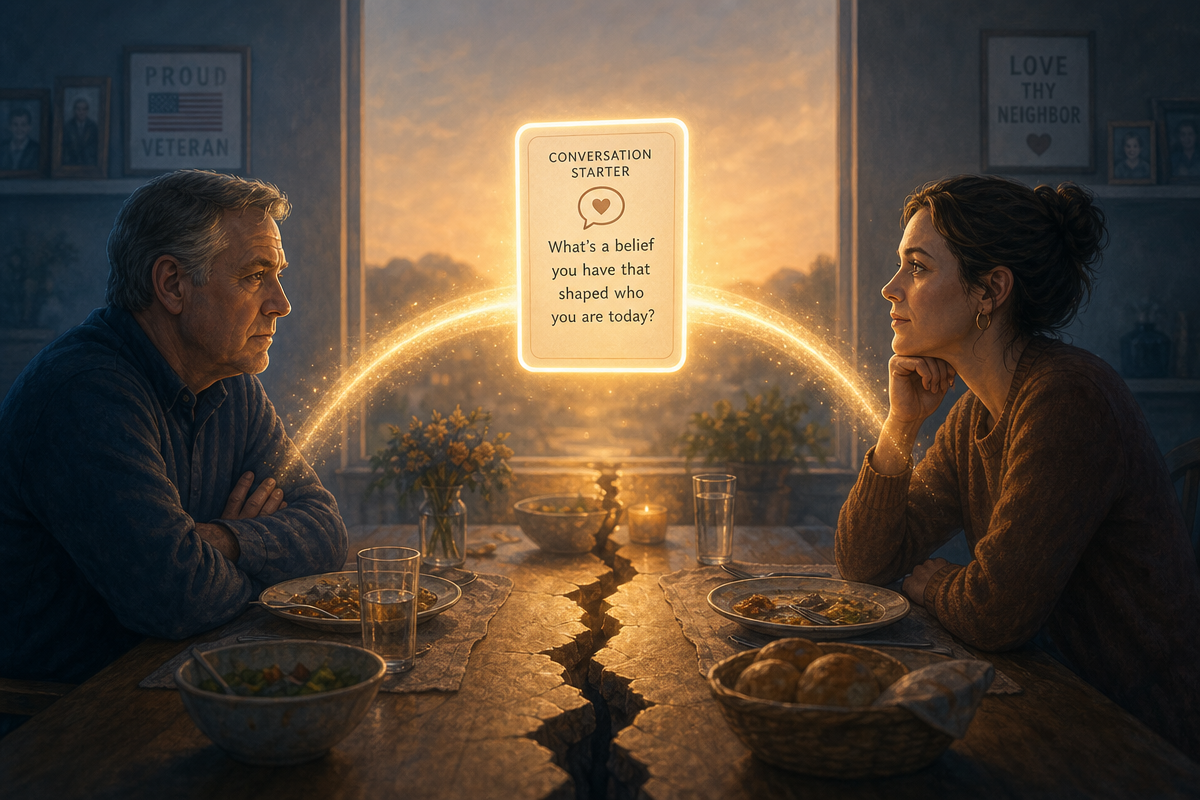
A conversation card acts as neutral territory — an external prompt that shifts the dynamic from adversarial to curious.
This shift matters because it removes defensiveness. No one feels singled out or challenged directly. Instead of responding to an attack, both people are responding to a neutral prompt that invites reflection.
When a political debate starts escalating at the dinner table, drawing a conversation card redirects the energy. It moves people out of attack-and-defend mode and into curiosity mode. The card functions as an external circuit breaker that everyone has already agreed to respect.
UC Irvine’s 2025 research on curiosity found that structured prompts designed to foster genuine curiosity about others’ perspectives significantly improved political conversations and relationships. The structured prompt forces a pause, introduces a new topic, and gives everyone a moment to reset emotionally.
Digital conversation starters make this tool even more accessible. You don’t need to carry a physical deck of cards or remember to pack them. The intervention is always in your pocket, ready on any phone, the moment a conversation starts to spiral.
Finding shared values across political lines
Therapists who specialize in political conflict in families recommend focusing on shared foundational values before engaging on specific policy disagreements. Most families share more values than they realize: safety, fairness, opportunity, community. The political arguments are surface-level disagreements that often mask the same underlying concerns.
PBS News Weekend reported on this dynamic:
"Research finds that when we share stories with one another, we might not end up agreeing, but we respect each other’s positions more and often discover more common ground than we would otherwise." — PBS News Weekend, December 2024
This is why the framing of your questions matters so much. A prompt that asks "What’s your position on X?" invites a political stance and a debate. A prompt that asks "What experience shaped your view on community?" invites a personal story. The first leads to arguments. The second leads to understanding.
The goal isn’t to eliminate disagreement. That’s unrealistic in most families. The goal is to build enough mutual respect that disagreement doesn’t threaten the relationship. When family members understand each other’s stories, they can hold different political views without seeing each other as enemies.
Specific question frameworks for de-escalating political conflict
Here are five concrete question types you can use the next time a political conversation starts heating up at a family dinner. Each one is designed to redirect the energy without dismissing what anyone feels.
The story bridge
Ask a family member to share a personal experience related to the topic instead of debating policy positions. "How did you come to feel so strongly about that?" shifts the conversation from abstract argument to personal narrative. People argue with positions; they share stories.
The values anchor
"What’s the most important thing you want for your community?" This question surfaces shared values that transcend party lines. Most people, regardless of politics, want safety, fairness, and opportunity for the people they care about.
The curiosity flip
"What’s something about your perspective you wish more people understood?" This channels the desire to be heard into a structured, respectful exchange. It gives people the floor to explain themselves without anyone having to concede a point.
The common ground question
"What’s an area where you think people on both sides actually agree?" This trains the brain to look for unity rather than division. It’s surprisingly effective at lowering the temperature because it reframes the conversation from opposition to shared concern.
The temperature check
When things are genuinely getting too hot, draw a completely unrelated prompt. A question about a favorite trip, a childhood memory, or a dream vacation acts as a deliberate pattern interrupt that resets the emotional baseline. This is where having conversation cards or a digital prompt ready makes a real difference.
Convo Cards offers 18+ themed question packs, including family and relationship categories, with ready-made prompts designed for exactly these moments. You can browse by occasion and pull a question that fits the mood at the table.
The real stakes: what political estrangement costs families
The cost of getting this wrong isn’t just an uncomfortable evening. It’s permanent damage to relationships that can’t be replaced.
The APA’s 2025 data shows the physical toll is severe. Among those stressed by societal division, 83% experienced at least one physical symptom. Depression and sadness affected 65%, nervousness and anxiety affected 60%, and fatigue affected 53%.
"More than half of Americans say they experience loneliness in their daily lives, and nearly seven in ten report that their closest relationships do not provide enough emotional support." — Austen Riggs Center analysis of APA 2025 Stress in America survey, November 2025
Nearly one in five Americans has lost a family relationship entirely over politics. These aren’t temporary disagreements that blow over. They’re permanent fractures. Family dinners and holiday gatherings are among the few remaining spaces where people with different political views still interact face to face. Protecting those spaces matters more than ever.
The avoidance strategy, just not talking about it, isn’t working either. Pew data shows avoidance is rising year over year, and APA data shows loneliness is at crisis levels. The answer isn’t fewer conversations. It’s better ones.
Conversation starters are a small investment that protects something priceless: family relationships that can’t be rebuilt once they’re severed.
How digital family conversation starters make reconnection accessible
Everything discussed in this article comes down to one practical question: what can you actually do before your next family dinner?

Digital conversation starters are always in your pocket — ready the moment a family dinner needs a redirect.
Digital conversation starters remove every common barrier to implementation. No physical cards to remember, no app downloads, no planning ahead. You open a browser on any phone at the dinner table and you have a prompt ready.
Convo Cards lets anyone start for free with no account required. You can try the approach with zero commitment before a family gathering. If it works, premium access unlocks all 18+ themed question packs, including family and relationship categories, for $4.99 per year. That’s less than a single coffee, making it the most affordable conversation tool available.
The platform also includes progress tracking and a favorites feature, so families can save prompts that sparked great conversations and build on them over time. The best questions become part of your family’s ongoing dialogue.
Before your next family dinner, pull up Convo Cards on your phone, pick a question pack, and set the conditions for connection instead of conflict. The research is clear: structured prompts create the respect and curiosity that defuse political tension. The only thing left to do is try it.
Leave a Reply